The View from the Border Has Not Changed
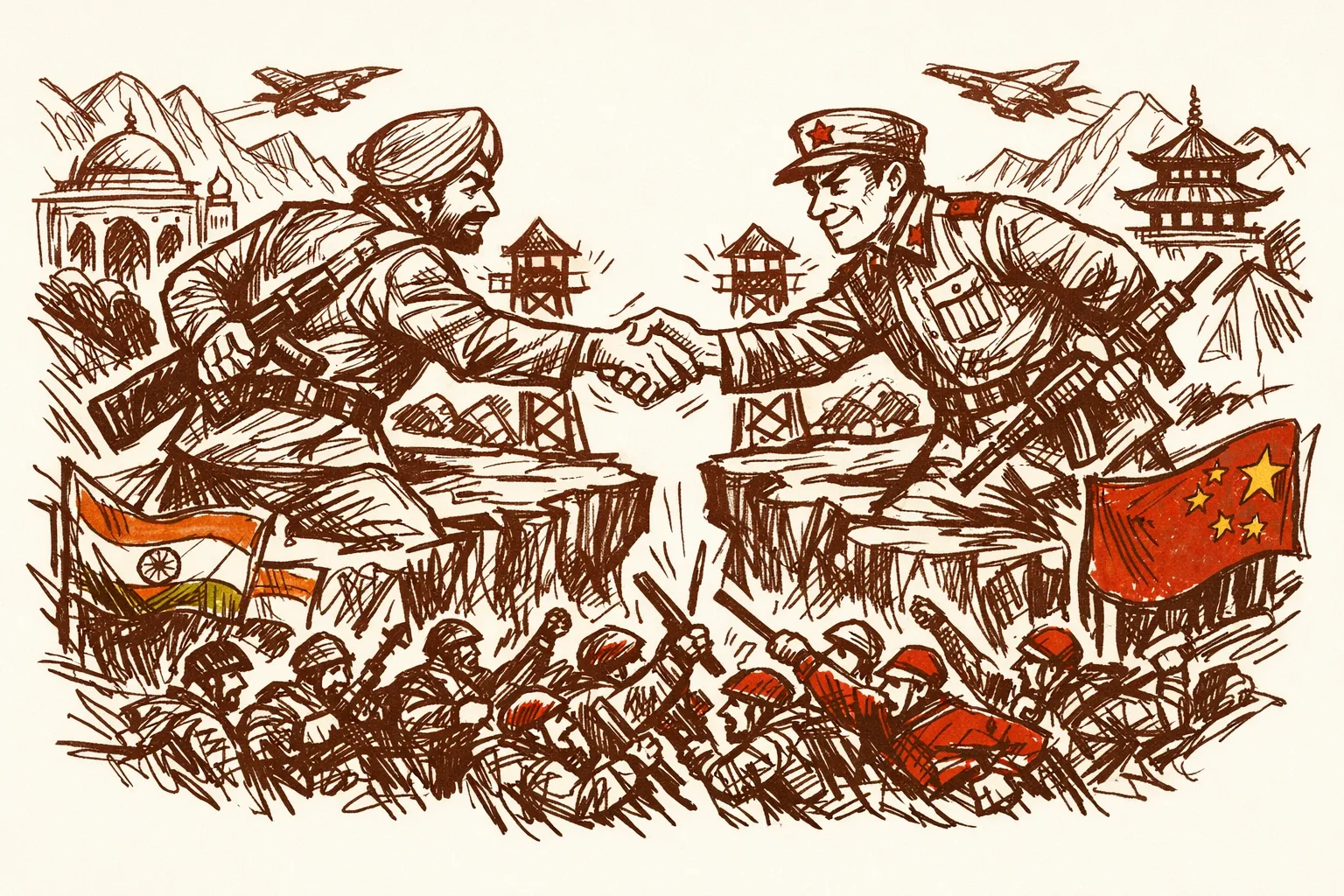
Stand at the Sela Pass in Arunachal Pradesh - the mountain gateway to Tawang - and look north. On India's side, new roads are going up. On China's side, entire villages have appeared from nothing. Roads, helipads, supermarkets, 5G towers. All within kilometers of the Line of Actual Control, the unmarked frontier that separates two nuclear-armed countries in the Himalayas.
Diplomatic language calls this "people-to-people contact" and "win-win cooperation." Satellite imagery tells a different story.
The October patrolling agreement between India and China was a real achievement. External Affairs Minister S. Jaishankar confirmed that Indian patrols had resumed at Depsang and Demchok - areas where Indian soldiers had been blocked for over four years. Modi's government fought through 21 rounds of corps commander talks to get there. That matters and deserves to be said clearly.
But what has happened since is worth examining. India is now easing investment rules, resuming direct flights, relaxing visas for Chinese nationals, and echoing Beijing's language about "normalization." In the same period, China continued building dual-use border villages, issued new administrative names for places inside Arunachal Pradesh, detained an Indian citizen at Shanghai airport for 18 hours because she was born in Arunachal, and announced plans for the world's largest hydropower dam on the Brahmaputra - upstream of India.
One side is moving. The other is standing still.
What the Numbers Show
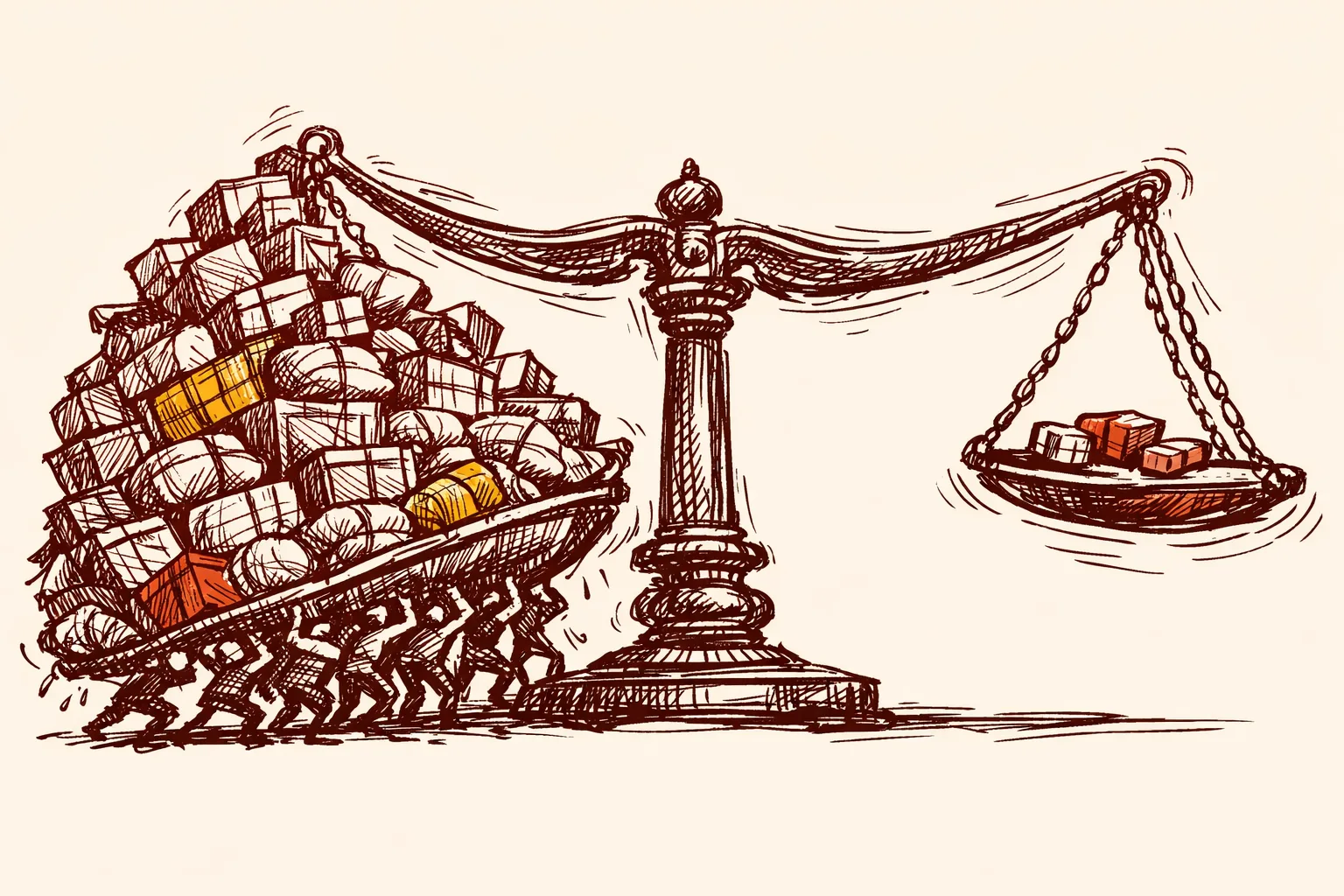
India's trade deficit with China hit a record USD 99.2 billion in the financial year ending March, according to BusinessToday. Up from USD 85 billion the year before. India's exports to China fell 14.5 percent to USD 14.25 billion. Imports from China rose 11.52 percent to USD 113.45 billion.
On the border, China had built 628 dual-use "xiaokang" (well-off) villages along the LAC under its Tibet Autonomous Region plan, according to the Center for Strategic and International Studies. These villages have housing, roads, helipads, police stations, supermarkets, and 5G connectivity. CSIS satellite analysis found military or paramilitary facilities embedded within kilometers of the disputed border. Former Indian Army Chief General MM Naravane said directly: "In the absence of any sizable local population to justify such investment, it is apparent that such developments are for military purposes."
This is what China's military-civil fusion strategy looks like in practice. Civilian labels. Military capability. Below the threshold of direct confrontation.
China has not stopped its administrative pressure on Arunachal Pradesh either. Beijing regularly releases lists of renamed places inside the state in Chinese and Tibetan characters. In November, an Indian citizen from Arunachal - Prema Wang Thongdok, traveling through Shanghai on a valid Indian passport - was detained for 18 hours. A Chinese immigration officer reportedly told her that because she was born in Arunachal Pradesh, her passport could not be accepted since "the region is part of China," according to the Observer Research Foundation. China's Foreign Ministry denied wrongdoing and reiterated its claim that Arunachal Pradesh - which Beijing calls "Zangnan" - is Chinese territory.
Three Indian wushu athletes from Arunachal were blocked from the Hangzhou Asian Games. The same three were blocked from the World University Games in Chengdu. Sports Minister Anurag Thakur cancelled his trip to China in protest. The Ministry of External Affairs called it "targeted and pre-meditated" discrimination. The Observer Research Foundation describes this entire pattern as "calibrated instruments" Beijing uses to assert territorial claims while staying below the level of open military confrontation.
Why This Pattern Keeps Repeating
India and China have no agreed, demarcated border. India considers the LAC to be roughly 3,488 kilometers long. China claims it is about 2,000 kilometers. That gap in perception leaves enormous room for contested moves.
Since President Xi Jinping took power, China's posture has become more assertive, not less. The Lowy Institute notes that China has extended its territorial claim from just Tawang district to the entire state of Arunachal Pradesh - roughly 90,000 square kilometers. The shift in claim came with a shift in tools. Renaming, village-building, visa harassment, and infrastructure - all below the level of soldiers shooting.
The Carnegie Endowment for International Peace analyzed all 21 rounds of military talks from the standoff and found a consistent pattern: China agreed to de-escalation language at the diplomatic level while making physical moves on the ground. The Stimson Center put China's motive clearly: by easing border tensions, China seeks to prevent New Delhi from imposing further restrictions on Chinese investments. It is economic defense, not strategic goodwill. India should price it accordingly.
What India Has Already Built - And What Remains
India has not been passive. Under Modi, the government has built more border infrastructure than at any point since independence.
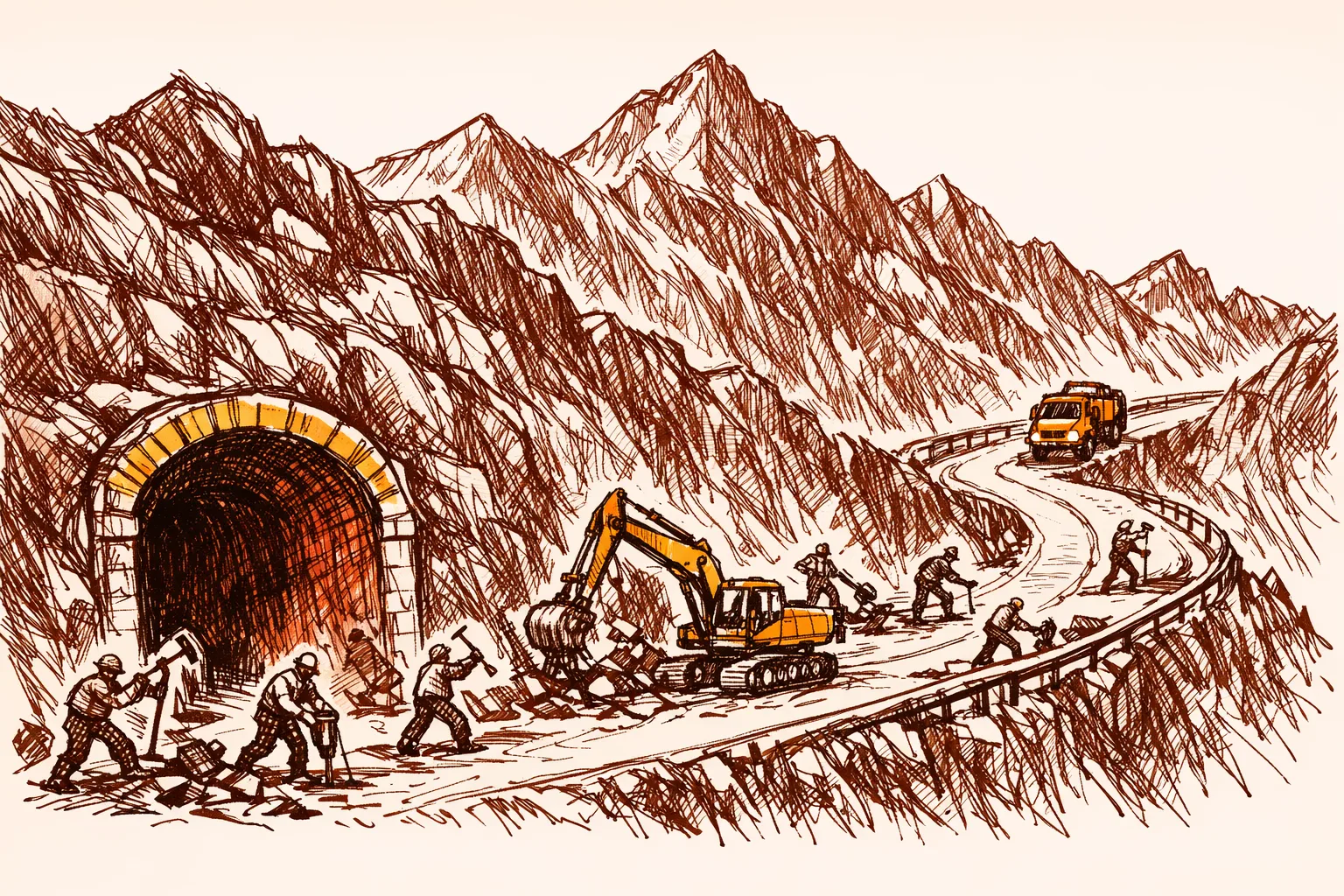
The Ministry of Defence confirmed India built 2,088 kilometers of roads along the China border in five years at a cost of Rs 15,477 crore. The Border Roads Organisation's budget was raised 40 percent to Rs 3,500 crore in one budget cycle. The Sela Tunnel now gives all-weather access to Tawang. The Trans-Arunachal Highway is 92 percent complete. The Arunachal Frontier Highway - NH-913, a 1,748 kilometer road parallel to the LAC - is underway at Rs 42,000 crore.
The Vibrant Villages Programme, approved as a centrally sponsored scheme under the Modi government in 2023, targets 662 border villages in Arunachal Pradesh, Himachal Pradesh, Uttarakhand, Sikkim, and Ladakh. Phase II, sanctioned at Rs 6,839 crore, covers 1,954 villages through to 2029. By mid-Phase I, 1,010 villages were under active development. Tourist inflows to Arunachal Pradesh had risen 30 percent.
After the 2020 Galwan clash, India banned over 200 Chinese apps and tightened foreign investment rules through Press Note 3, requiring government approval for all investments from land-bordering countries. The FDI restriction sent the right signal: India's strategic assets are not available for opportunistic Chinese acquisition.
Where the Risk Now Sits
The risk is not that India is weak. The risk is that India is offering normalization while China offers rhetoric.
India recently eased some FDI rules. The Union Cabinet amended Press Note 3 to allow investments where Chinese beneficial ownership is below 10 percent. The intent was narrow: free global private equity funds that had Chinese minority investors stuck in a bureaucratic trap. The core protection of majority Indian control remains.
But the optics matter strategically. Taken together with resumed flights, eased visas, and normalization language, Beijing's diplomatic apparatus will use every signal to argue India has accepted a new normal on the LAC. That argument has real-world consequences at international forums, in third-country capitals, and in the way Beijing's state media frames India's position to its own public.
Disengagement at Depsang and Demchok restored patrolling rights. De-escalation - the actual reduction of the 50,000 to 60,000 troops each side massed since 2020 - has not happened. Jaishankar told Parliament that de-escalation was the next priority. India's Army Chief confirmed that troop levels would not be reduced yet. China completed a new road giving the People's Liberation Army a 15 kilometer shorter route to the Galwan Valley.
The October agreement managed a crisis. It did not resolve a dispute.
How Other Countries Have Handled This
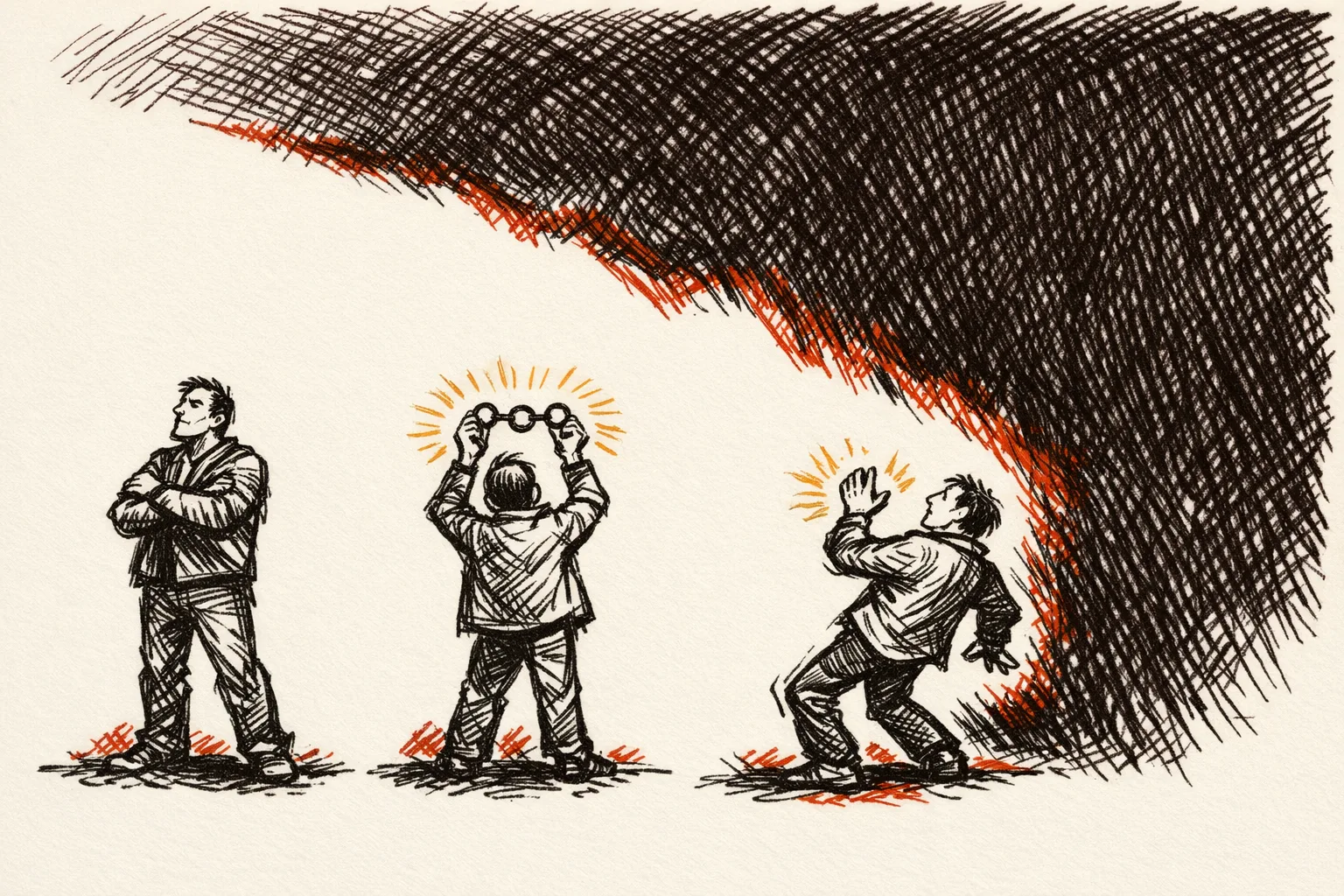
Vietnam - Two Tracks, No Confusion Between Them
Vietnam trades heavily with China - Beijing is its largest partner. Vietnam also maintains military ties with the United States, Japan, and India. Hanoi does not let economic engagement signal strategic trust. The lesson for India is not to choose between trade and security - but to stop allowing economic gestures to be read as strategic concessions by Beijing.
Taiwan - Make Dependency Into Deterrence
Taiwan runs a trade surplus with China and relies on Chinese exports as a key market. Yet it has never allowed this to translate into security vulnerability. It deepened its dominance in semiconductor manufacturing, making itself irreplaceable to global supply chains. Economic interdependence, managed correctly, creates deterrence - not dependence. India's Production Linked Incentive scheme for electronics and pharmaceuticals is this same logic. The lesson is to accelerate it during periods of diplomatic warmth, not slow it down.
Australia - What a Reset Without Conditions Cost
Australia pursued a diplomatic reset with China after years of trade tensions. Beijing did not respond with genuine reciprocity. China partially lifted trade restrictions on Australian barley and wine - but only after Australia moderated its public language. The country that showed more willingness to normalize bore most of the cost of normalization. India should study this outcome carefully before extending more gestures.
Who Is Accountable
The Ministry of External Affairs controls the diplomatic track. The Ministry of Defence and the Border Roads Organisation control the physical border infrastructure. The Home Ministry runs the Vibrant Villages Programme and the Border Infrastructure and Management Authority. The Ministry of Commerce controls FDI policy. All four are making moves simultaneously. They need a single unified public position: no broadening of economic normalization until verifiable de-escalation of massed troops along the LAC is complete. Jaishankar has said this. It needs to be the stated condition, not just the internal calculation.
What Would It Cost
India has already committed Rs 4,800 crore for Vibrant Villages Phase I and Rs 6,839 crore for Phase II. The Arunachal Frontier Highway is budgeted at Rs 42,000 crore. The Border Roads Organisation completed 90 projects along the China border worth Rs 2,941 crore, with 36 in Arunachal Pradesh alone.
China spent an estimated USD 6.4 billion on its 628 border villages. India does not need to match that number exactly. But it needs to match it result by result - and finish what it started.
Sixteen Indian border villages were reported empty, according to data cited by VICE World News. An empty Indian village on the LAC is an argument China makes without words. And a USD 99.2 billion annual trade deficit means India is effectively funding Chinese industrial capacity every year. Reducing that through domestic manufacturing is not just economic strategy. It is the foundation of strategic independence.
What Needs to Happen
India should make de-escalation - the real, verifiable reduction of troops massed since 2020 - the stated condition for any further economic normalization steps. Disengagement was the floor. It should not be treated as the ceiling.
India should accelerate the Vibrant Villages Programme without waiting for diplomatic cycles. Every empty border village is a liability. Every occupied, connected, economically active border village is a statement of sovereignty. China understood this in 2017. India understood it in 2022. The gap in pace must close faster.
India should attach a clear, automatic consequence to every act of harassment of Indian citizens from Arunachal Pradesh. Not a protest statement - a mechanism. When Beijing detains an Indian citizen or blocks an Indian athlete because of their birthplace, one specific pending bilateral arrangement gets suspended. China responds to costs, not complaints.
India should hold its position on import dependence. Active pharmaceutical ingredients, electronics, industrial machinery - all areas where India still relies heavily on Chinese supply chains. The Production Linked Incentive scheme is the answer. It must run at full speed in parallel with every diplomatic gesture toward Beijing.
Growing up in Himachal Pradesh, I knew what it meant when government attention reached the edge of the map. For decades it did not. Under Modi, that has changed - the tunnels, the roads, the villages. The next step is making sure the diplomatic track does not move faster than the security track. The LAC is not a relic. It is live, contested, and watched every day by people who live on it.