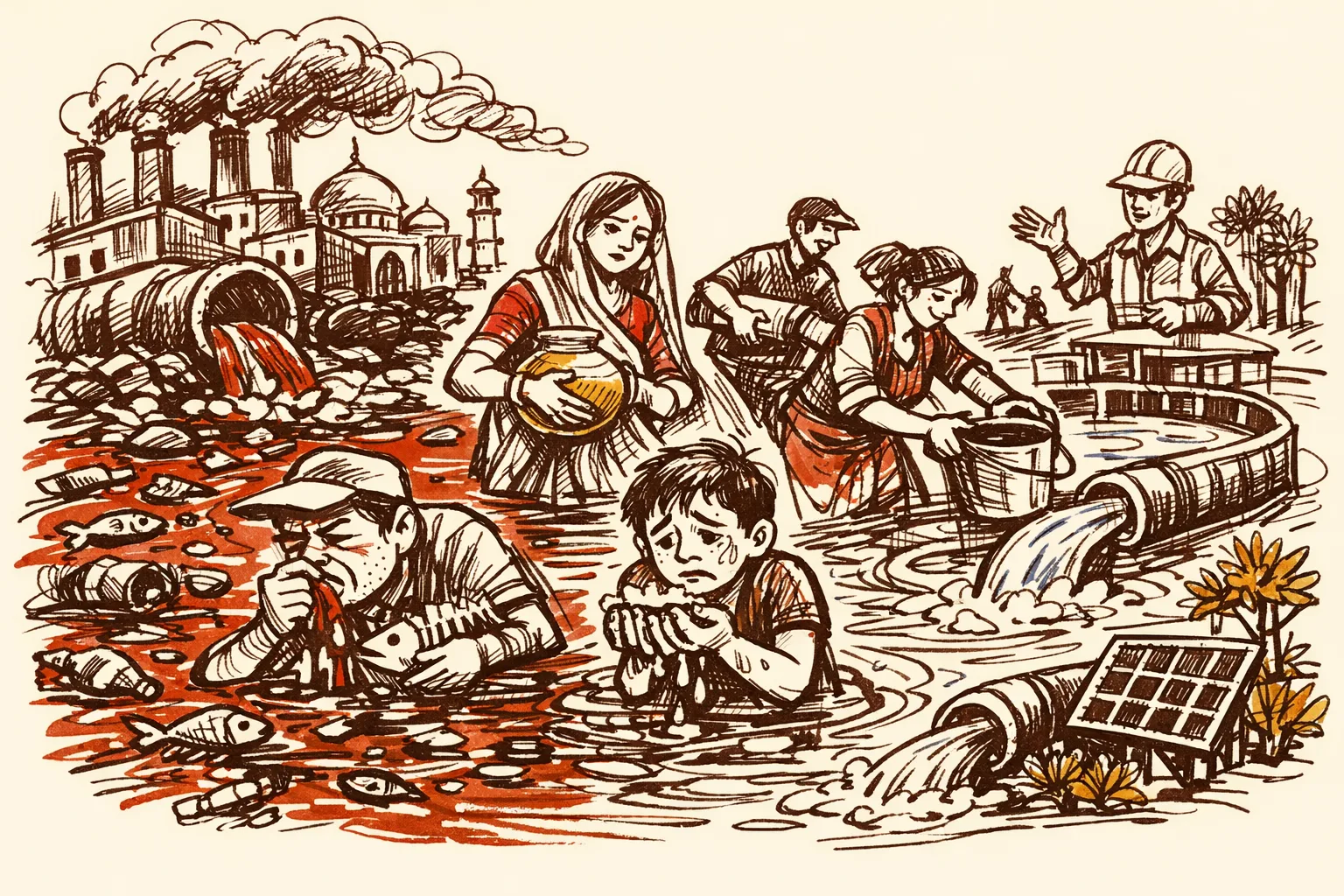
Stand on the banks of the Yamuna at Delhi and look at the water. It is black. It smells. A thick white foam sits on the surface. The river has become a drain.
The India Water Portal reports that faecal coliform levels in the Yamuna reached 4.9 million MPN per 100 mL. Safe limit is 500. That is nearly 10,000 times above what is considered safe for bathing.
This is what decades of neglect look like up close. I grew up in Chamba, Himachal Pradesh, where mountain rivers ran clear. Then I watched those same rivers change as they moved downstream through cities that had no real sewage systems. Political will, money, and execution - in that order - are what determine whether this gets fixed.
The Scale of the Problem
India holds 18% of the world's population but just 4% of global freshwater, according to the World Economic Forum. When you add pollution to it, the crisis becomes acute.
The Central Pollution Control Board reports that more than 350 river stretches across the country are polluted, covering rivers in 14 states, from Assam to Gujarat to Tamil Nadu.
The biggest single cause is untreated sewage. India generates roughly 72,000 million litres of sewage per day. Only about 44% of that is treated. The rest goes directly into rivers, lakes, and groundwater.
Industry adds to this. Over 746 industries discharge wastewater directly into the Ganga, containing lead, cadmium, copper, chromium, and arsenic. Agriculture adds fertilizer and pesticide runoff. In peri-urban zones around Delhi, Kanpur, and Varanasi, heavy metal concentrations in leafy vegetables run two to five times the permissible limit, because farmers irrigate with contaminated river water.
The Ganga basin is home to roughly 500 million people and generates over 40% of India's GDP, according to the International Finance Corporation.
The Health and Economic Cost
The World Bank estimates water pollution costs India approximately 3% of GDP each year, from healthcare, lost farm output, and collapsed fisheries and tourism.
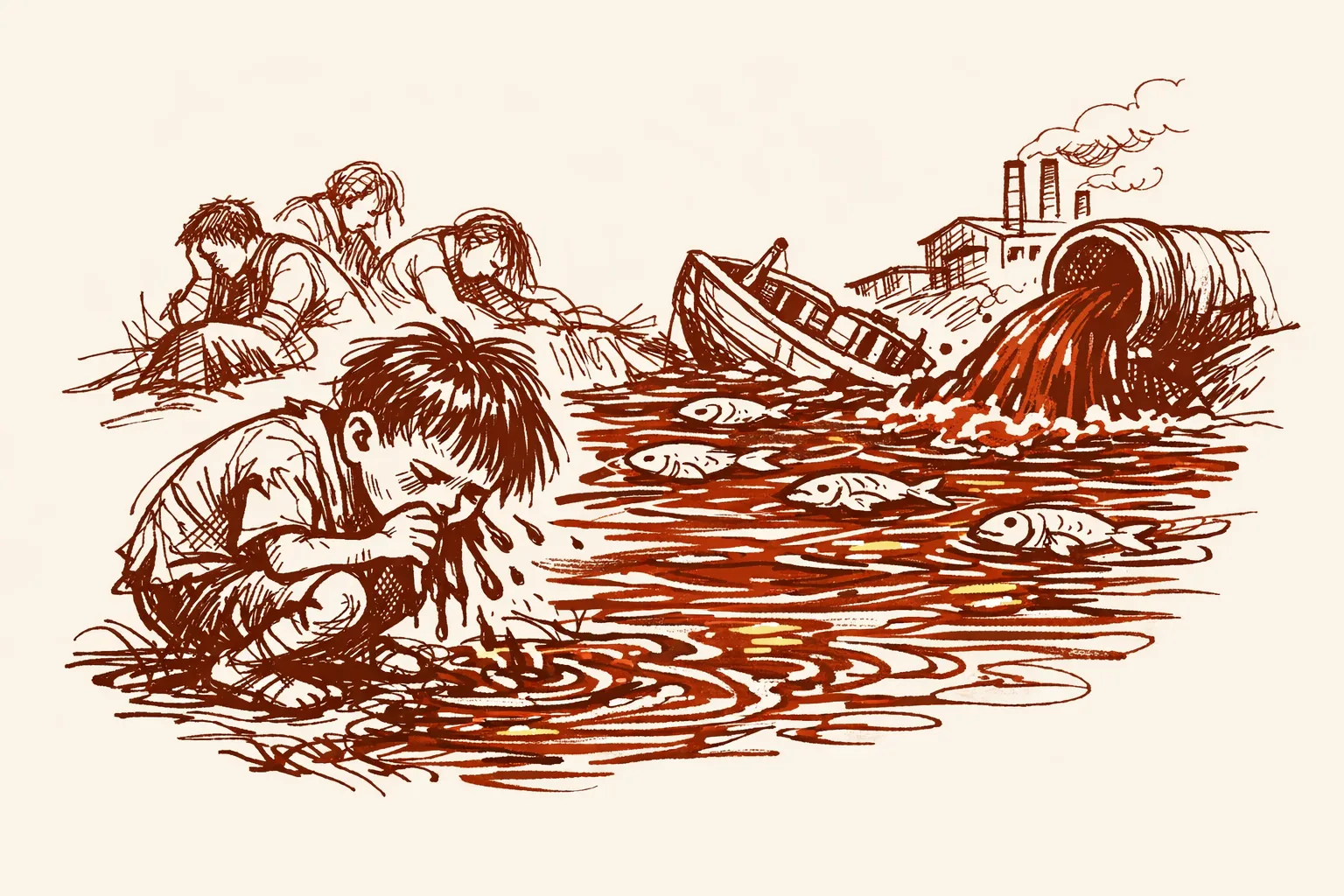
Approximately 37.7 million Indians are affected by waterborne diseases annually. The World Economic Forum estimates the health costs at between $6.7 billion and $8.7 billion per year. Cholera, typhoid, hepatitis, and severe diarrhoea together cause an estimated 73 million lost working days every year.
Children pay the highest price. Studies cited by the India Water Portal show that 1.5 million children die from diarrhoeal illness each year in India. The WHO estimates that safe drinking water for all households could prevent nearly 400,000 deaths annually, saving approximately 14 million Disability Adjusted Life Years.
Fish catches in the Ganga declined by an estimated 36% between 2000 and 2020, with key species including hilsa, rohu, and catla showing sharp drops in polluted stretches. India's inland fisheries sector employs over 14 million people.
The NITI Aayog has warned that water scarcity could reduce India's GDP by up to 6% by 2050.
Why the Problem Is This Deep
Three things drive this crisis: not enough sewage treatment, no real industrial enforcement, and a bureaucracy split across too many ministries.
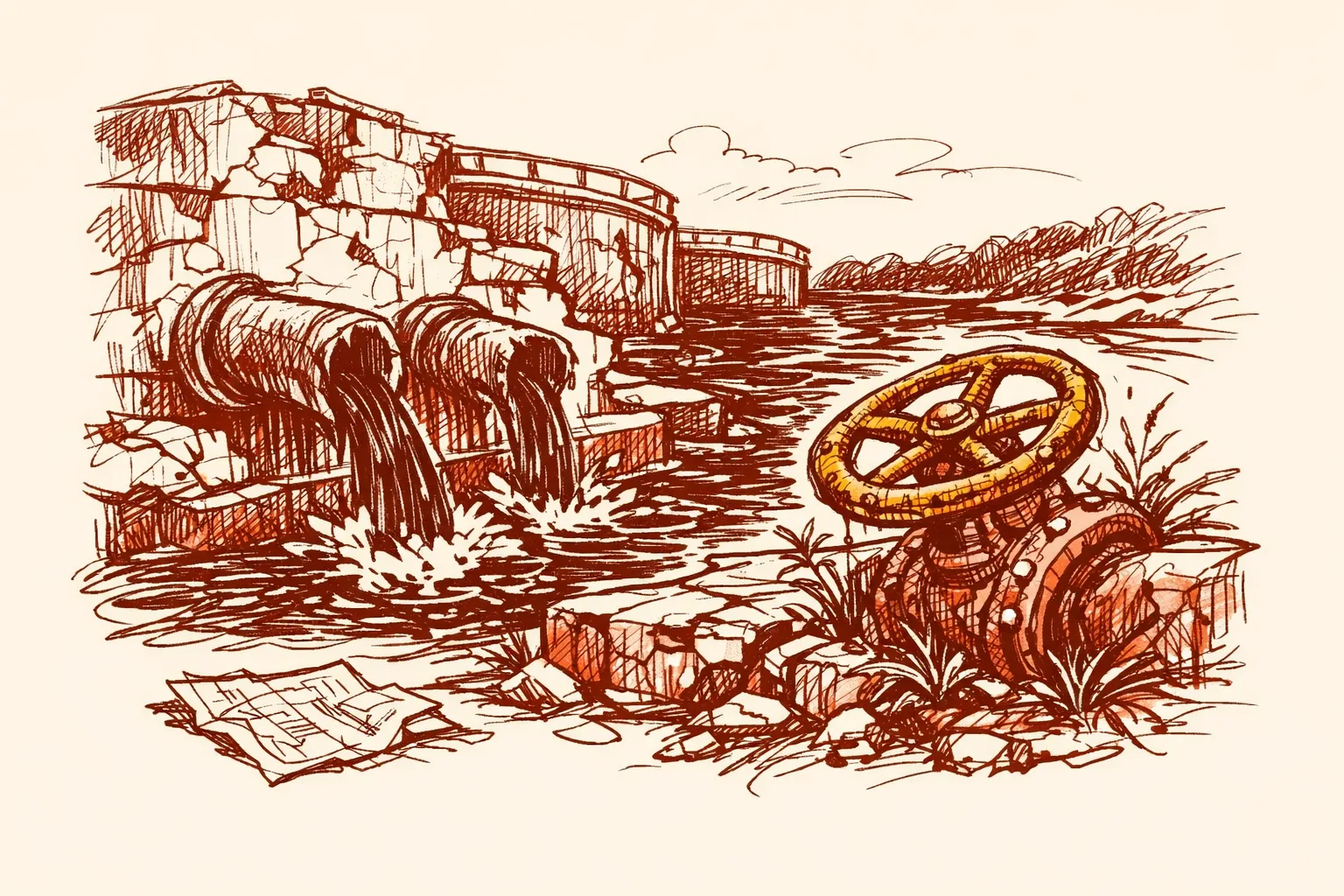
On sewage: cities grew fast. Sewage infrastructure did not keep pace. Many treatment plants that were built do not run properly. A government auditor review documented that plants fail due to power cuts, poor maintenance, and design errors. In some cases, sewers were built but never connected to the treatment plant. The water passed through a pipe and went straight to the river anyway.
On industry: the Environment Protection Act of 1986 prohibits toxic discharge into water bodies. But enforcement is not working. Inspections happen. Notices are issued. Factories restart. The cycle continues.
On fragmentation: responsibility for water is split across more than a dozen central and state ministries. Even after a revised National Water Policy was passed, no single body owned the outcome.
What Has Already Been Tried
India has been trying to fix this for a long time. The record is instructive.
Ganga Action Plan (1985-2000) - Failed. Prime Minister Rajiv Gandhi launched the Ganga Action Plan in June 1985, covering 25 towns across Uttar Pradesh, Bihar, and West Bengal with a budget of Rs 462 crore. Phase 2 followed between 1993 and 1996, covering 56 towns across five states.
It did not work. A sewage treatment plant in Kanpur was built at a lower elevation than the river, so sewage could not flow to it by gravity. Plants had no backup power. Phase 2 treated only 780 MLD against a target of 1,912 MLD. After decades of effort and billions of rupees, river water quality had in fact deteriorated. The Central Ganga Authority, set up to oversee the plan, met only twice between its creation and 2000.
Yamuna Action Plan (1993, 2004) - Partially failed. Even after treatment, Yamuna water near Delhi remained toxic and unfit for irrigation. Dissolved oxygen at several points was recorded at zero. That is dead water.
National Ganga River Basin Authority (2009) - Insufficient. After the failure of earlier plans, the government declared Ganga a National River and took a World Bank loan of over $1 billion. The river continued to deteriorate.
Namami Gange Programme (2014 - present) - Underway, producing early results. Prime Minister Modi launched Namami Gange in June 2014 with an initial budget of Rs 20,000 crore. It uses a Hybrid Annuity Model where private operators are paid over time to build and maintain plants, creating an incentive to keep them running. According to the Press Information Bureau, 513 projects have been sanctioned at a cost of Rs 42,019 crore, of which 344 have been completed.
The stretch of the Ganga from Kannauj to Varanasi - classified as one of the most polluted categories in 2015 - has improved by two full pollution categories. Sewage treatment capacity in Varanasi quadrupled from 100 MLD to 420 MLD. The Gangetic Dolphin population grew from 3,330 in 2018 to 3,936, according to a Wildlife Institute of India survey. The United Nations named Namami Gange one of the top ten ecosystem restoration initiatives in the world.
But the Yamuna remains in crisis. According to the India Water Portal, 641 million litres of untreated sewage still entered the Yamuna daily as recently as late . Delhi's sewage problem requires state government action that has not been delivered at scale.
The Jal Jeevan Mission - launched in 2019 with a budget of Rs 2.08 lakh crore - has connected over 15.72 crore rural households to tap water, up from 3.23 crore in 2019. Eleven states and Union Territories have achieved 100% tap water connectivity for rural households.
How Other Countries Fixed This
South Korea: The Han River Turnaround
Seoul's Han River was functionally dead by the early 1970s. BOD levels in key tributaries exceeded 200 mg/L - a standard river should be below 3 mg/L.
South Korea tied the cleanup to a national economic plan, not just an environmental programme, linking it to hygiene, housing, and industrial transformation. Korea built its first modern sewage treatment plant in 1976, then four more in preparation for the 1988 Seoul Olympics - treating the Games as a hard deadline with national prestige on the line. By 2022, 95.1% of South Korea's population was covered by sewage treatment systems. The Han River is now a public park. Fish have returned. People swim in it.
The takeaway for India: a hard deadline, attached to something the government cannot afford to fail publicly, accelerates execution that a policy memo never will.
What India Can Learn from Korea's Private Sector Model
By 2012, 58% of South Korea's wastewater treatment plants were privately owned and managed. Private operators have a direct financial interest in keeping plants running. This is the logic behind India's Hybrid Annuity Model in Namami Gange. According to the International Finance Corporation, it has been replicated in 11 cities across three states, drawing $500 million in private sector investment.
Who Is Accountable
The Ministry of Jal Shakti is the nodal authority for both Namami Gange and Jal Jeevan Mission. The National Mission for Clean Ganga disburses funds and sanctions projects. The Central Pollution Control Board monitors river water quality. State Pollution Control Boards are responsible for enforcing discharge norms on industries and municipalities within their states.
The Yamuna's persistent crisis shows the gap between central funding and state delivery. Delhi's sewage infrastructure falls under the Delhi Jal Board, which operates under the Delhi state government. The National Green Tribunal has repeatedly directed action. The problem continues. Nobody gets fired.
What Would It Cost
The government has already committed over Rs 42,000 crore to Namami Gange and Rs 2.08 lakh crore to Jal Jeevan Mission - the largest investment in water infrastructure in Indian history.
India still needs to close a large gap in urban sewage treatment. It generates about 72,368 MLD of sewage daily and treats only about 44%. Closing that gap fully would require hundreds of additional treatment plants.
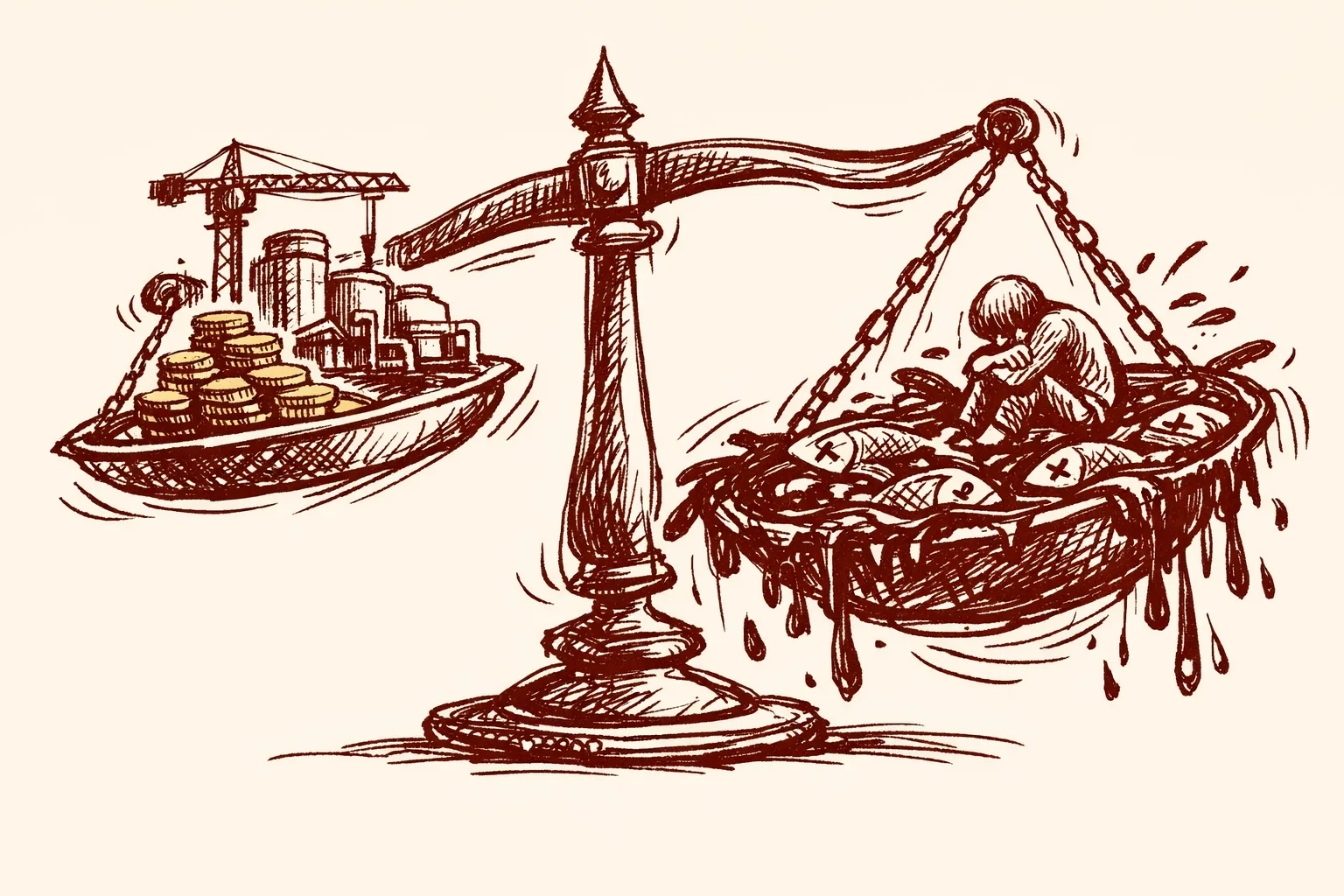
Water pollution currently costs India over $100 billion every year. The cost of fully closing the sewage treatment gap would be a fraction of that figure.
What Needs to Happen
One: Fix the Yamuna urgently. The Yamuna receives 70% of its total pollution load from a 2% stretch inside Delhi. The Delhi state government must be held to specific targets with timelines. The National Green Tribunal has the authority to enforce this. Use it.
Two: Make private operators standard, not exceptional. The Hybrid Annuity Model works because operators are paid over 17 years - and only if plants stay functional. This should be the default for every new sewage treatment plant in India, not just Ganga basin projects.
Three: Real-time monitoring with public dashboards. Sensors on every major discharge point, data fed to a public dashboard, visible to citizens and journalists. When discharge data is public, the political cost of non-compliance goes up. The Tata Centre for Development at the University of Chicago has demonstrated this model in India. Scale it.
Four: Enforce industrial discharge laws with speed. The Central Pollution Control Board has the power to shut down grossly polluting industries. Closure orders must be executed within days, not months.
Five: Protect groundwater alongside rivers. The Central Ground Water Board's data shows arsenic contamination in 10 states and fluoride in 20 states. Groundwater is what most rural Indians drink. It needs the same monitoring and protection focus as surface rivers.