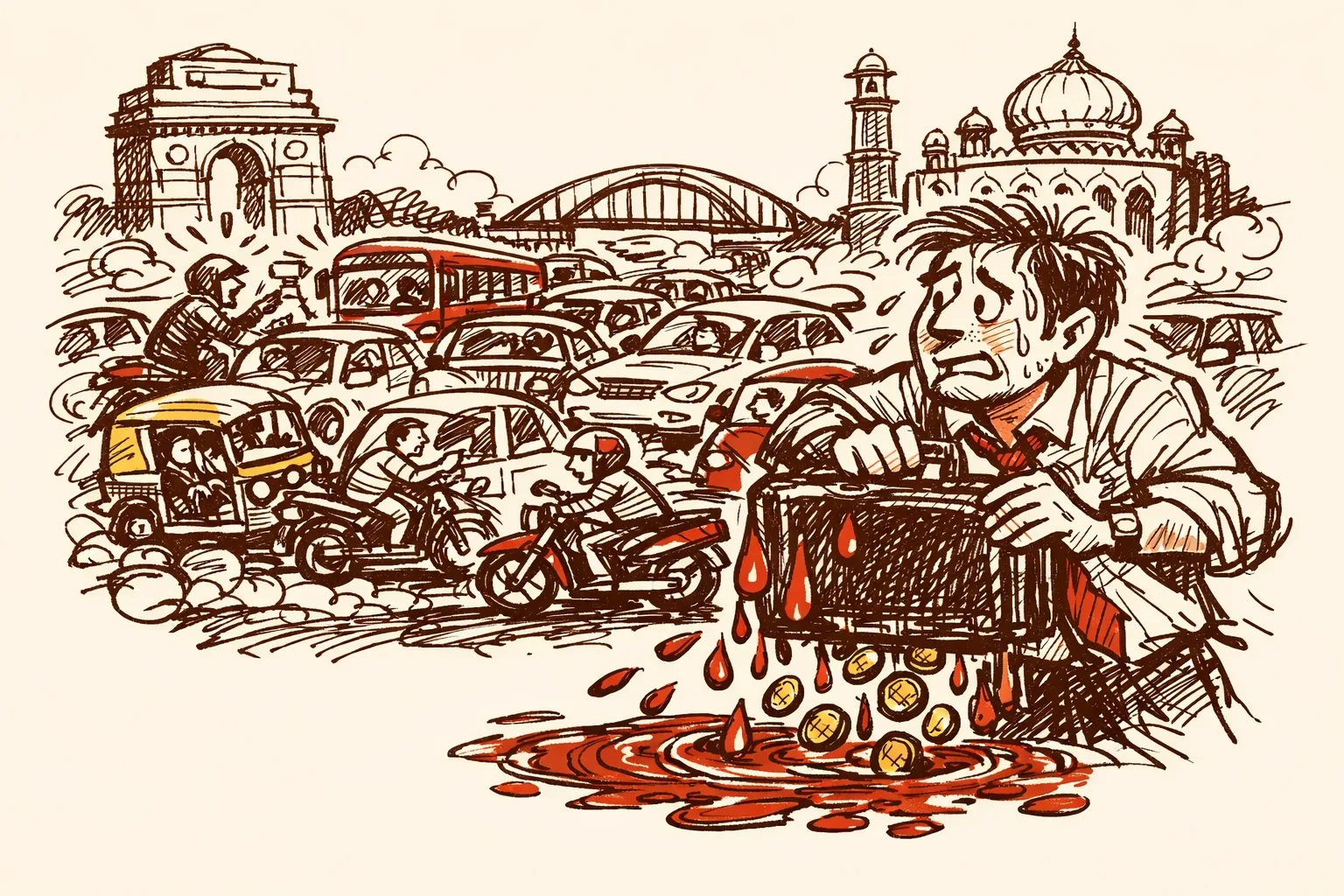
Stand at the Ashram Chowk intersection in South Delhi during the evening rush. Cars stretch back half a kilometre in every direction. Nothing moves. The average speed on the road you are standing on drops to 8 kilometres per hour - slower than a bicycle.
How Bad Is the Problem
An IIT Madras study found that traffic congestion in Delhi costs the city close to Rs 60,000 crore every year - money burned in wasted fuel, lost work hours, and accident costs.
A Centre for Science and Environment (CSE) report found that on weekdays, congestion cuts average speed by 41 percent during morning peak hours. Evening peak is worse - 56 percent slower than free-flowing traffic. Peak and off-peak hours have nearly merged. The roads are choked all day.
The CSE report calculated that an unskilled worker loses between Rs 7,200 and Rs 19,600 each year to commute delays alone. A skilled worker loses up to Rs 23,800 - nearly 12 percent of monthly take-home pay.
Why Delhi Roads Are This Way
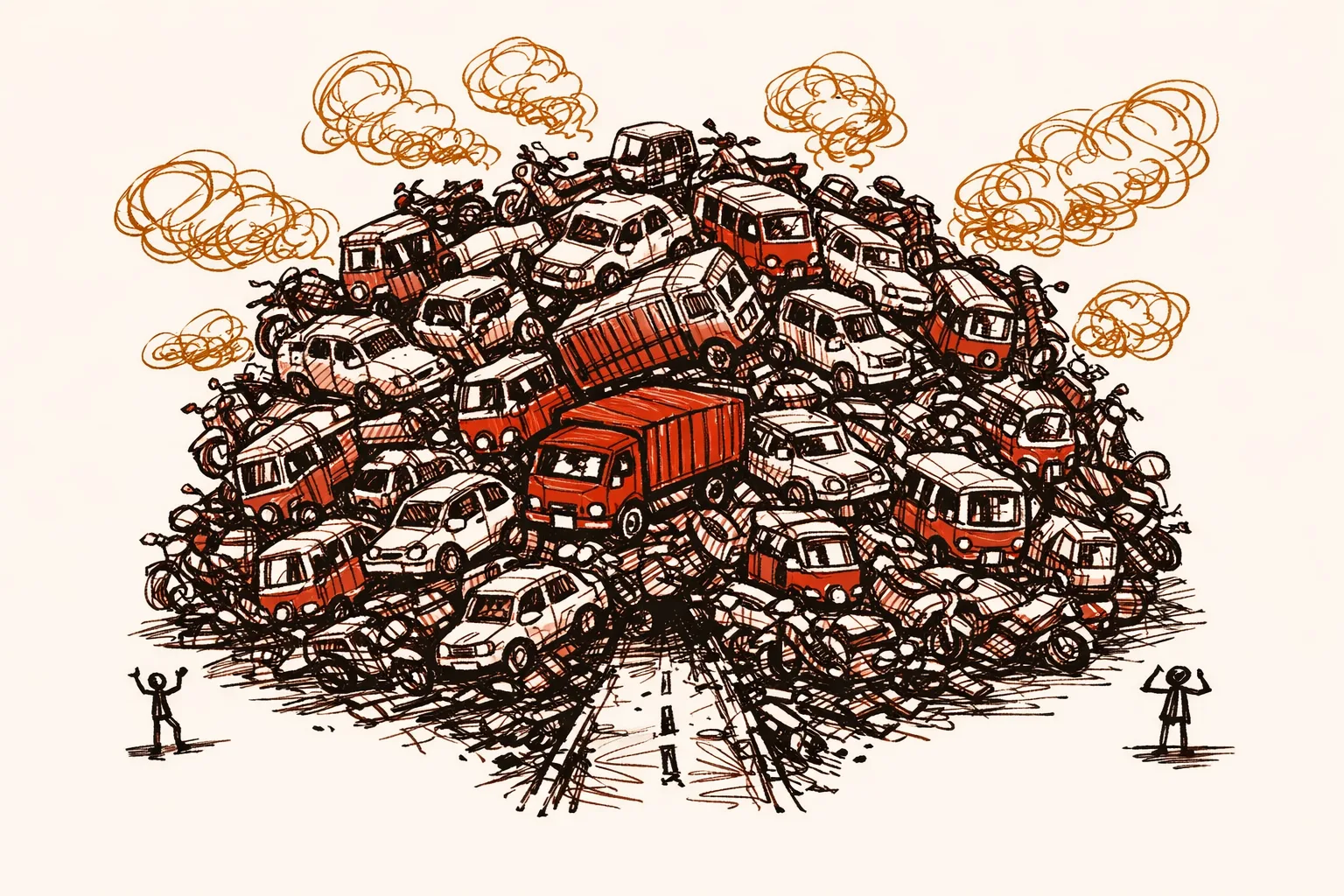
The root problem is a gap that has been widening for fifty years. According to Delhi's Economic Survey, the road network grew roughly 3.7 times between the early 1970s and recent years. In the same period, vehicle numbers grew more than 40 times.
Delhi now has 87.61 lakh registered vehicles. The city adds an average of 1,100 two-wheelers and 500 private cars every single day. Vehicle density stands at 522 per 1,000 people - 3.2 times the national average. No city's roads can absorb a 40-fold vehicle increase.
More than 90 percent of Delhi's registered vehicles are two-wheelers and private cars. Public buses carry 33 percent of the city's trips but run in the same congested lanes, so they slow down too.
Five national highways pass through the city. A significant share of interstate goods vehicles entering Delhi are not headed for Delhi - they are cutting through. Every heavy truck that crosses town adds to the load without being a Delhi commuter at all.
What Has Already Been Tried
Bus Rapid Transit (BRT) Corridor - launched 2008, dismantled 2016. The idea was to give buses their own lane. The execution failed. The Delhi BRT never had dedicated buses built for it. Standard buses were thrown into the lane, creating bunching and breakdowns. Bus platforms were placed in the middle of the road with no safe underpasses. Traffic police did not enforce the lane rules. Private car owners who moved into the bus lane faced no consequences. In 2016, the government dismantled the corridor. The buses had been carrying 12,000 passengers per hour per direction. But the benefit went to bus riders. The outrage came from car owners. The car owners won.
That failure had one clear lesson: a reform that cannot be enforced is not a reform.
Odd-Even Scheme - first run in early 2016. The Delhi government restricted private cars based on whether their number plate ended in an odd or even digit. In practice, fewer than 0.5 percent of Delhi's private cars received a fine for violating the rule. The city had 2.8 million private cars at the time. Without fine collection infrastructure, it functioned as a public awareness exercise, not a demand management tool.
Delhi Metro - ongoing, partially successful. The metro was certified by the United Nations as the first rail system in the world to earn carbon credits for reducing emissions. Annual ridership reached 235.8 crore trips in the last reported year. Phase 4 expansion is approved at Rs 46,845 crore, adding over 100 km of new corridors. The problem is that Delhi's vehicle count grows faster than metro lines can be built.
How Other Countries Fixed This
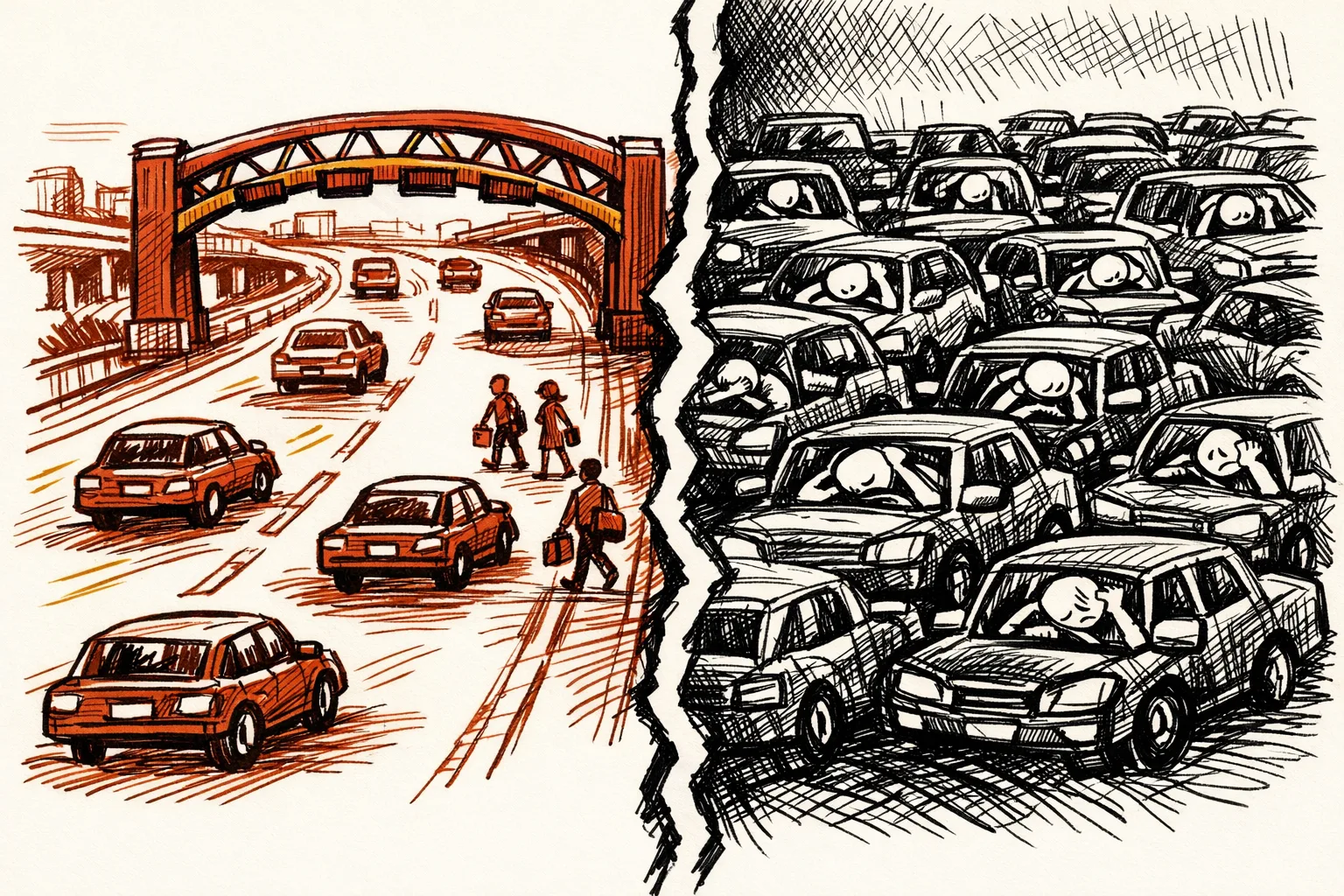
Singapore introduced congestion pricing in 1975, charging vehicles a fee to enter the city centre during rush hours. The system was upgraded in 1998 to electronic road pricing based on live traffic conditions, reviewed every quarter. According to the Lincoln Institute of Land Policy, Singapore has maintained optimal expressway speeds of 45 to 65 kilometres per hour and arterial speeds of 20 to 30 kilometres per hour. Revenue is 2.5 times the operating and capital costs - the programme pays for itself. If roads get slower, the charge goes up. Drivers adjust.
London launched its Central Congestion Charging Zone in 2003. Within one year, vehicles entering the zone during charging hours fell by 18 percent, traffic delays fell by 25 percent, and travel speeds increased by 30 percent. Emissions of nitrogen oxide, carbon dioxide, and particulates fell by 13 to 16 percent. Revenue - last reported at 282 million US dollars in a single year - went directly to fund bus and rail improvements.
The lesson from both cities: charging for road use in busy zones reduces demand without requiring more road space. The money collected pays for better public transport. The sequence matters: build the alternative first, then price the roads.
Jakarta shows what happens when bus infrastructure is done properly. TransJakarta, Southeast Asia's first BRT system, launched in 2004 and now spans over 251 kilometres - the world's longest BRT network. It works because it was built at scale from the start, with proper stations, enforcement, and integration with other modes. It is what Delhi tried in 5.6 kilometres and then abandoned.
Who Is Accountable
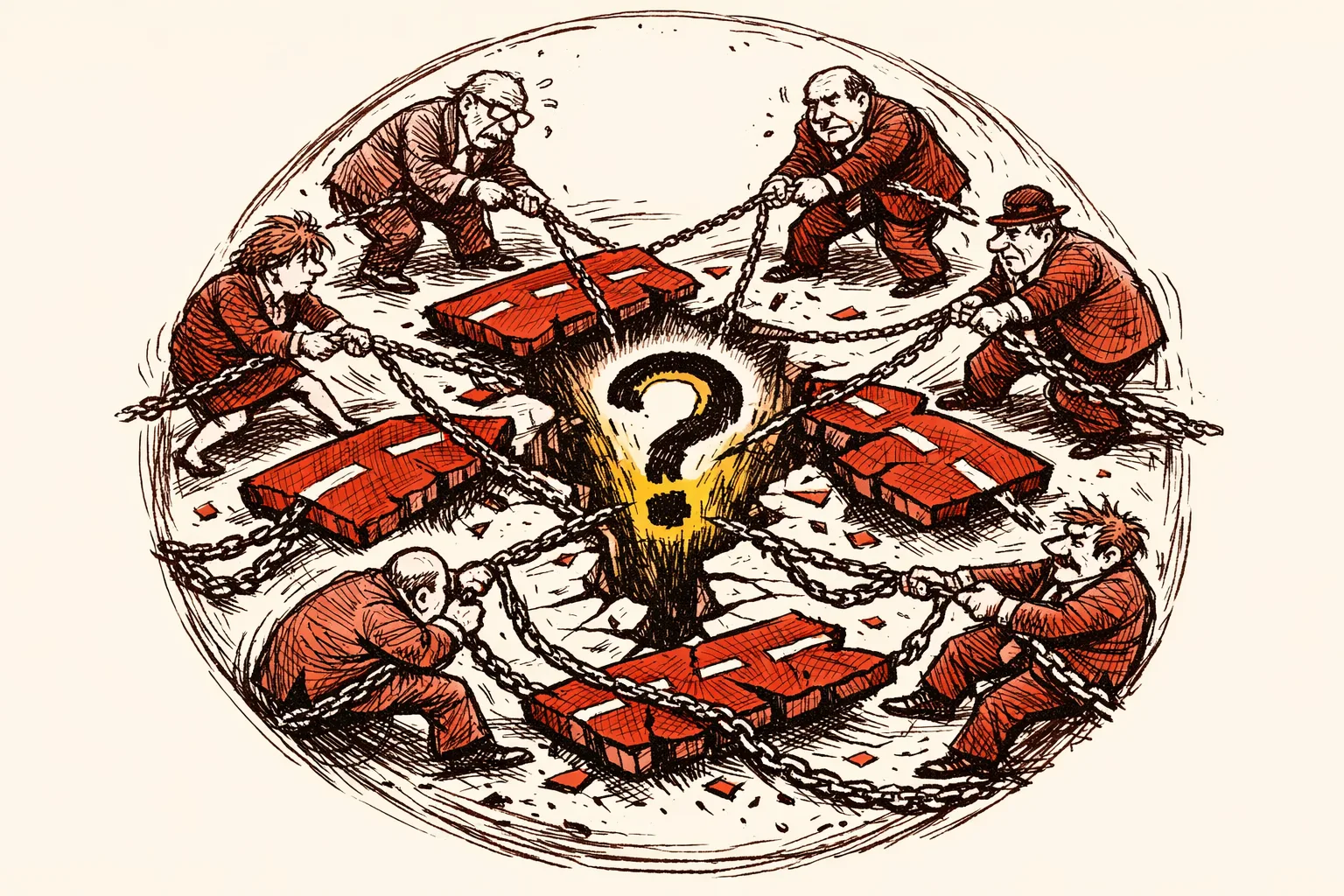
Delhi's transport system has no single owner. Roads are built and maintained by five agencies - the Public Works Department, the Municipal Corporation of Delhi, the New Delhi Municipal Council, the Delhi Cantonment Board, and the Delhi Development Authority - none reporting to the same command structure. Traffic enforcement sits with Delhi Traffic Police, which reports to the Lieutenant Governor, not the Chief Minister. The Delhi Metro Rail Corporation reports jointly to the Ministry of Housing and Urban Affairs and the Delhi government.
The money is moving - Delhi's government budget allocated Rs 2,929.66 crore for metro and buses, a six-fold increase from the previous year. The gap is coordination between agencies over who builds what, where, and when. Nobody is accountable for the overall outcome.
What Would It Cost
Delhi Metro Phase 4 carries a total project cost of Rs 46,845 crore. A congestion pricing system for central Delhi would cost a fraction of that. London's system cost roughly 200 million pounds to set up. India already has Fastag infrastructure deployed on national highways - the same technology can be adapted for urban congestion zones. The setup cost is manageable. The political cost is harder.
The alternative is inaction. IIT Madras projected that Delhi's congestion costs will reach the equivalent of USD 14.7 billion annually if current trends continue.
What Needs to Happen
Three things, done in sequence and enforced without exception, would change the trajectory.
First, finish the metro and make buses work. Phase 4 must be completed on schedule. The city needs dedicated bus lanes on major arterials - not a pilot corridor, but a network - with automatic cameras fining vehicles that use them illegally. The difference between Delhi's BRT failure and Jakarta's BRT success is enforcement. Jakarta fined violators. Delhi did not.
Second, introduce congestion pricing for the central business district using Fastag. Set the charge low to start. Let the data set the price. Use every rupee collected to fund bus frequency improvements.
Third, create a single Delhi urban transport authority with real power. Five agencies build roads and none are accountable to the same minister. Singapore's Land Transport Authority controls roads, buses, rail, and pricing from one office. Delhi needs one agency that owns the outcome - with a director who can be fired if congestion gets worse.
The Delhi Metro was built on time because it was structured as a special-purpose vehicle with autonomy. That model needs to be applied to traffic management as a whole.