The Wrong Comparison
Pull up any India-China military comparison in a Western publication and the story is predictable. China has more aircraft, more ships, and a larger budget. India is behind.
That framing is lazy. And it is wrong.
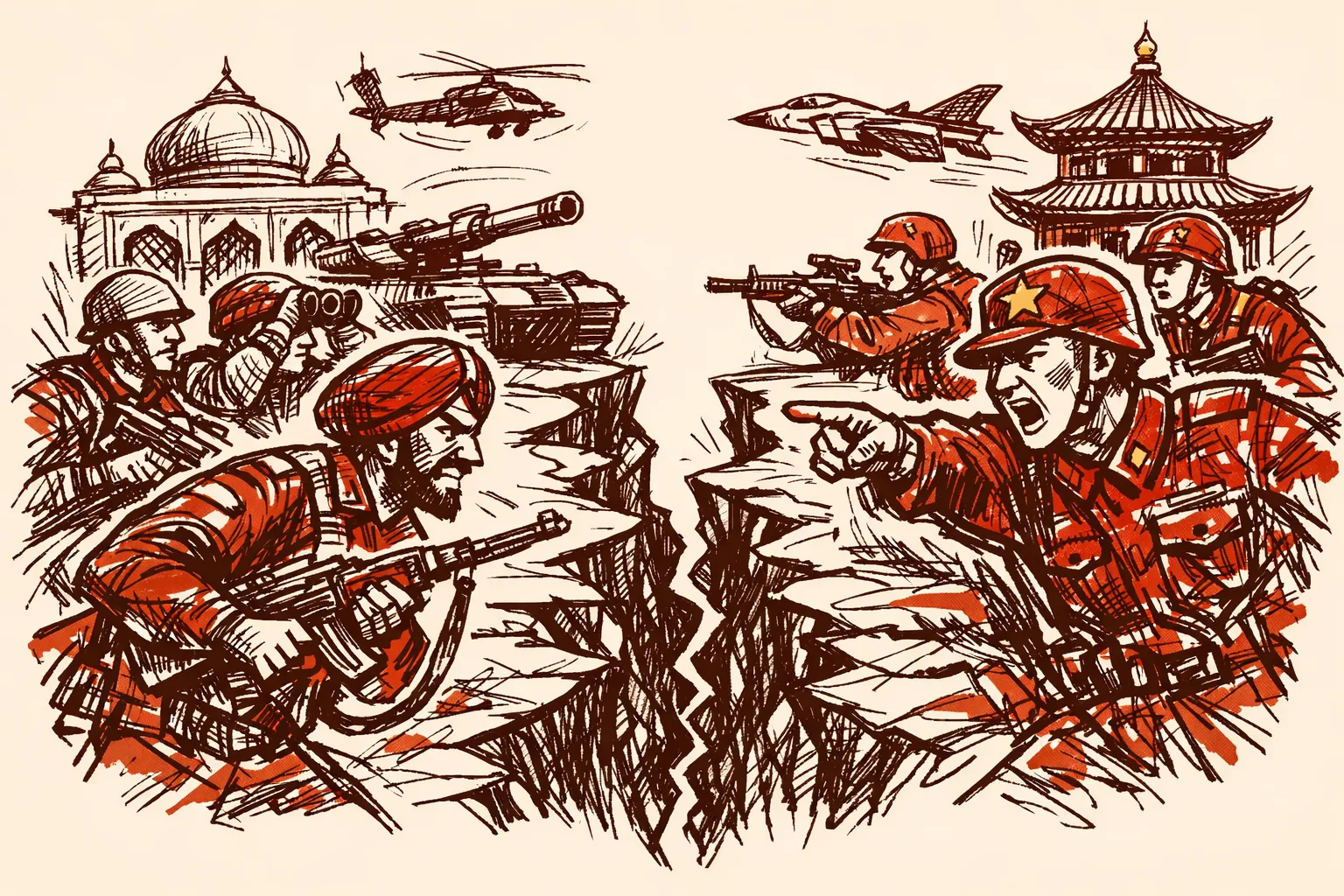
It treats military power like a scoreboard - whoever has the biggest numbers wins. But war is not played on a spreadsheet. The terrain decides. The soldier decides. The specific conditions of a specific place decide. And when you look at the actual conditions where India and China would ever face each other, India's hand is considerably stronger than the headline numbers suggest.
I grew up in Chamba, in the hills of Himachal Pradesh. I know what a mountain does to a plan. The Himalayas are not an obstacle India must overcome. They are an asset India owns.
What the Numbers Do Show
China has a large fleet of nearly 2,000 combat aircraft. Modern jets like the J-20, J-35, J-16, and J-10 give China both ability and depth.
On spending, the gap is real. China spends around US$261 billion annually. India's budget for the same period was $78 billion. China spends roughly three times more.
And China has been building fast at the border. China's high-altitude military infrastructure program is estimated to exceed US$20 billion when factoring in runway construction, hardened shelters, missile facilities, and logistical networks.
These facts are real. Spending more does not mean winning. Those are different questions.

Why Geography Changes Everything
The actual line of confrontation between India and China is the Line of Actual Control - a 4,000-kilometer border running through some of the most extreme terrain on earth.
At elevations where oxygen levels drop by 40 percent at 15,000 feet, combat effectiveness declines sharply. These conditions are unfamiliar to the People's Liberation Army, whose training largely focuses on plains and urban warfare.
India's soldiers are not unfamiliar with this. Decades of deployment in Siachen - the world's highest battlefield - and the Kargil conflict at 16,000 to 18,000 feet have made Indian soldiers specialists in mountain combat.
The air power picture also flips when you look at actual geography. Operating from the high Tibetan plateau, Chinese aircraft pay a weight penalty and cannot carry a full war load. Indian radar systems located high in the Himalayas pick them up as they take off. Indian fighters based in the plains can take up full war loads and pop up over the Himalayas to strike.
The Belfer Center and the Center for a New American Security have both assessed this directly, reaffirming India's operational superiority in high-altitude warfare and that India's defensive positioning neutralises China's numerical advantage.
China also faces a two-front problem. Much of its air defense resources are tied up in the Pacific, focused on Taiwan and a potential conflict with the United States. India can treat China as its primary conventional military concern.
Put simply - India can focus on one border. China cannot.
What Has Already Been Tried - India's Reform Record
The honest account of India's defence modernisation has to include the failures of the past.
For decades before Modi, India's defence procurement was a slow-moving, import-dependent machine. The Defence Procurement Policy introduced in the early 2000s changed the paperwork. It did not change the outcomes. India remained the world's largest arms importer through most of that period.
The Defence Production Policy of 2018 set a target of $5 billion in annual exports by the mid-2020s. That target was missed. But the trajectory it set became the foundation for what came next.
The real turn came with Atmanirbhar Bharat - the self-reliance mission launched under Modi, accelerated by the standoff with China's PLA along the border.
Defence production reached Rs 1,27,434 crore in the last full reported year - up from Rs 46,429 crore in 2014-15 - a 174 percent increase in a decade. Around 65 percent of defence equipment is now manufactured within India, up from a period when imports dominated.
The Strategic Advantages Western Analysts Undercount
Advantage 1 - The Indian Ocean
China's military power is impressive in the Pacific. In the Indian Ocean, India is home.
China has expanded its naval presence in the Indian Ocean, but it remains geographically distant from its core bases. India is centrally positioned within this theater, allowing it to project power more efficiently. Any Chinese naval vessel operating in the Indian Ocean has to pass through chokepoints that India can observe and, if necessary, contest.
Advantage 2 - Democratic Legitimacy and Multi-Alignment
China's military strength is real. But China has no allies. It has clients.
India engages multiple partners simultaneously, selecting areas of cooperation based on national interests. This includes the Quad and I2U2, which comprises India, Israel, the United Arab Emirates, and the US. India sits inside both Western and non-Western structures at the same time. China sits outside both.
Collaborations give India cutting-edge technology from Quad countries, energy and arms from Russia and West Asia, and supply-chain diversification from Japan and Korea. No single rival can cut India off from all of these simultaneously.
Advantage 3 - A Rising Defence Export Base
A country that only buys weapons depends on its suppliers. A country that sells weapons has power of its own.
India's defence exports have witnessed a 34-fold increase over the last decade. Exports have crossed Rs 23,622 crore in the most recent financial year, reaching over 100 nations. The top three destinations are the USA, France, and Armenia. When America and France are buying Indian defence equipment, India's credibility as a military manufacturer is not in question.
China cannot build this kind of partner network because countries that depend on Chinese loans and weapons are not partners. They are leverage points. China's debt levels are enormous, and its stagnating economy cannot sustain unlimited strategic industrial spending.
What Has Already Been Tried - International Cases
South Korea - Turning Imports Into Exports
South Korea was once as dependent on foreign weapons as India. Today it is one of the top ten arms exporters in the world, selling K2 tanks to Poland and K9 howitzers to India.
The mechanism was simple: the government refused to buy foreign equipment unless a meaningful share was made locally. Every major purchase required technology transfer and local production. Over two decades, this built an industrial base from scratch.
India's positive indigenisation lists work on the same logic - four such lists banning the import of 411 items that must now be made at home. The South Korea model shows this approach works. It just takes two decades, not two years.
Israel - Small Country, Massive Deterrent
Israel's military budget is a fraction of what its adversaries spend collectively. It has survived by building asymmetric advantages - intelligence networks, precision weapons, air force training, and cyber capabilities that cost less but achieve more.
India is not trying to build 2,000 fighter jets to match China's 2,000. It is building BrahMos cruise missiles that can hit targets 500 kilometres away with high precision and exporting them to partners like Indonesia. Asymmetric deterrence is cheaper and often more effective than raw numbers.
Who Is Accountable
India's defence modernisation sits under the Ministry of Defence. The budget allocation of Rs 681,210 crore marks a 9.5 percent increase from the previous year. Of that total, three-fourths of the modernisation budget - Rs 111,544.83 crore - is for procurement through domestic sources.
The Border Roads Organisation received Rs 7,146.50 crore, 9.74 percent higher than the previous year. Roads matter. An army that cannot move fast cannot defend fast.
The challenge the Delhi Policy Group has flagged: procurement is not working. There is a clear disconnect between the Services' modernisation plans and actual annual allocations. The Ministry of Defence has declared the current financial year as a Year of Reforms to address this directly.
What Would It Cost
Annual defence production has reached a record Rs 1,50,590 crore in the most recent financial year, up 18 percent from the previous year.
Reaching strategic parity with China in the domains that matter - high-altitude warfare, Indian Ocean control, and missile deterrence - does not require matching China rupee for rupee. It requires sustained capital allocation, faster procurement cycles, and continued private sector growth. The primary structural problem is salaries and pensions squeezing fiscal space for capital acquisition.
What Needs to Happen
Three things. None of them require inventing new policy from scratch.
First, cut procurement timelines. The biggest gap between India's capability on paper and capability in the field is how long it takes to actually buy things. India's defence ministry signed a record 193 contracts in one recent year, with 92 percent going to domestic industry. That pace must become the floor, not the ceiling.
Second, complete the theatre commands. India's three military services still operate largely as separate institutions. China reorganised into joint theatre commands years ago. India has started this process. It must finish it.
Third, protect the export momentum. Selling weapons to 100 countries builds relationships that money alone cannot buy. Every BrahMos sold to a partner nation is a country that now has a stake in India's security. This is how influence compounds.