The Pressure Is Real. So Is the Opportunity.
India exports roughly $86 billion in goods to the United States every year. The US is India's single largest trading partner - for the fourth consecutive year. The US buys about 22 percent of everything India sells to the world.
When Washington threatened tariffs as high as 50 percent on Indian goods last year, India's exposure was undeniable - and the internal problems being postponed instead of fixed were suddenly impossible to ignore.
I grew up in Chamba, Himachal Pradesh. When things were hard, there was always a choice: ignore the problem or fix it. India has been choosing to ignore parts of this problem for decades. The current moment is too loud for that.
What Actually Happened - and What It Means
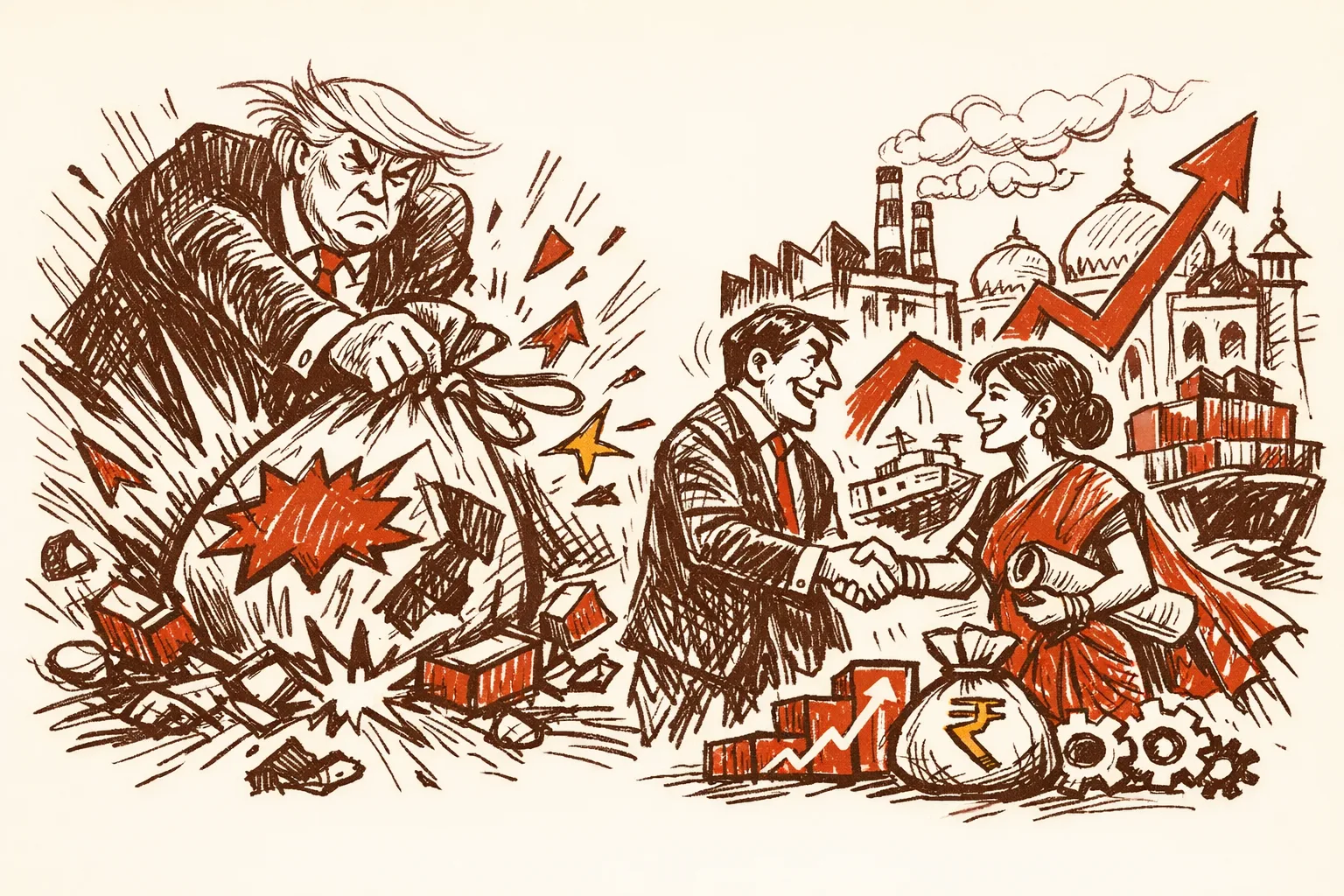
India and the US reached an interim trade framework in February. According to the White House joint statement, the US cut its tariff on Indian goods from 25 percent to 18 percent. The extra 25 percent penalty - imposed because India was buying Russian oil - was removed entirely by executive order.
According to Brickwork Ratings, the deal averted punitive duties of up to 50 percent that had threatened labour-intensive sectors including textiles and leather. Commerce Minister Piyush Goyal called it an opening to a $30 trillion market for Indian small businesses, farmers, and fishermen.
Then the legal ground shifted. On February 20, the US Supreme Court ruled in Learning Resources, Inc. v. Trump that the emergency powers law used to impose the original reciprocal tariffs did not grant the president authority to levy them. According to the Congressional Research Service, the court held that taxing authority belongs to Congress, not the executive. The 18 percent tariff on India fell with it.
The Trump administration responded within hours. It imposed a 10 percent flat tariff on all countries under Section 122 of the Trade Act of 1974 - a provision that carries a 150-day cap and expires automatically around late July. According to GHY International's customs guidance, Indian goods entered after February 24 are no longer subject to the old additional duties.
The acute tariff crisis has eased. The legal environment in Washington remains unstable. At a panel discussion in Delhi hosted by the Indian Futurs think tank, Shishir Priyadarshi of the Chintan Research Foundation said any assurance from the current US administration must be viewed as conditional, not absolute, because the volatility is driven by domestic politics and executive discretion.
India cannot control what Washington does next. India can only control how ready it is.

What Was Already Tried - and What Was Left Unfinished
India has been at a forced reform crossroads before. In 1991, India was nearly bankrupt. Foreign exchange reserves had fallen to cover only a few weeks of imports. The government pledged 67 tonnes of gold as collateral for emergency loans just to stay solvent.
Prime Minister P.V. Narasimha Rao and Finance Minister Manmohan Singh chose reform. According to CSR Education's review of the period, Singh's budget dismantled the License Raj - the maze of government permits and import restrictions that had choked every industry since independence. Import licensing was abolished for most goods, foreign investment rules were opened, and the rupee was made partially convertible.
The results were transformative. GDP growth, which had averaged just 3.5 percent before the reforms, accelerated to 6-7 percent annually in the following decades. Foreign investment jumped from $132 million to $5.3 billion within four years.
The reforms were also incomplete. India never fully reformed agriculture, land markets, or labour law. Non-tariff barriers have risen over the past decade, according to Capital Economics. India remains on the US Trade Representative's Special 301 Priority Watch List for inadequate intellectual property protection, alongside China and Russia. India's data localization rules and digital services tax remain unresolved irritants in trade talks.
The Modi government has moved on the reform agenda. The Goods and Services Tax unified a fragmented tax system, and production-linked incentive schemes have pulled investment into electronics, pharmaceuticals, and textiles. These are real steps. The inherited backlog from decades of statism is simply large.
How Other Countries Fixed This
South Korea: Forced Competition, Better Industry
Between 2000 and 2015, Seoul signed fifteen free trade agreements, according to research published by the National Bureau of Asian Research. Those agreements came to govern over 85 percent of South Korea's total trade. The Korea-US Free Trade Agreement - negotiated against fierce domestic opposition from farmers and industrial workers - was described by the Peterson Institute as the gold standard for trade agreements in Asia.
External trade commitments forced domestic industries to compete or restructure. Korean auto and electronics manufacturers modernised because the alternative was irrelevance. By last year, bilateral trade between South Korea and the US had reached roughly $194 billion. The industries that hated the deal most became more productive after it passed.
India can also learn from South Korea's error. According to the National Bureau of Asian Research, Seoul lagged in capitalizing on mega-FTA waves in the 2010s because policymakers believed bilateral deals were enough. They were not. A US deal is necessary but not sufficient. India needs to keep building its network - the UK deal and the EU deal concluded this year are the right direction.
Japan: Using External Pressure to Fix Internal Problems
According to the French Institute of International Relations, Japan used external pressure - particularly from the United States - throughout the post-war period to reform domestic structures through trade liberalization. That outside pressure improved the competitiveness of Japan's manufacturing sector in ways that purely domestic policy could not have achieved alone.
Committing to a trade agreement creates a deadline and a reference point. Domestic reform lobbies can point to the agreement and say: this is what we agreed to internationally. That changes the political dynamics inside the government.
India needs the same mechanism. The US bilateral trade agreement negotiations - which are ongoing beyond this interim framework - should be treated as a forcing function for the domestic reforms that have been stuck in committees for years.
Who Is Accountable
The Ministry of Commerce and Industry led these negotiations. Commerce Secretary Rajesh Agrawal ran multiple rounds in Washington, while Minister Piyush Goyal handled the public narrative. The next phase - implementing what was agreed and pushing deeper domestic reform - sits with the same ministry and with the Department for Promotion of Industry and Internal Trade.
The US side is led by Assistant US Trade Representative Brendan Lynch for South and Central Asia. US Ambassador Sergio Gor, a close Trump confidant, is reported to have been a key catalyst for the final deal.
Congress's Rahul Gandhi called the deal a national surrender. That framing is politically motivated and analytically wrong. The deal protected dairy, rice, millets, and pulses. A punitive tariff that was costing Indian exporters real money got removed. What India must watch for is whether the ministry follows through on the non-tariff barrier commitments made quietly inside the agreement text.
What Would It Cost
The tariff deal is estimated to add 0.15 to 0.3 percent to India's GDP, according to independent analysis cited by Fair Observer. That is real but modest.
The larger cost is on energy. India has been buying Russian crude at a discount of $8 to $10 per barrel below global market prices. Shifting away from that supply could add $4 to $6 billion per year to India's import bill. India's current account deficit widened significantly in recent quarters, according to Goldman Sachs data. The rupee hit record lows in the same period. These are signals that India's external financial position requires active management.
The cost of not reforming is larger. India's electronics exports to the US are $11 to $13 billion per year. Vietnam's electronics exports to the US are $43 billion. That $30 billion gap is not primarily about tariffs. It is about component supply chains, logistics capacity, and regulatory predictability. A trade deal cannot fix those. Only sustained domestic investment can.

What Needs to Happen
The deal is a window. It is not a solution. Four things must happen at once.
Cut non-tariff barriers proactively. The joint statement commits India to addressing barriers on medical devices, technology goods, and food products. Quality control orders that function as hidden import barriers should be reviewed for whether they protect consumers or simply protect incumbents.
Fix intellectual property enforcement gaps. Remaining on the US Trade Representative's watch list year after year is a signal to every global technology company that India is a risky place to invest in innovation. The gaps in patent protection and data exclusivity need to be closed - not for Washington's benefit but for India's own investment climate.
Establish predictable digital trade rules. India's data localization and digital taxation policies are legitimate. But they need to be codified in a framework that investors can rely on. Unpredictable rules drive investment to clearer jurisdictions. Singapore and the UAE are competing aggressively for exactly the digital investment that India should be capturing.
Build manufacturing depth. Trade agreements open doors while domestic capability decides whether firms can walk through them. Production-linked incentives are working - but India needs industrial clusters with deep component ecosystems, not just assembly facilities. That requires sustained infrastructure investment in logistics and power in the right locations.
India reforms under compulsion. The compulsion is present. The remaining question is whether the momentum goes all the way down to the non-tariff barriers, the IP rules, and the manufacturing clusters that determine whether Indian exporters can actually compete. Not in Washington's trade statistics. On the factory floor.