The Proof Already Happened
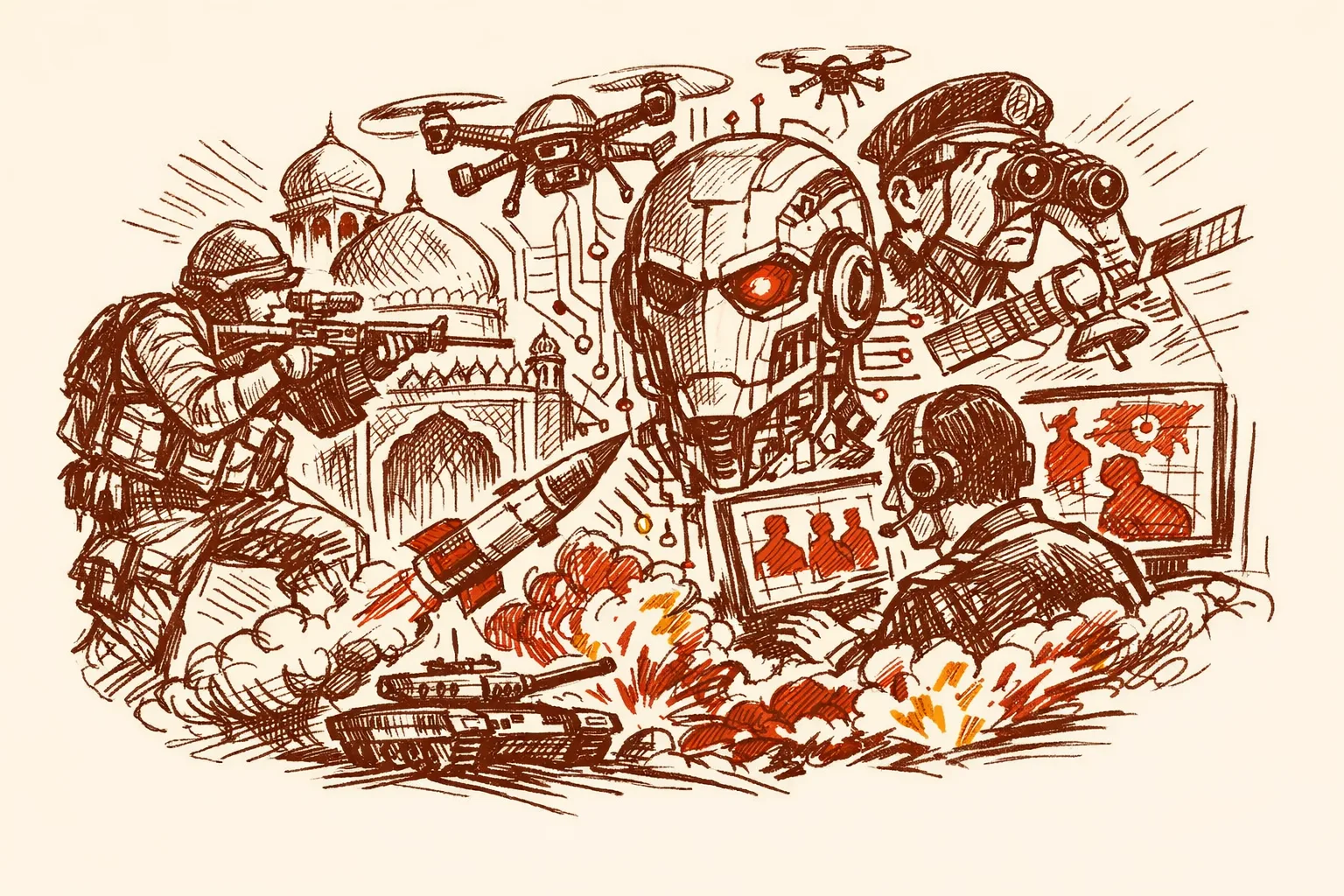
In May, India struck nine terror camps across the border in 23 minutes. Not a single Indian asset was lost. The Indian Air Force jammed Pakistan's Chinese-supplied air defence systems. Drones built by Indian startups hit targets with 94% accuracy. AI-processed data collected over 26 years - from satellites, radar sensors, and electronic intercepts - guided every strike.
According to Lt General Rajiv Kumar Sahni, who served as Director General of Information Systems during Operation Sindoor, AI-based analytics allowed commanders to identify hidden supply routes, camouflaged bunkers, and communication hubs that human analysts would have missed. India's Integrated Air Command and Control System fused data from multiple sensors in real time. The result: precision without risk to personnel on the ground.
Years of policy reform made it possible - drone import bans, production incentive schemes, iDEX startup challenges, and the Modi government's Aatmanirbhar Bharat push in defence. The question now is whether India can institutionalise what it proved in four days into a permanent, doctrine-level national security architecture.
The Scale of the Threat
India faces a two-front security environment. To the north, China has declared intelligentized warfare as the organising principle of its entire military modernisation plan. Xi Jinping personally chairs the commission overseeing this. According to the Center for Security and Emerging Technology at Georgetown University, China awarded 2,857 AI-related defence contracts in just two years. Beijing's military spending for the current fiscal cycle stands at roughly 1.9 trillion yuan - around $278 billion.
China's approach is called Military-Civil Fusion. It forces civilian technology companies - from drone manufacturers to AI labs - to serve military goals. Chinese strategists describe the goal as decision-making dominance - the ability to process battlefield information faster than any adversary and act on it first.
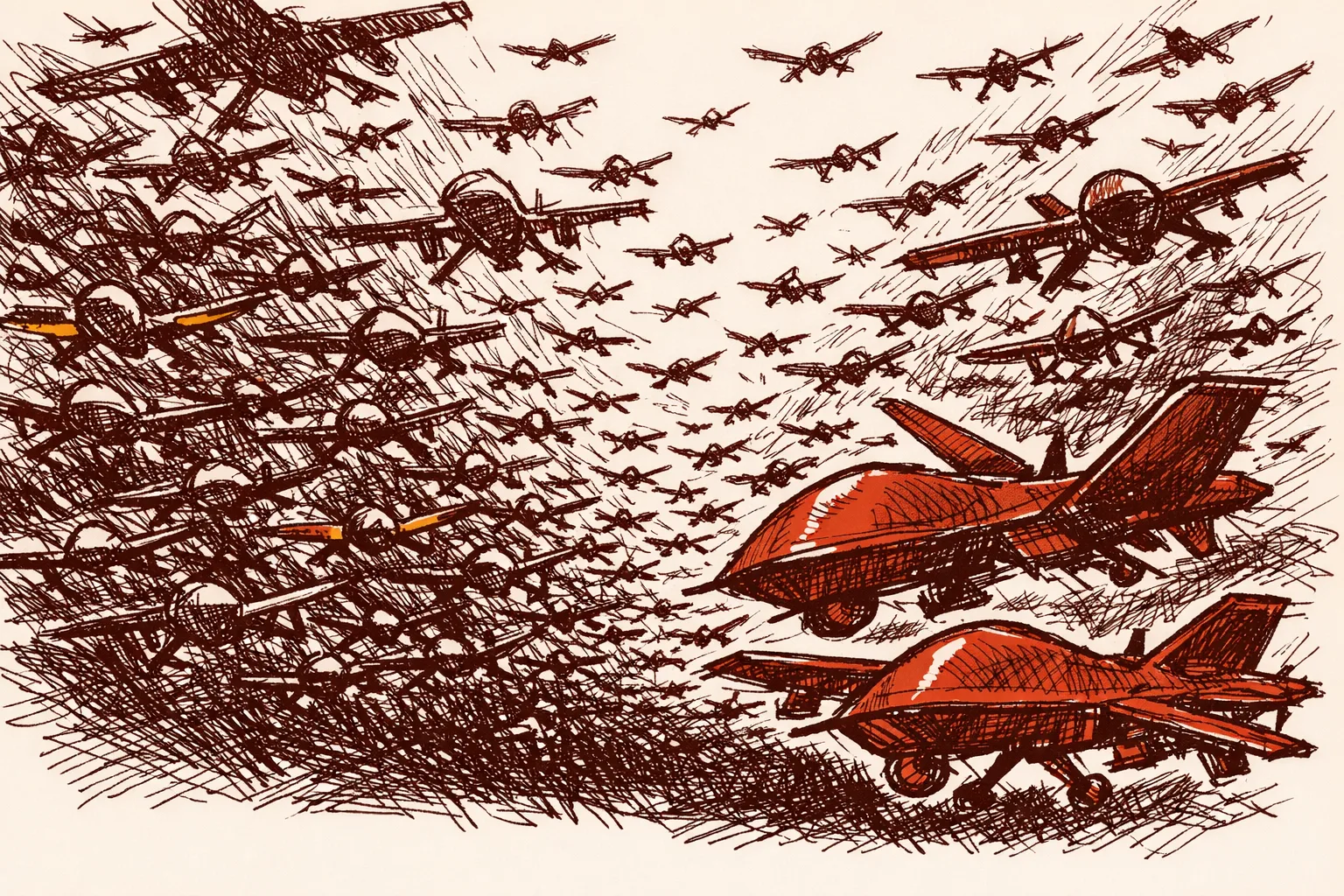
To the west, Pakistan is not standing still. During Operation Sindoor, Pakistan deployed between 300 and 400 drones - including Turkish Bayraktar TB2s and Chinese CH-4 and Wing Loong II platforms. India's layered air defence neutralised over 600 Pakistani drones. But according to Air Marshal Ashutosh Dixit, speaking at a September conference in Delhi, Pakistan is actively attempting to emulate India's drone capabilities.
Every border breach - physical or digital - suppresses investment in the affected region. India must move fast.
What India Has Already Built
The Modi government began a structured AI-in-defence programme in 2018, when the Ministry of Defence constituted a task force titled Strategic Implementation of AI for National Security and Defence. Based on those recommendations, the government created two institutions in 2019. The Defence AI Council is chaired by the Defence Minister and includes the three service chiefs, the Defence Secretary, the National Cyber Security Coordinator, and representatives from industry and academia. The Defence AI Project Agency serves as the executive body.
The government earmarked Rs 100 crore per year for the Defence AI Project Agency. Each service headquarters adds another Rs 100 crore per year for AI-specific application development.
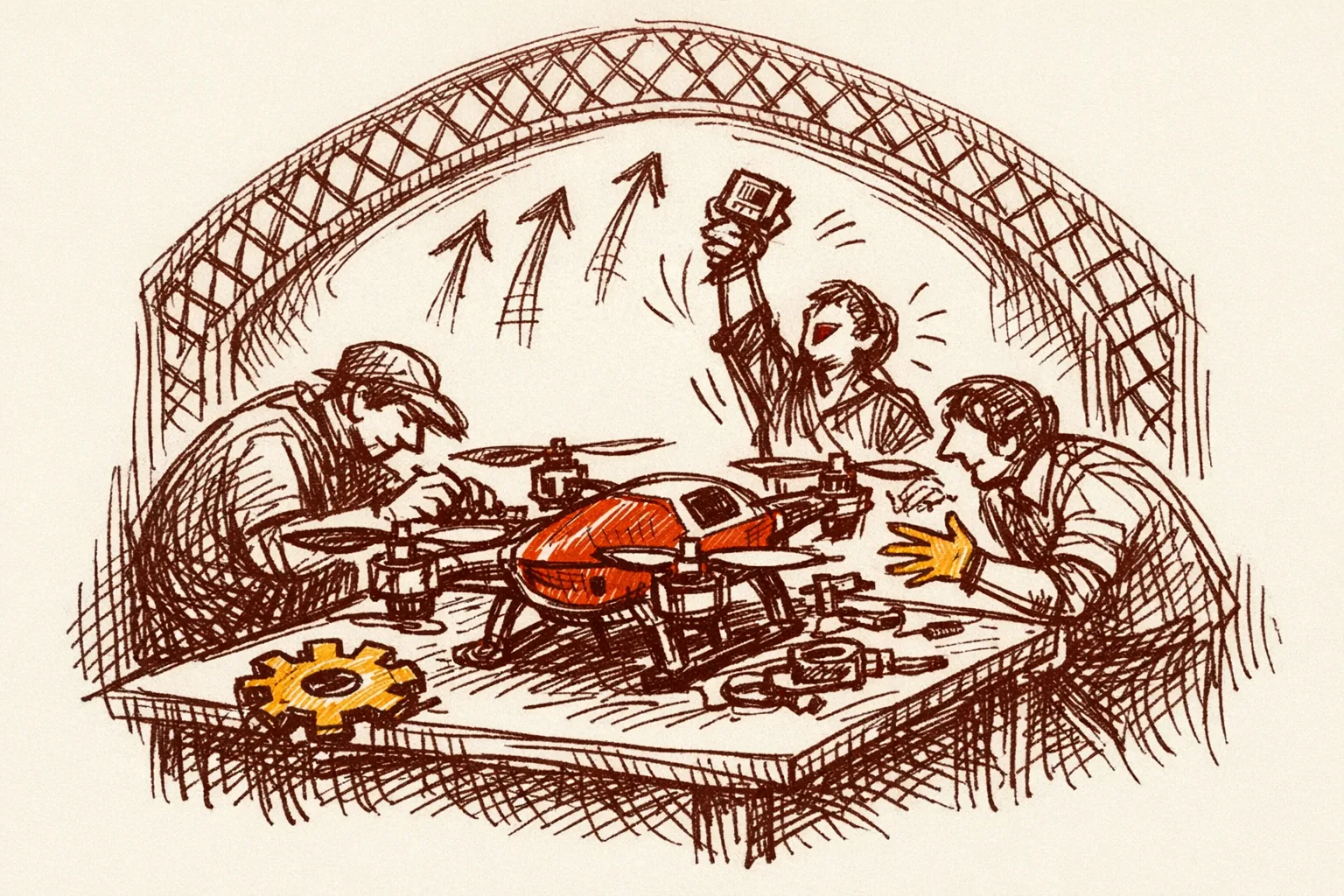
The iDEX programme - Innovations for Defence Excellence - launched in 2018, has become the most consequential structural change in how India develops defence technology. Until iDEX, only large companies like Tata and L&T could afford to participate in defence R&D. Now over 2,000 defence startups and 300 space startups are active contributors.
iDEX has awarded 650 contracts worth approximately $344 million, spanning over 50 technology categories including AI-enabled surveillance, unmanned systems, and encrypted communications. The armed forces have procured 43 products from iDEX innovators worth over Rs 2,400 crore. Challenges are typically solved within 12 to 18 months, at a fraction of what traditional procurement costs.
The ADITI sub-scheme offers grants up to Rs 25 crore for deep-tech challenges. One example: a startup called QuBeats received Rs 25 crore to build a GPS-free navigation system for the Indian Navy - critical in combat environments where GPS signals are jammed. The Defence Research and Development Organisation's Centre for AI and Robotics has developed over 75 AI-based defence products. Around 140 AI-based surveillance systems have been installed along the Pakistan and China borders.
During Operation Sindoor, the Akashteer system built by Bharat Electronics Limited integrated data from all sensors to create a real-time air picture for the Indian Air Force. A fully indigenous loitering munition called the JM-1 made its combat debut - the first Indian-designed kamikaze drone to strike a target in active combat. Defence exports crossed Rs 24,000 crore and are targeted to reach Rs 50,000 crore.
What Has Been Tried - and What Still Lags
Three structural problems remain.
First, institutional silos. According to the Observer Research Foundation, the biggest challenge is the lack of integration across the armed forces, ministries, and private technology firms. Intelligence, surveillance, and reconnaissance systems across different services do not share data on a common platform.
Second, procurement speed. Defence procurement is slow and risk-averse. Operation Sindoor required emergency allocations of nearly Rs 9,000 crore for drones and counter-drone systems. That speed was possible under crisis conditions. Peacetime bureaucracy does not move that fast by default.
Third, sovereign compute. India does not yet have domestic cloud infrastructure for classified defence data. Defence applications rely on sensitive datasets - satellite imagery, electronic intelligence, battlefield data - that become vulnerable when processed through foreign platforms. India currently lacks the GPU clusters and secure defence cloud that a sovereign AI programme requires.
Operation Sindoor also revealed specific technical gaps. Several drones suffered under GPS jamming. Platforms operated independently rather than as part of coordinated swarms. Critical navigation components in some drones still used foreign-sourced parts. India won the engagement. It also knows exactly what must be fixed next.

How Other Countries Fixed This
Israel - The Integration Model
Israel's Unit 8200 integrates AI into every stage of the intelligence cycle - facial recognition, audio analysis, target identification, and battlefield communications monitoring. The Royal United Services Institute has described it as probably the foremost technical intelligence agency in the world in everything except scale.
The talent pipeline is the real lesson. Unit 8200 established an internal innovation hub called Studio that pulls AI professionals from companies like Google, Microsoft, and Meta into military development during reserve duty. Civilian engineers become military contributors without leaving the private sector permanently.
Israel also shows the limit. The October 7 Hamas attack exposed what happens when AI-generated threat assessments replace human judgement. Analysts' warnings were dismissed. The lesson for India: AI improves the speed and quality of human decisions. It does not replace trained analysts who can challenge a model's output.
United States - The Shared Data Layer
The US integrates AI across defence agencies through shared cloud infrastructure under its Joint All-Domain Command and Control initiative, connecting previously siloed systems across the Army, Navy, Air Force, and intelligence community. The US Defence Innovation Unit connects technology companies directly with defence procurement, cutting time from prototype to deployment.
The single mechanism that matters most: the US built a shared data layer first. Before any AI model can perform well, the data it runs on must be clean, consistent, and accessible across agencies. India's next priority is exactly this.
China - What Not to Copy, and What to Borrow
China's Military-Civil Fusion forces every civilian AI advance to serve military goals simultaneously. Researchers at Xi'an Technological University report their AI system can analyse 10,000 battlefield scenarios in 48 seconds - a process that would otherwise take human planners roughly two days.
India should not copy this centralised, coercive model. It is incompatible with a democratic system. But the underlying discipline - ensuring civilian AI advances flow rapidly into defence applications - is something India can replicate through iDEX, ADITI, and the INDUS-X partnership with the US Defence Innovation Unit.
Who Is Accountable
The Ministry of Defence, through the Defence AI Council, holds strategic accountability. The Defence AI Project Agency executes it. The Department of Defence Production manages iDEX contracts and startup induction. The Defence Research and Development Organisation's Centre for AI and Robotics owns core technology development. The shortfall is not budget or institutions - it is a doctrine document. India does not yet have a publicly declared, unified AI defence doctrine that binds all agencies to shared data standards, integration timelines, and accountability metrics. Nobody gets fired when integration stalls.
What Would It Cost
India's current AI-in-defence budget runs at roughly Rs 400-500 crore per year across the ministry and service headquarters combined. Emergency spending during Operation Sindoor reached nearly Rs 9,000 crore on drones and counter-drone systems alone.
Building sovereign compute infrastructure would require additional investment above the current baseline. A phased programme starting at Rs 2,000-3,000 crore for compute infrastructure and classified cloud would be a credible starting point. The return is immediate: a single operation conducted with full AI integration costs less in munitions, time, and personnel risk than one conducted with incomplete data.
What Needs to Happen
Publish a unified AI defence doctrine. India needs a single document that states what AI is for in national security, what standards every service must meet, and who is responsible for integration. The Defence AI Council should produce and release this document.
Build a classified defence cloud. Satellite imagery, electronic intelligence, and battlefield telemetry cannot safely run on foreign servers. India needs a domestic GPU cluster and classified cloud stack built specifically for defence applications. The Defence Research and Development Organisation and the National Informatics Centre should jointly own this infrastructure.
Fix the procurement lag. iDEX challenges are solved in 12-18 months. Getting those solutions into active service can take years. India needs a fast-track procurement lane where AI and drone technologies move from prototype to deployment within 12 months. Operation Sindoor showed this speed is possible under crisis. It should be the default.
Create an AI talent pipeline into the military. India has some of the best AI engineers in the world. Almost none of them work in defence. A fellowship and embedded assignment model - similar to Israel's reserve system - would bring private sector AI expertise directly into military problem-solving.
Connect the silos. The most urgent gap is shared data infrastructure across the three services and intelligence agencies. This is a governance problem, not a technology problem. The Defence AI Council needs the authority to mandate data-sharing standards across all services and set hard deadlines for compliance.
What broke isolation in payments was UPI: one layer that forced every bank to speak the same language. The defence services need their own version of that. India's AI assets are ready. The integration is what remains.