What the Verdict Actually Says
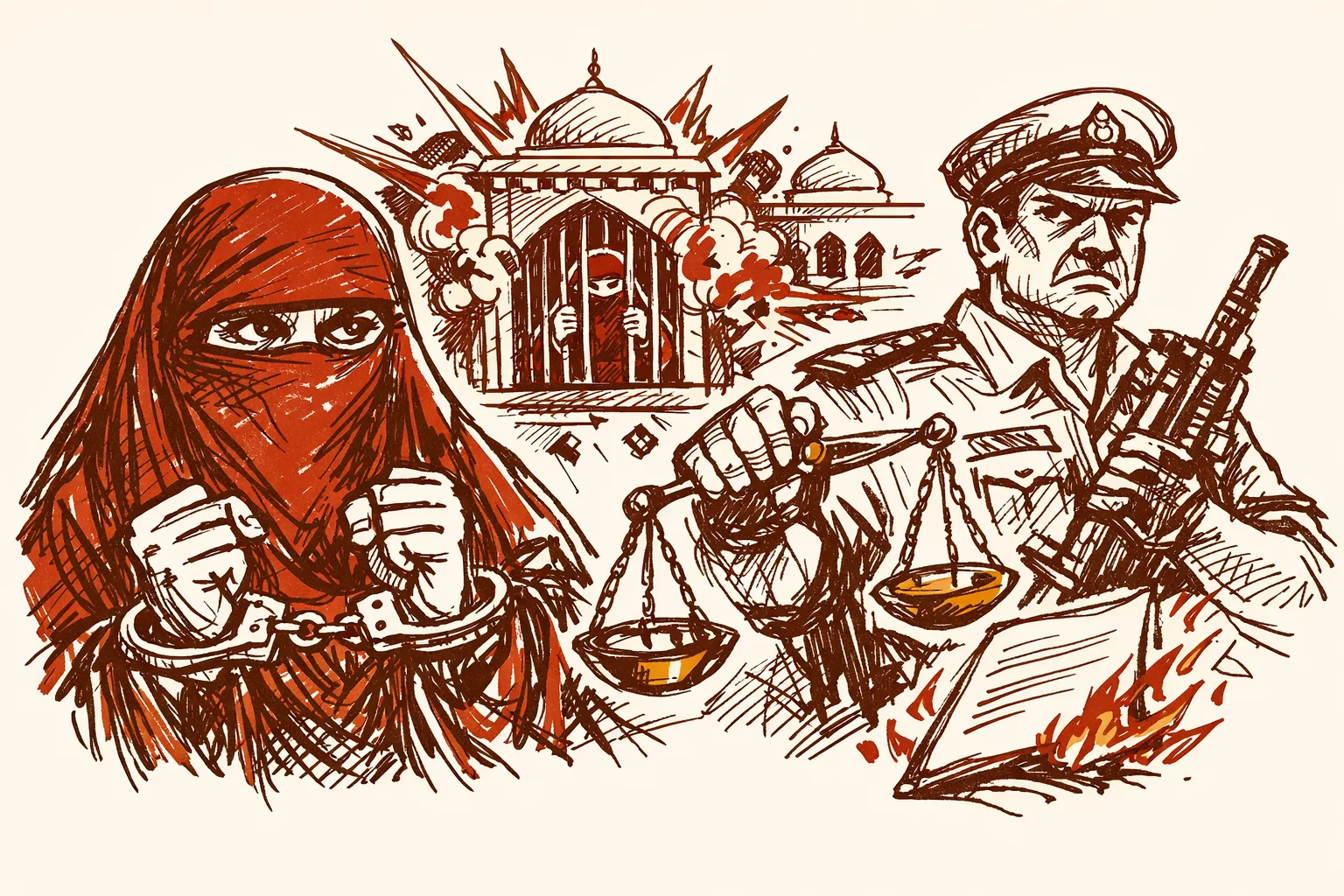
On March 24, a special National Investigation Agency court in New Delhi handed Aasiya Andrabi three concurrent life sentences. Two of her associates received 30 years each. Pakistan condemned it. International media called it political persecution. India's supporters called it long overdue.
Both sides are talking past the verdict itself.
The 290-page judgment, written by Additional Sessions Judge Chander Jit Singh at Karkardooma Court in Delhi, contains a passage that is hard to read any other way. The court noted that 53 prosecution witnesses were examined. Not one testified to an actual act of terrorism carried out by Andrabi or her banned organisation, Dukhtaran-e-Millat. The court wrote that "no violent incidence in particular, pursuant to such endorsement or encouragement, has been brought on record."
Then it sentenced her to life imprisonment anyway.
That gap - between what the prosecution alleged, what the court found, and the punishment imposed - is the story.
Who Andrabi Is and What She Was Charged With
Andrabi, now 64, is the founder of Dukhtaran-e-Millat, an all-women separatist group formed in Srinagar in 1987. The group is listed as a banned organisation under the Unlawful Activities (Prevention) Act - India's main anti-terror law, known as UAPA. She holds a biochemistry degree and an Arabic degree from the University of Kashmir.
She is not a sympathetic figure by any standard of national interest. During NIA interrogation, she admitted to regular contact with Hafiz Saeed, the Lashkar-e-Taiba founder and a UN-designated global terrorist. She acknowledged contact with Pakistan's then-ISI chief Hamid Gul. She was connected to Hizbul Mujahideen chief Syed Salahuddin, another UN-designated terrorist. The NIA's chargesheet alleged hawala money flowed to her associates through operators linked to Lashkar in Saudi Arabia and Lahore.
She hoisted a Pakistani flag in Srinagar. Her husband, Ashiq Hussain Faktoo, is a founding member of Hizbul Mujahideen and has been in prison since 1992. The NIA registered 33 separate FIRs against her across Jammu and Kashmir.
India had reason to prosecute her. The question is whether the prosecution proved what it set out to prove - and whether the resulting conviction will survive legal challenge.
The Problem with the Conviction
The charges filed in December 2020 included waging war against the Indian government, raising funds for terrorist acts, and membership in a terrorist organisation.
The court acquitted Andrabi of all three. No evidence of actual violence. No proof the bank records met the standard for terror financing. Terrorist organisation membership in the legal sense required was not established either.
She was convicted instead on charges of promoting enmity between communities, making statements prejudicial to national integration, criminal conspiracy, and two sections of UAPA related to association with a banned group.
But the court imposed three concurrent life sentences, using as a key reason the fact that Andrabi showed no remorse.
Kashmir Times ran an editorial calling this "deeply problematic," noting that elevating remorse to a central factor in sentencing "risks penalising an accused for what they believe or choose not to express, rather than for what has been proven in law."
The court also compared Andrabi to Ajmal Kasab - a gunman who murdered over 150 people in Mumbai - while simultaneously acquitting her of all charges involving any violence.
That comparison will likely be the centrepiece of her appeal to the Delhi High Court and, eventually, the Supreme Court.
The Scale of the Problem - UAPA's Conviction Rate
This case is not isolated. It sits inside a pattern that India's own data makes clear.
According to a detailed study by the People's Union for Civil Liberties, using National Crime Records Bureau data for 2015 to 2020, 8,371 persons were arrested under UAPA. Only 235 were convicted. That is a conviction rate of 2.8 percent based on arrests.
Put simply: 97 out of every 100 people arrested under UAPA are eventually acquitted or released - after spending years in prison without bail.
The Ministry of Home Affairs confirmed 10,440 UAPA arrests between 2019 and 2023. Convictions in the same period: 335. Jammu and Kashmir alone accounted for 3,662 of those arrests - over 35 percent of the national total - but only 23 convictions. A conviction rate of under one percent.
The most commonly used charge in NIA-handled UAPA cases is Section 18 - conspiracy. Conspiracy charges were used in 238 out of 357 NIA UAPA cases. In 64 percent of those conspiracy cases, no actual violent incident was recorded.
In practice: arrest under UAPA, deny bail for years using Section 43D(5), and use pretrial detention as the punishment itself. Former Supreme Court judge Justice Aftab Alam described this as "even if the case fails, the accused can be incarcerated for 8 to 12 years."
What Has Already Been Tried
UAPA is not the first anti-terror law to produce this pattern. The Terrorist and Disruptive Activities Prevention Act, known as TADA, was introduced in 1987. It was not renewed in 1995 after widespread criticism of misuse. The Prevention of Terrorism Act, known as POTA, was passed in 2002 after the Parliament attack and repealed by Presidential Ordinance in 2004.
UAPA absorbed the provisions of both. First passed in 1967, it was strengthened with anti-terror provisions in 2004, with further amendments in 2008 and 2013. The 2019 amendment extended the power to designate individuals - not just organisations - as terrorists.
Two petitions challenging the constitutional validity of the 2019 amendment are pending before the Supreme Court. The court issued notice to the government in September 2019. The government has not filed its reply. The challenge rests on whether the amendment violates Articles 14, 19, and 21 - the rights to equality, free speech, and life and liberty.
The pattern across all these laws is the same: broad definitions, arrest as tool, low conviction, eventual repeal or challenge. India keeps building the same structure and getting the same results.
How Other Countries Handle This
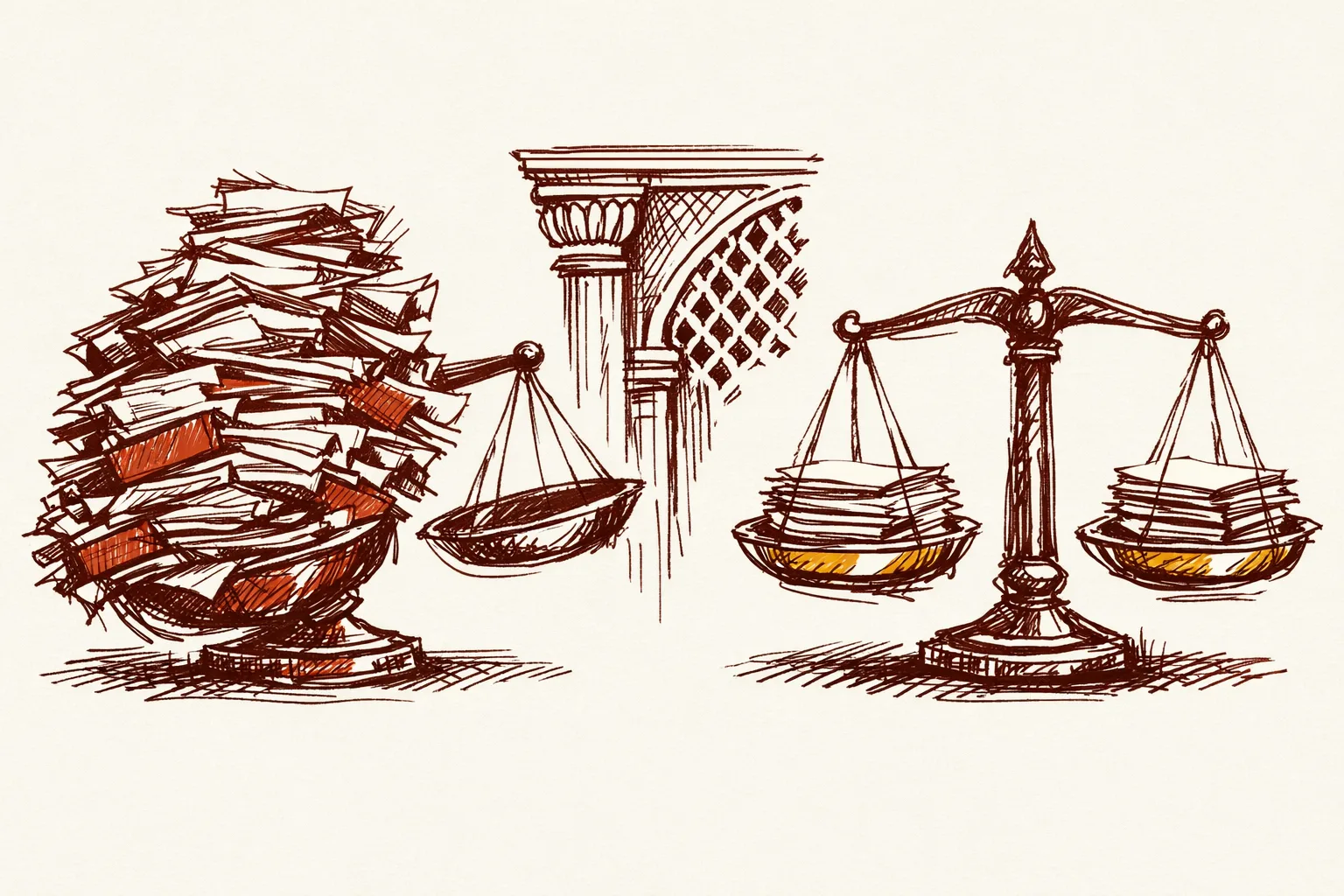
The United Kingdom passed the Terrorism Act 2006 after the London bombings. It created an offence of "encouragement of terrorism" - covering direct or indirect incitement. The standard requires that statements be "likely to be understood as encouragement" to commit a terrorist act. Anjem Choudary was finally convicted in 2016 for directly encouraging travel to Syria to fight for the Islamic State. The conviction held because prosecutors waited until they had evidence of specific encouragement to a specific violent act. The UK model is slower but produces convictions that survive appeal.
The United States uses the Brandenburg standard - speech is not protected if it is "directed to inciting or producing imminent lawless action" and is "likely to produce such action." The 2010 case Holder v. Humanitarian Law Project added that coordination with or advocacy on behalf of a designated foreign terror organisation is a criminal offence, regardless of whether the speech directly incites violence. This means the ISI connections and Hafiz Saeed links documented in the NIA chargesheet would have been, under American law, a sufficient basis for conviction - without needing to prove any specific violent act.
Both countries build cases that survive appellate review because the evidence matches the charge. India charges the most serious offences, fails to prove them, convicts on lesser ones, and imposes the same maximum sentence anyway. That produces reversals on appeal and gives Pakistan exactly the international narrative it wants.
Who Is Accountable
The National Investigation Agency, under the Ministry of Home Affairs, investigated and prosecuted this case. The NIA's investigating officer, Abhinav Kajla, is named in the court record. Ministry of Home Affairs holds the budget and policy authority for UAPA enforcement. Nobody gets fired when conviction rates run below one percent.
The Supreme Court's bench hearing the constitutional challenge - Sajal Awasthi v. Union of India - is the legal forum where the structural fix must come. That case has been pending since 2019 without a government reply on record.
What Would It Cost
Nothing. This is a legal design problem, not a budget problem.
The fix requires the NIA to build cases to the standard of evidence required for the specific charges brought. It requires the government to file its reply in the pending Supreme Court challenge so the court can provide clarity on where the constitutional lines are. It requires that sentencing be based on what was proven, not what was alleged.
Each high-profile UAPA acquittal on appeal is a propaganda gift. Pakistan's Ministry of Foreign Affairs issued a statement on March 25 calling the verdict "a grave miscarriage of justice" and urging international bodies to intervene. Pakistan's moral authority on rule of law is nonexistent - it has entered more than 20 IMF programmes over 65 years with total public debt reaching Rs 79.32 trillion in January. But verdicts that collapse on appeal hand Pakistan arguments it does not deserve.
What Needs to Happen
Three things need to change.
First, the NIA must match charges to evidence before filing. If the case is about speech and organisational links, charge speech and organisational links. Do not charge waging war if you cannot prove war was waged.
Second, the government must resolve the pending Supreme Court challenge to the 2019 UAPA amendment instead of leaving it pending indefinitely. Constitutional ambiguity creates legal risk in every case built on it.
Third, sentencing must be based on proved offences, not on a defendant's refusal to show remorse. The comparison of Andrabi to Ajmal Kasab - while she was simultaneously acquitted of every charge involving violence - is the section of the verdict most likely to be reversed on appeal.
India put a genuine separatist with documented links to ISI-funded terror networks on trial. That was the right call. The execution leaves the conviction legally exposed. Fix the execution.