
The Deal That Was Made in a Delhi Parking Lot
On the evening of April 18, a man connected to one of India's biggest defence-linked drone companies drove to Essex Farms, near the IIT Delhi flyover in New Delhi. He was there to deliver cash. According to the Central Bureau of Investigation's First Information Report, the amount was Rs 2.5 lakh - a bribe to process three pending import applications faster. The CBI was watching. Both men were arrested the same night.
The company at the centre of this arrest was Asteria Aerospace - a drone technology firm that is a subsidiary of Reliance Industries' digital arm, Jio Platforms. The official on the other side was Mudavath Devula, a Deputy Director General at India's aviation regulator, the Directorate General of Civil Aviation. The Reliance executive named in the case was Bharat Mathur, a Senior Vice President.
What Asteria Aerospace Is and Why It Matters
Asteria Aerospace was founded in Bengaluru in 2011 by Nihar Vartak and Neel Mehta. In December 2019, Reliance Industries acquired it for approximately $2.45 million. Today, Reliance Jio Platforms controls 74% of Asteria.
Asteria is not a small side venture. It provides aerial intelligence - using drones to capture geospatial data for agriculture, construction, telecom, and oil and gas clients. It has more than 400 drones deployed across India. Its drone, the AT-15, was showcased at India's Republic Day parade. It has received three types of certifications from the DGCA - making it, by its own account, the first Indian drone maker to achieve this.
In the financial year ending March, Asteria reported revenue of Rs 79 crore - a 90% jump from the previous year, according to filings sourced from the Registrar of Companies.
Reliance has said it did not authorise, nor was aware of, any such transactions. The lawyer for Devula has opposed his custody. The legal process will now run its course.
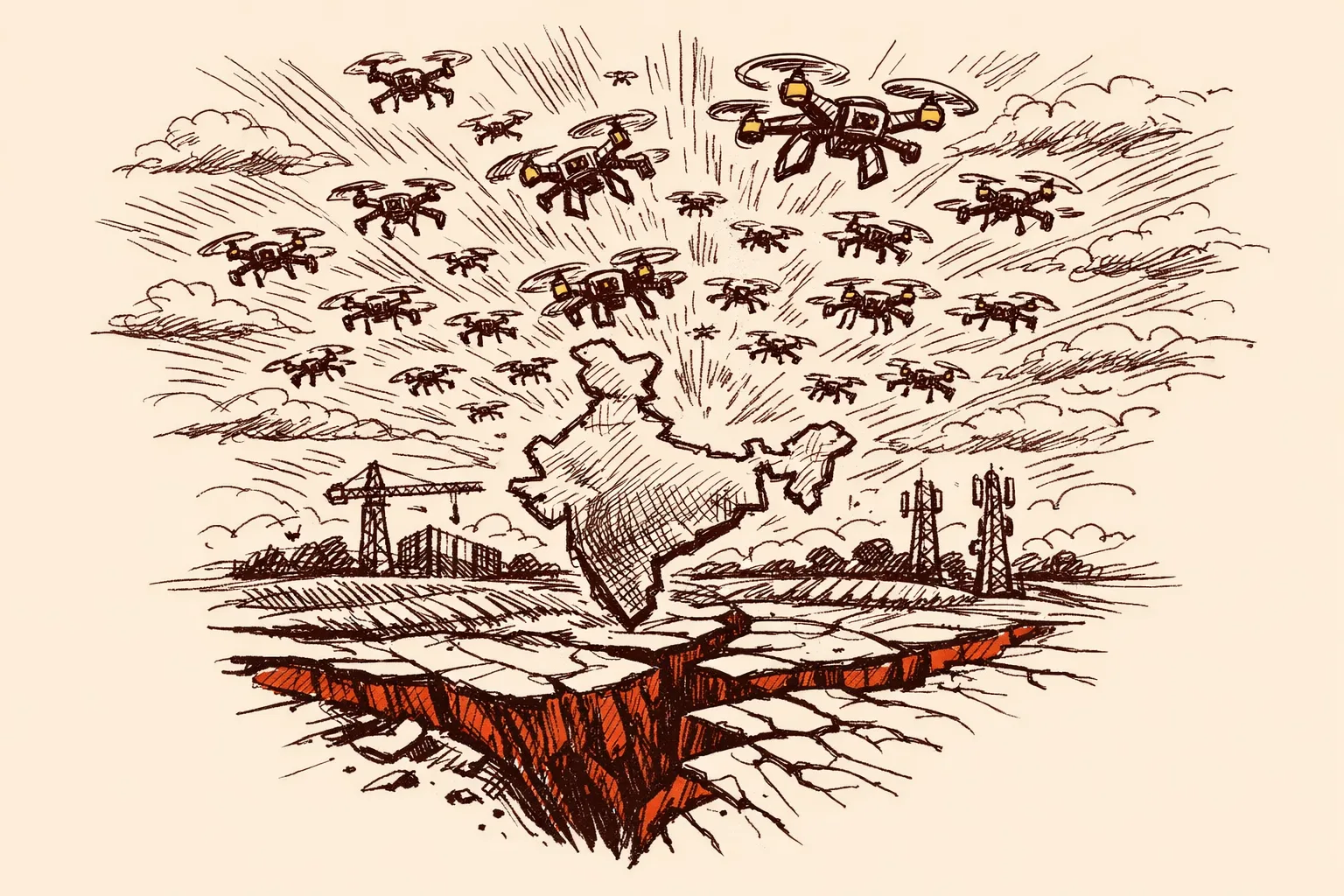
The Scale of What Is Being Built - and What Is Now at Risk
India's drone sector is one of the most exciting industrial stories in the country right now. The Modi government's Drone Rules of 2021 opened nearly 90% of Indian airspace as a green zone for drone operations. Before 2021, the DGCA had effectively banned drone use in civil airspace since 2014 due to a lack of safety standards.
The government backed those rules with real money. Under the Atmanirbhar Bharat policy, it approved a Production-Linked Incentive scheme for drones worth Rs 120 crore. It created the DigitalSky platform for online approvals. It launched the Drone Shakti initiative to back drone-as-a-service startups. GST on drones was cut from 18-28% down to a flat 5%.
According to MarketsandMarkets, India's drone market is expected to grow from $0.47 billion to $1.39 billion by 2026 - a compound annual growth rate of 24.4%. The defence and security segment alone is forecast to grow at 26.4% annually.
Operation Sindoor in May last year showed why this matters. Indigenous drones and counter-drone systems performed in live combat conditions. The drone self-reliance mission is not theoretical.
Now ask yourself: how many of the certifications and approvals in this sector were earned honestly? How many were bought?

The Real Problem Inside the DGCA
The DGCA is the watchdog responsible for certifying every drone that operates in Indian airspace. Without its approval, no drone can fly commercially. That gives every DGCA official significant gatekeeping power.
The CBI's FIR states that Mathur first contacted Devula on March 18 to ask about the status of three import applications for Asteria Aerospace. Two days later, Devula allegedly asked how many files were involved. The alleged rate was settled at Rs 5 lakh per file - for three files, a total of Rs 15 lakh. The agreement was then partly acted on before the CBI intervened.
The regulator has been starved of staff, independence, and resources for years - which creates exactly the conditions where individual officials can extract rents from companies desperate to get approvals processed.
A Parliamentary committee report from August last year described the DGCA's staffing crisis as an existential threat to the integrity of India's aviation safety system. The DGCA has a sanctioned strength of over 1,600 posts. According to the parliamentary panel, only around 553 posts were filled at the time of its review. The committee stated plainly that the DGCA, in its current form, is not in a position to discharge its duties for which it was established.
Every major decision on staffing, enforcement, procurement, or rule implementation requires ministry approval - meaning the DGCA has no independent budget and no freedom to hire. The Civil Aviation Authority Bill introduced by the UPA government in 2013 would have given the DGCA statutory independence. It lapsed when that government fell. No equivalent legislation has been passed since.
That is a corruption breeding ground - and every company seeking approvals knows it.
What Has Already Been Tried
India has made genuine progress on the policy side. The Drone Rules of 2021 replaced an earlier, more restrictive framework. The SVAMITVA scheme used drone mapping to create property records in rural areas, covering over 3.28 lakh villages. The PLI scheme put public money behind domestic manufacturers. The DigitalSky platform was designed to make approvals faster and more transparent.
These were real reforms. But they addressed the policy environment. They did not fix the regulator at the centre of it all.
Multiple parliamentary panels over multiple years have flagged the staffing crisis and the lack of autonomy. According to a report in The Wire, the committee noted that well-reasoned recommendations, repeatedly acknowledged by the Ministry, remain largely unimplemented.
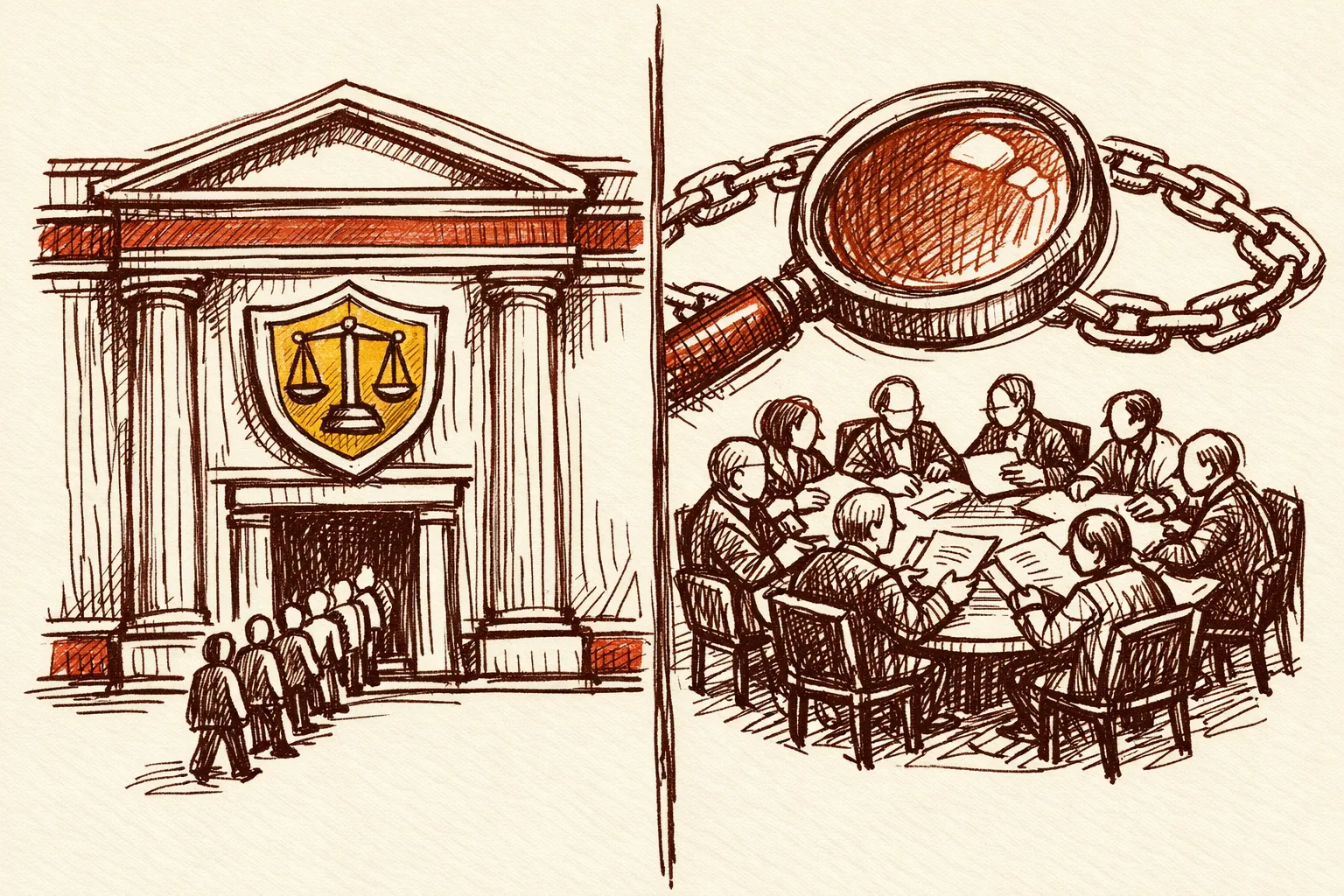
How Other Countries Fixed This
Singapore - One Agency, One Standard, No Exceptions
Singapore's anti-corruption body, the Corrupt Practices Investigation Bureau, was founded in 1952. It operates under the Prime Minister's Office and investigates corruption in both the public and private sectors with equal authority. All suspected cases of bribery - including in defence procurement - are referred to the CPIB for investigation by an independent body outside the ministry.
The CPIB's conviction rate for corruption cases averaged 98% between 2014 and 2018. Singapore ranks first in the entire Asia-Pacific region on defence procurement integrity, according to Transparency International's Government Defence Anti-Corruption Index. The mechanism is simple: one agency, full independence, no carve-outs for powerful companies or senior officials.
South Korea - A Dedicated Procurement Agency with Built-In Oversight
South Korea created the Defence Acquisition Program Administration in January 2006 - a civilian agency with exclusive authority to plan and budget all defence procurement. It was built specifically to fix corruption scandals in arms and technology procurement that were damaging national security and public trust.
The Board of Audit and Inspection maintains a special department that regularly audits the agency. A special inspector general for defence acquisition examines each stage of procurement projects. All defence industrial personnel are required to sign an Integrity Pact, and non-compliance has legal consequences. The principle is separation - the body that regulates procurement is not the same body that benefits from it.
India does not have an equivalent structure for technology-intensive sectors like drones, where civilian and defence applications overlap.
Who Is Accountable
Three parties are named in the CBI case: Mudavath Devula, Deputy Director General at the DGCA's Airworthiness Directorate; Bharat Mathur, Senior Vice President at Reliance and a person associated with Asteria Aerospace; and Asteria Aerospace Limited itself, booked under the Prevention of Corruption Act and the Bharatiya Nyaya Sanhita. The Ministry of Civil Aviation oversees the DGCA and controls its budget and staffing decisions. The Ministry has acknowledged the staffing gap but has not presented legislation to grant the DGCA operational independence.
What Would It Cost
The DGCA has roughly 880 vacant posts against its sanctioned strength. A fully staffed regulator with competitive pay - comparable to what the Reserve Bank of India or the Securities and Exchange Board of India offer - would cost a fraction of one year's PLI spending on drones.
The drone sector is now valued at approximately Rs 57 billion and is projected to reach Rs 123 billion by 2027. India's Ministry of Defence issued procurement orders of approximately Rs 2,400 crore in one year alone. If even a small share of approvals in this sector has been corrupted, the cost in lost competition, inflated procurement, and strategic risk far exceeds the cost of fixing the regulator.
What Needs to Happen
The first step is straightforward: pass legislation giving the DGCA full operational independence from the Ministry. The template exists - it was drafted more than a decade ago and lapsed. Pass it now. Give the DGCA independent budgeting, the ability to hire specialists without slow government recruitment pipelines, and performance-linked pay comparable to the private sector it regulates.
The second step is accountability for private players, not just government officials. The CBI has correctly booked Asteria Aerospace Limited as a corporate entity under the Prevention of Corruption Act. But prosecution alone is not enough. The government should introduce mandatory debarment provisions - any company found guilty of bribery in a regulated sector should be barred from government contracts for a defined period. No exceptions for large conglomerates.
The third step is a ring-fenced oversight body for strategic technology procurement. Drones, semiconductors, surveillance systems, and defence electronics all sit in the same space - civilian companies holding contracts with national security implications. A dedicated procurement integrity office for this category, reporting independently to Parliament rather than to the Ministry, would close the gap that this case exposes.
The Asteria case was caught because the CBI received a tip and acted on it. But the problem is not that one official was corrupt. The structure made corruption easy - and many cases are never reported. The government that liberalised drone policy, built DigitalSky, and backed Indian drone companies with PLI money must now fix the regulator so that the next company cannot buy its way to certification.
Atmanirbhar Bharat means self-reliant India. Self-reliance built on bribery is not self-reliance. It is a liability.