The Problem You Can See Everywhere
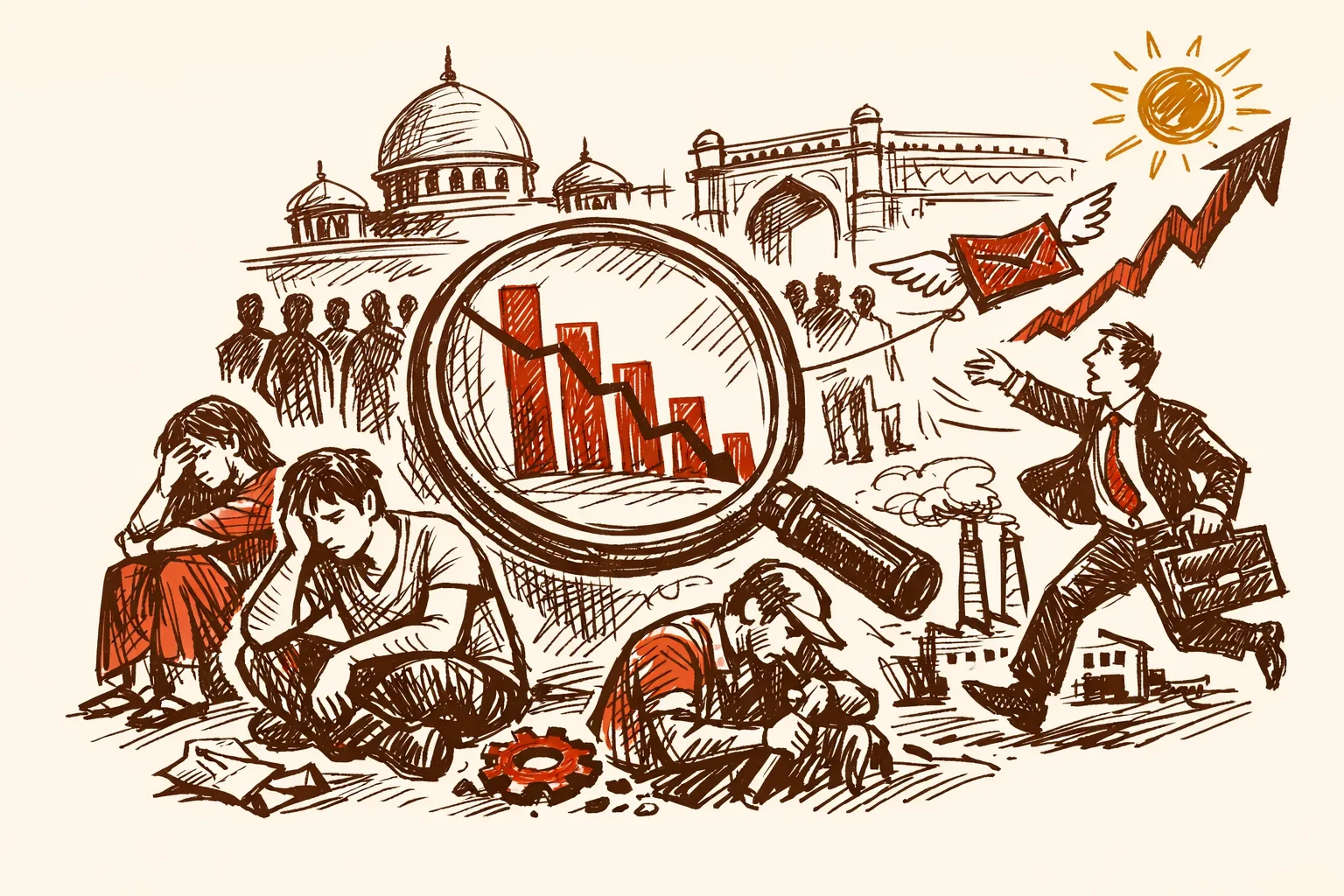
Walk into any small-town government office in India. Outside, there is always a queue of young men with certificates and folders. They are waiting for results. Some are still waiting on interview calls. I grew up seeing that queue in Chamba and Chandigarh. It has not gone away.
India's economy is growing fast. But the jobs are not keeping pace.

The Scale of the Problem
India's overall unemployment rate hit 9.2 percent in June, according to the Centre for Monitoring Indian Economy (CMIE). That was up from 7 percent the previous month.
But the headline number hides the real crisis. Among young people aged 15 to 29, the unemployment rate was 10.2 percent according to the government's Periodic Labour Force Survey. CMIE found even higher figures: youth unemployment at 45.4 percent among those aged 15 to 24 in one recent year, roughly six times the adult rate.
The gender gap compounds this. Urban women face unemployment rates of over 20 percent. Female participation in the labor force fell from 32 percent to 23 percent between the mid-2000s and the early part of the current decade, according to data cited by the Observer Research Foundation.
According to research published in Work, Employment and Society, India has seen average GDP growth near 7 percent for decades. That growth has generated less than 1 percent employment growth. The economy expands but the job market does not grow with it.
Why It Is This Way
Nearly 85 percent of jobs in India are informal - no written contract, no benefits, no job security, according to the National Sample Survey. That number has not shrunk much in 30 years.
Two reasons dominate.
First, India's old labour laws made it very expensive to hire formal workers. A factory with 100 or more workers needed government permission before it could lay anyone off. Owners kept headcounts just below that threshold, hired fewer people on paper, kept more workers informal, and never scaled up. Policy analysts at PRS Legislative Research called these adverse incentives - the rules rewarded smallness over growth.
Second, India's education system produces too many people with degrees and too few with skills that factories actually need. A welder, an electrician, a machinist - these roles go unfilled while qualified engineers wait in that queue outside the office.
Manufacturing accounts for less than 20 percent of India's nearly four-trillion-dollar economy. In China and Vietnam, that number is above 25 percent. Fewer factory jobs means the informal economy absorbs the overflow.
What Has Already Been Tried
Skill India Mission (launched 2015): Prime Minister Modi launched this mission to train 30 crore people by 2022. Over 1.64 crore candidates have been trained and certified under PMKVY, and 49 lakh apprentices have been engaged through NAPS, according to the Ministry of Skill Development and Entrepreneurship. The number of ITIs has grown from 9,776 to over 14,600. The share of youth aged 15 to 29 who are vocationally trained rose from 7.1 percent to 26.1 percent between 2017-18 and 2023-24. That is real progress. But India's auditor found ghost accounts and dubious certifications inflated some numbers. The mission was set to train 500 million people by 2022 but reached 13.2 million verified trainees. Training at scale requires tighter quality controls, not just targets.
PLI Scheme (Production Linked Incentive, launched 2020): The government introduced performance-based incentives across 14 manufacturing sectors with a total outlay of Rs 1.97 lakh crore. The scheme attracted investments of over Rs 2.16 lakh crore, generated sales of Rs 20.41 lakh crore, and created more than 14.39 lakh direct and indirect jobs. Electronics production rose 146 percent between 2020-21 and 2024-25. Mobile phone imports fell by 77 percent. This is a genuine success. The question is whether it can be scaled across more labor-intensive sectors.
Four Labour Codes (passed 2019-2020, implemented November): India's parliament passed four codes replacing 29 old labour laws covering wages, industrial relations, social security, and workplace safety. Key changes include raising the threshold for needing government permission before layoffs from 100 workers to 300, giving gig and platform workers access to social security, and setting a national minimum wage floor. Implementation is now the test.
How Other Countries Fixed This - Germany's Apprenticeship Model
Germany has one of the lowest youth unemployment rates of any large industrial nation - 5.8 percent, compared to 15.1 percent across the EU, according to CEDEFOP.
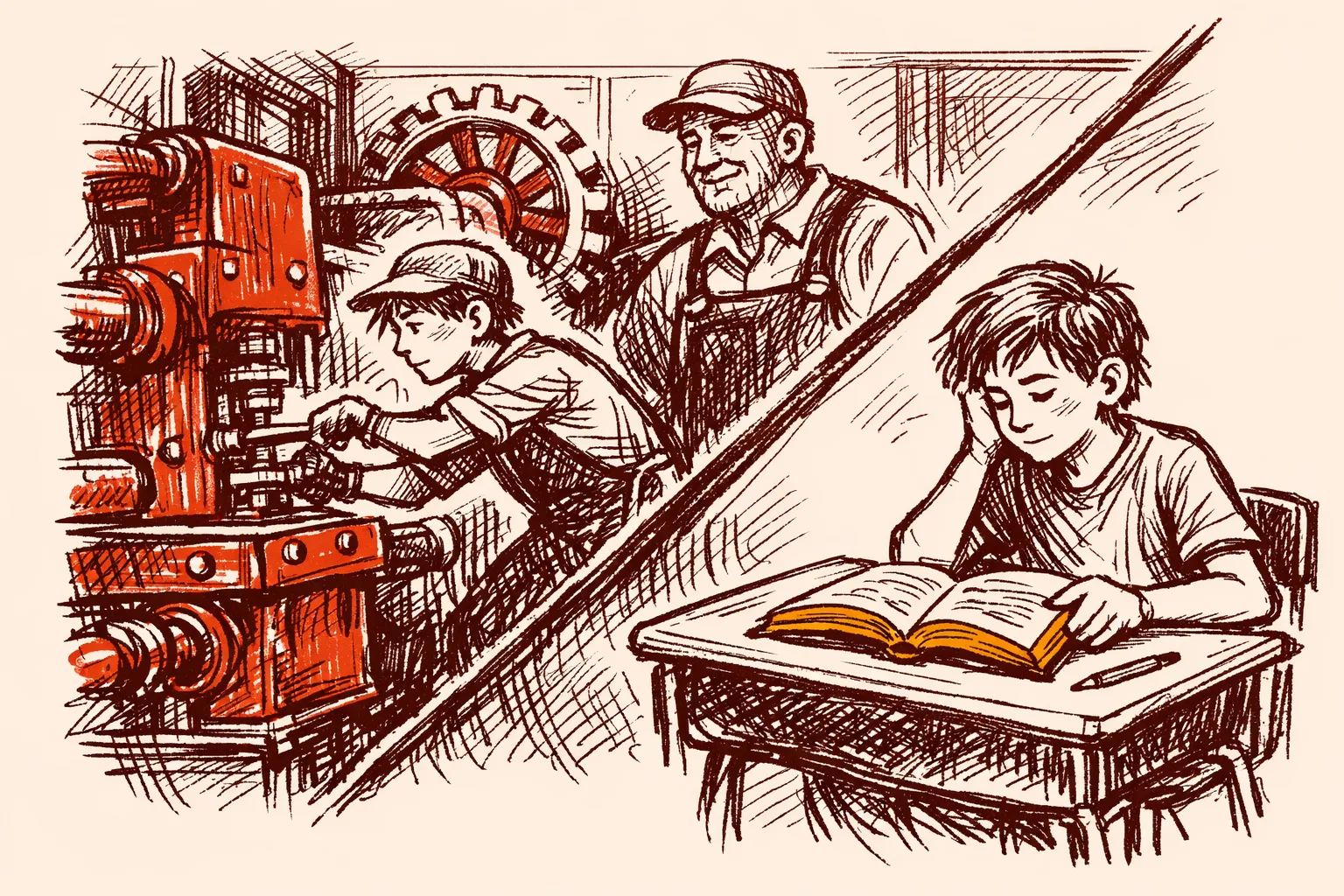
The reason is dual vocational training. About 60 percent of German school leavers enter this system. A young person spends roughly 70 percent of their training time inside a company on real jobs, and 30 percent at a vocational school. Companies pay wages during training. The state pays for the school component. After typically three years, the young person already has real work experience and is ready to be hired.
German companies help design the training curricula through their industry chambers. They are partners in building the workforce they need.
India's ITI system was designed with this logic in mind but the connection to industry needs has been weak. The PM SETU scheme proposes to upgrade 1,000 ITIs over five years at Rs 60,000 crore, building a hub-and-spoke model that connects training directly to employers.
Who Is Accountable
The Ministry of Skill Development and Entrepreneurship oversees vocational training including PMKVY, NAPS, and the ITI network. The Ministry of Labour and Employment owns the four Labour Codes and their enforcement. The Ministry of Commerce and Industry runs the PLI scheme. Budget allocation to the Ministry of Skill Development was Rs 3,517 crore in one recent Union Budget. PM SETU commits Rs 60,000 crore over five years.
What Would It Cost
PM SETU commits Rs 60,000 crore over five years to upgrade 1,000 ITIs. The PLI scheme carries a Rs 1.97 lakh crore outlay across 14 sectors. Whether the spending reaches workers who actually get hired is what determines whether any of this matters. The auditor's finding on Skill India shows that money without accountability produces certificates, not jobs.

What Needs to Happen
Every ITI upgrade under PM SETU should have a signed employer partner before a single rupee is released. If a training center cannot show who will hire its graduates, it should not be funded.
The four Labour Codes are now live. The codes introduced an Inspector-cum-Facilitator system designed to help businesses comply rather than punish them. But enforcement agencies need staffing and training. States also need to finalize their own rules under the codes - several have not yet done so.
The PLI scheme must expand into more labor-intensive sectors. Electronics and pharmaceuticals are high-value but not high-headcount. Textiles, furniture, footwear, and food processing can each absorb millions of workers.
Female labor force participation needs its own intervention. The labour codes now allow women to work night shifts legally across all establishments. Getting women into those shifts requires safe transport, onsite facilities, and enforcement against harassment. District administrations can deliver them.