The Question People Are Afraid to Ask
Every few years, someone asks it out loud. Why did Gandhi keep telling Hindus to be calm while the country was being torn apart? Why did he fast to protect Muslim interests while Hindus and Sikhs were being slaughtered in Pakistan? Why did he push the government to send Rs 55 crore to Pakistan while Indian soldiers were dying fighting Pakistani-backed raiders in Kashmir?
These are not fringe questions. Babasaheb Ambedkar - the man who wrote India's Constitution - asked them. The Foreign Affairs journal asked them. Historians at Oxford and Cambridge have written books about them. The controversy around Gandhi and partition is real, documented, and still largely buried under the weight of Congress-era mythology.
What the Record Shows
Gandhi publicly opposed partition until the very end. That part is true. According to Wikipedia's documented record of partition opposition, Gandhi stated that "Hindus and Muslims were sons of the same soil of India; they were brothers who therefore must strive to keep India free and united." He called the division a vivisection of India's body.
But opposition in words is one thing. Actions are another.
Foreign Affairs found that Gandhi's earlier choices - his adoption of Hindu vocabulary, his obsession with cow protection as a political symbol, his decisions that Muslim leaders considered pro-Hindu - meant that, as the journal put it, "he cannot be absolved from at least partial responsibility for what came to pass." At the same time, Muslim elites saw him as a Hindu nationalist. He alienated both sides.
The Khilafat Gamble That Backfired
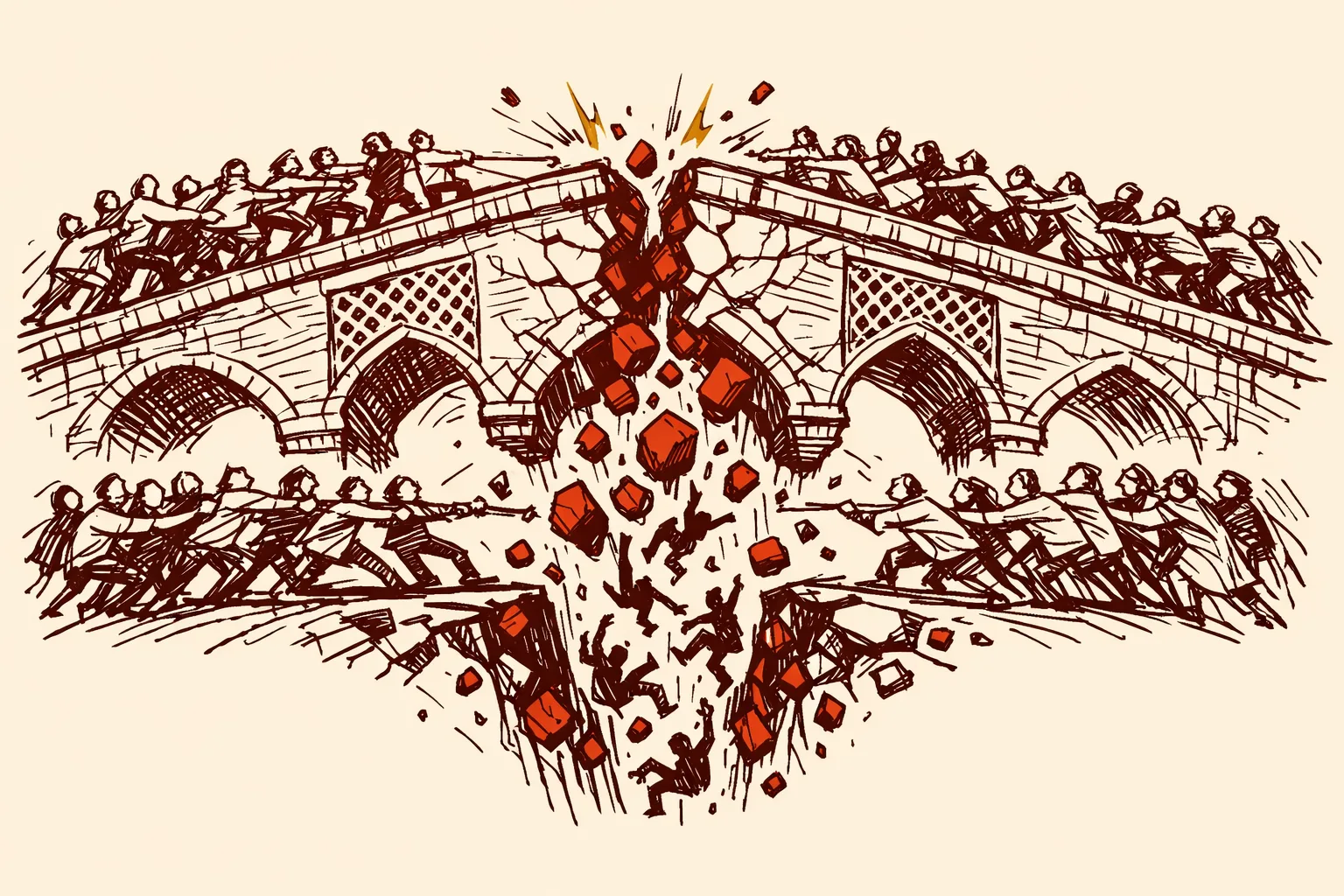
In the years after World War One, Gandhi made a fateful decision. He backed the Khilafat Movement - a pan-Islamic campaign to restore the Ottoman Caliph, whose empire had just been defeated and dismembered by the British and their allies.
Gandhi did not believe in a caliphate. His support was purely tactical. He wanted to bring Indian Muslims into the independence movement by championing something they cared about deeply. For a brief period, it worked. According to Britannica, the period between 1919 and 1922 is widely seen as the high point of Hindu-Muslim unity in India's freedom struggle.
Then it collapsed - and the collapse was catastrophic.
In 1821, at the height of the movement, a group of Moplah Muslims in Malabar launched what Britannica calls a rebellion that "deeply stirred Hindu India." According to Foreign Affairs, the rebels tried to establish a small caliphate in southern India, killing or forcibly converting hundreds of Hindus. The British put down the uprising at a cost of over 2,300 rebels killed and 45,000 imprisoned.
Gandhi's response shocked many Hindu leaders. Koenraad Elst, in his book Gandhi and Godse: A Review and a Critique, documents how Gandhi called the Moplah perpetrators "brave, God-fearing" men and avoided condemning their actions against Hindus. Dr. Ambedkar, in Thoughts on Pakistan, documented the communal riots that followed the Khilafat movement's collapse as evidence of the failure of Gandhi's strategy.
By 1924, the Caliph had been abolished by Turkey's own reformers. The Khilafat Movement was dead. Muslim support for Gandhi largely evaporated. The alliance he had built on a religious foundation had no secular roots to survive on. Hindu-Muslim riots started after the Khilafat Movement's collapse at regular intervals and never truly ended until partition in 1947.
The Double Standard That Still Angers People
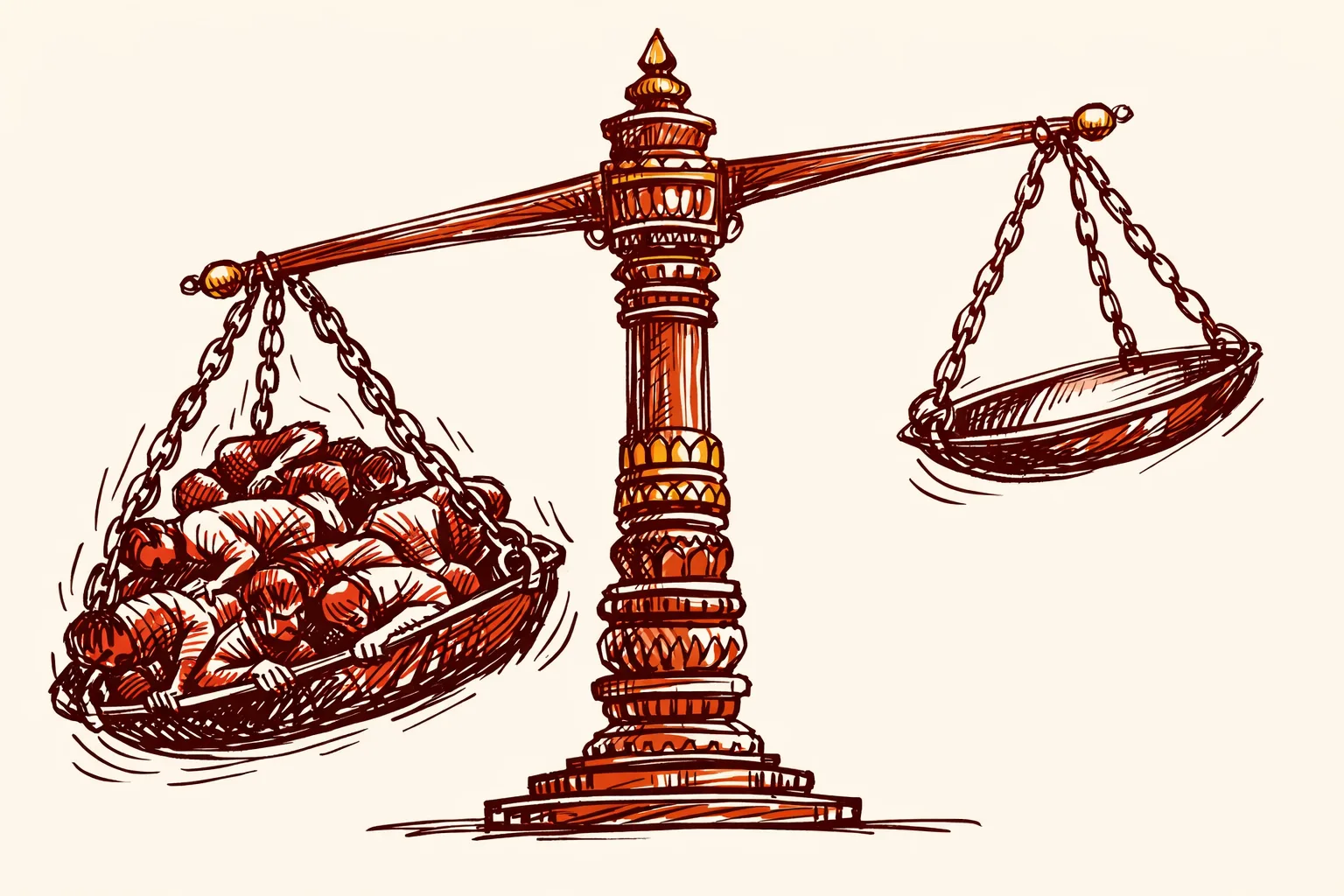
Gandhi used his most powerful weapon - the fast unto death - repeatedly. He fasted to stop Hindu-Muslim riots. He fasted to force the government to act. But he never once used this weapon to pressure Jinnah or the Muslim League to stop their drive toward partition.
Koenraad Elst documents that Godse pointed to this asymmetry as Gandhi's defining failure: Gandhi used his fasts to compel Hindus to bend, but never used them with the Muslim League to prevent partition or stop anti-Hindu massacres. Godse was wrong to kill Gandhi - his act was a crime, full stop. Whether the underlying political criticism had merit is a separate question. Many serious historians say it did.
After partition, Gandhi fasted in January of the following year with two conditions for ending the fast. The first was communal peace in Delhi. The second - added after a meeting with Viceroy Mountbatten - was that India pay Pakistan Rs 55 crore, the remaining share of the pre-partition treasury.
The timing was extraordinary. Pakistan had by then launched Operation Gulmarg - arming tribal militias to seize Kashmir. Indian soldiers were fighting and dying. Prime Minister Nehru and other leaders had frozen the payment as leverage. Industrialist Ghanshyam Das Birla warned Gandhi directly that the money would be used to buy weapons against India. Gandhi did not budge. The government capitulated. The Rs 55 crore was paid. Pakistan did not change its military position in Kashmir.
Gandhi's supporters argue that the payment was a pre-agreed financial obligation from the partition settlement, not a gift. That is technically accurate. But Sardar Patel had made a deliberate decision to withhold it as diplomatic pressure while the war was active. Gandhi's fast reversed that decision. The consequence was real regardless of the intent.
What Ambedkar Actually Said
Dr. B.R. Ambedkar - the father of India's Constitution, a man nobody can accuse of Hindu bias - wrote Thoughts on Pakistan in the early 1940s. His conclusion about Gandhi and the Congress leadership was unsparing. Ambedkar documented what he called the record of twenty years of civil war between Hindus and Muslims, citing Government of India annual reports to Parliament. He believed Gandhi's strategy of appeasing Muslim political demands without extracting reciprocal commitments had strengthened the Muslim League's hand, not weakened it.
Ambedkar also criticised Gandhi for using the fast to coerce Hindus and the Congress, but never deploying it against the Muslim League when they were driving toward partition.
The Case for Gandhi
Gandhi went to Noakhali and Calcutta personally, walking through villages where communal violence had occurred, to stop the killing. According to the Institute of South Asian Studies at the National University of Singapore, Gandhi came to Calcutta personally during the Great Calcutta Killings and his efforts helped restore peace to that bleeding city. He was willing to stake his life for communal harmony - in both directions.
According to Wikipedia's detailed record, Gandhi was not part of the final decision to accept partition. The June agreement was signed by Nehru, Vallabhbhai Patel, and J.B. Kripalani on behalf of Congress - in stark opposition to Gandhi's stated position. Gandhi was politically sidelined at the moment the country was divided.
The Oxford academic B.R. Nanda, in Gandhi and his Critics, notes that the conflict between Hindus and Muslims predated Gandhi's emergence in Indian politics by decades. Gandhi did not create the communal divide. He inherited it, tried to manage it, and failed - but whether anyone could have succeeded is one historians still debate.
What the Honest Assessment Looks Like
Gandhi was not the cause of partition. The British divide-and-rule strategy, the two-nation theory championed by Jinnah and the Muslim League, the Congress leadership's eventual acceptance of division as the only alternative to civil war - all of these were larger forces.
But Gandhi made specific choices that had specific consequences. He backed the Khilafat Movement tactically and it produced communal riots that deepened the divide. When anti-Hindu violence came, his response was to counsel Hindus toward non-violence and non-retaliation - a standard he never made a condition of Muslim League cooperation. He fasted to deliver Rs 55 crore to a country that was actively attacking India in Kashmir.
These are not invented grievances. They are documented by Ambedkar, by Sardar Patel's letters, by the government communiques of the day. The people angered by these choices were not all communalists or fanatics. Some of them were the sharpest legal and economic minds India had produced.
The Books You Should Read
Dr. B.R. Ambedkar's Pakistan or the Partition of India (also published as Thoughts on Pakistan) is the most rigorous economic and political analysis of the partition question written before it happened. It is available in print and online through the Marxists Internet Archive.
Koenraad Elst's Gandhi and Godse: A Review and a Critique, published by Voice of India, analyses Godse's courtroom speech against Gandhi's political decisions. Elst is a Belgian Indologist with a PhD from the Catholic University of Leuven. His analysis is polemical and contested - mainstream historians criticise him sharply - but the specific decisions he documents are drawn from primary sources.
B.R. Nanda's Gandhi and his Critics, published by Oxford University Press, is the scholarly counterpoint.
For the specific figures on the Rs 55 crore controversy, the Bharatdocs historical analysis and the Gandhi Manibhavan FAQ both document the event from opposite perspectives, using government documents from the period.
Why This Matters for India Today
Pakistan was created with religious separatism as its founding principle. It has funded terrorism inside India, backed insurgencies in Kashmir, and provided ideological cover for violence against Hindus inside Pakistan and Bangladesh for seven decades.
A leadership that tells one community to always absorb violence without retaliation while never demanding the same of the other community does not create peace. It creates resentment that festers for generations.
The National War Memorial, the Partition Horrors Remembrance Day instituted under the present government, the honest acknowledgment of what Hindus and Sikhs suffered in 1947 - these are attempts to let India grieve its real history instead of a sanitised version of it. A civilisation that mourns its real losses is stronger than one that pretends they did not happen.
Who Is Accountable
The Indian Council of Historical Research (under the Ministry of Education) controls what gets taught about partition in Indian schools and universities. For decades, the curriculum gave students a sanitised version that erased Hindu suffering and avoided any critical examination of Congress-era decisions. This is slowly changing. Full accountability requires the history curriculum to present Ambedkar's documented criticisms alongside Gandhi's stated intentions - without suppressing either.

What Needs to Happen
India's school curriculum should teach partition history from primary sources - including Ambedkar's Thoughts on Pakistan, Patel's letters, and the government documents from January 1948. Not to condemn Gandhi, but to give students the full picture.
Partition Horrors Remembrance Day should be treated as seriously as Independence Day. The suffering of Hindus and Sikhs who were killed, displaced, and terrorised deserves the same national acknowledgment as the liberation from British rule.
The honest conversation about Gandhi's specific decisions - the Khilafat gamble, the asymmetric application of non-violence, the Rs 55 crore fast - should be taught as a case study in what happens when idealism is not grounded in strategic clarity. Gandhi was not evil. But his choices had consequences that cost India dearly. Acknowledging that is not disrespect. It is the beginning of wisdom.