
On April 1, four astronauts climbed into a capsule called Orion and flew around the Moon. They traveled over 406,000 kilometers from Earth - farther than any human has gone since Apollo 13 in 1970. They came back safely. The mission, called Artemis II, was the first crewed flight beyond low Earth orbit in over 50 years.
India was not on that crew. Growing up in Chamba and then Chandigarh, I watched ISRO launches on Doordarshan with the same pride my father watched cricket - and I can tell you the stakes here run deeper than most coverage suggests. The difference now is the ambition has grown to match the pride. India is in the room, and it needs to act like it.
What Artemis II Actually Is
Artemis II is NASA's first crewed test of its Space Launch System rocket and Orion spacecraft. Commander Reid Wiseman and pilot Victor Glover led the crew, with mission specialist Christina Koch and Canadian Jeremy Hansen completing it - all four flew a free-return path around the far side of the Moon before returning to Earth for splashdown. The mission launched April 1. It landed near San Diego on April 10.
The Artemis II crew broke the record set by Apollo 13, reaching a maximum distance of about 406,780 kilometers from Earth - the farthest any human has traveled in space.
The first crewed lunar landing is a separate mission entirely. That is planned for Artemis IV, after a docking test mission. Artemis II is the proof-of-life test - it says the hardware works and humans can fly this far again.
Artemis II tells every space agency on Earth that the next phase is open. The race to the Moon's south pole - where water ice sits frozen in craters that have never seen sunlight - has a real timeline now. China wants to land by . America is targeting . India's plan puts Indian astronauts on the Moon by 2040.
Where India Stands Right Now
India's position is stronger than it looks from the outside. Three things make India a genuine player in the new lunar economy - not a spectator.
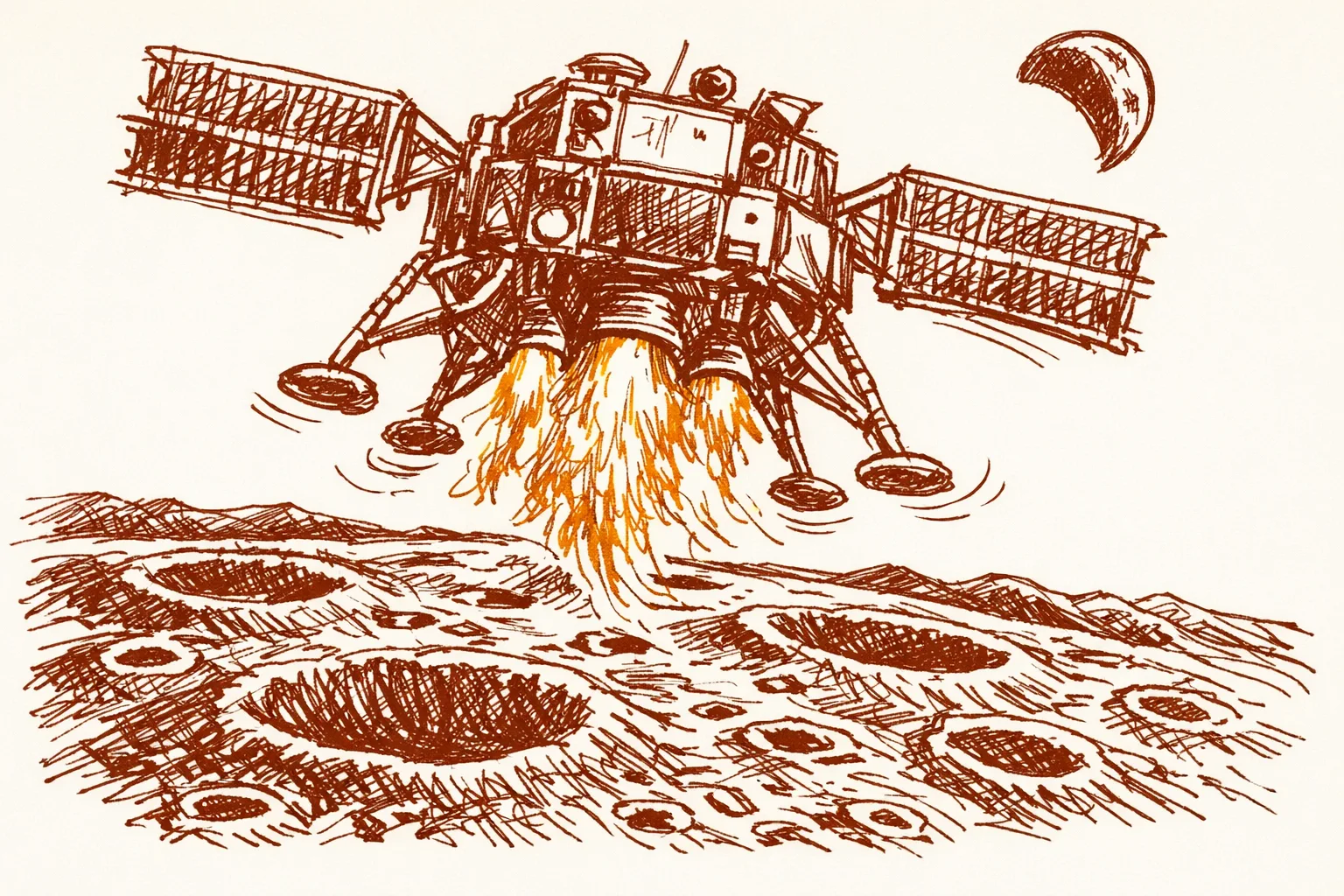
First, India already landed on the Moon's south pole. Chandrayaan-3 touched down in August 2023, making India the first country to land a spacecraft near the lunar south polar region. That is the exact territory the US and China are racing to reach with humans.
Second, India signed the Artemis Accords. Prime Minister Narendra Modi signed the Accords during his state visit to the US, making India part of the US-led framework for peaceful and cooperative lunar exploration. The Accords - signed by 61 countries as of January this year - set rules for how nations share data, mark off safety zones, and use lunar resources. Being inside this framework means India helps write the rules of the next chapter of space history, not just follow them.
Third, India and NASA already built something together. The NISAR satellite - a joint Earth-observation mission between NASA and ISRO - launched from Sriharikota in July aboard an Indian rocket. It is the first time the two agencies co-developed hardware for an Earth-observing mission. ISRO built the satellite body and S-band radar. NASA's Jet Propulsion Laboratory built the L-band radar. Two engineering teams delivered a $1.5 billion satellite together across 13 time zones.
The Scale of What Is Ahead
India's government has approved a lunar human mission by 2040. Before that, ISRO plans to launch the Gaganyaan crewed mission in . A national space station, the Bharatiya Antariksh Station, is planned for .
The revised Gaganyaan programme has a total approved budget of Rs 20,193 crore. That covers crew modules, human-rated rockets, three uncrewed test flights, and the first crewed mission.
Indian astronaut Group Captain Shubhanshu Shukla flew to the International Space Station on Axiom Mission 4 in June, becoming the second Indian in space. His mission was specifically designed to build experience for Gaganyaan.
India's space economy is valued at about $8.4 billion and is expected to reach $40-45 billion in the next eight to ten years. The number of space startups has grown from single digits to 399, following the opening of the sector to private companies after 2019.
What Has Already Been Done to Build This Ecosystem
The decisive reform was the creation of IN-SPACe - the Indian National Space Promotion and Authorisation Centre - in 2020. IN-SPACe acts as a single-window body that gives private companies access to ISRO infrastructure, test facilities, and launch support. Before IN-SPACe, the private sector could not independently build or launch rockets in India.
Skyroot Aerospace launched India's first privately developed rocket, the Vikram-S, from Sriharikota in November 2022. Agnikul Cosmos followed in June with India's first private launchpad. These are not government programs. They are Indian startups building hardware and flying it.
The Indian Space Policy 2023 allows 100% foreign direct investment in satellite manufacturing. A Rs 1,000 crore venture capital fund for space startups was launched. ISRO has transferred over 70 technologies to private industry.
In January, India demonstrated autonomous satellite docking - becoming only the fourth nation to do so. Docking is essential for any crewed lunar mission.
The Young Blood Coming Home
India's private aerospace sector is actively recruiting Indian engineers who have worked at GE, Pratt and Whitney, Rolls-Royce, and NASA-linked contractors. Companies like Tata, Mahindra, Godrej Aerospace, and L&T need world-class propulsion and materials expertise - and they are finding it among Indians who trained abroad and now want to build something at home.
Young Indian engineers who watched the Chandrayaan-3 landing from San Jose or Houston are asking a question they did not ask a decade ago: could I build this back home? The honest answer is increasingly yes.

How the US Built Its Model - and What India Can Learn
NASA did not build Artemis alone. The Space Launch System and Orion capsule are government-led, but the landing system is commercial. SpaceX is building a lunar version of Starship under a NASA contract. Blue Origin is building its own lunar lander. NASA sets the mission. Private industry builds hardware on fixed-price contracts.
NASA's annual budget is about $25 billion, but commercial space activity in the US generates far more. The government does not need to build everything itself. It needs to define the mission clearly and pay for results, not hours.
India's IN-SPACe model is pointed in this direction. The gap is speed. Experienced NRI aerospace engineers willing to take lower salaries are being blocked by rigid exam-based government hiring processes. A bureaucratic process is blocking technical progress. That is fixable.
Who Is Accountable
The Department of Space, headed by Prime Minister Modi in his capacity as the Minister in charge, owns the mission. IN-SPACe, under Secretary Pawan Kumar Goenka, is responsible for private sector facilitation. ISRO Chairman V. Narayanan is accountable for Gaganyaan, Chandrayaan-4, and the crewed lunar road map. The budget allocation for the revised Gaganyaan programme stands at Rs 20,193 crore. A Rs 1,000 crore venture capital fund has been allocated for space startups, and a separate Rs 2,104 crore has been approved for Chandrayaan-4.
What Would It Cost
ISRO's total annual budget is about $1.6 billion - compared to NASA's $25 billion. India's cost advantage is real. ISRO's Mars mission cost $74 million. NASA's Maven mission to Mars cost $671 million.
The full lunar human programme has not been publicly costed in total. But if India does not capture 8-10% of the global space economy - the target stated by ISRO Chairman Narayanan - India leaves tens of billions of dollars in high-value manufacturing and services to other nations. The space economy generates a multiplier of $2.54 for every dollar earned.
What Needs to Happen
Three things need to happen now.
First, the government must fix the hiring process for experienced aerospace professionals. Engineers with patents and project experience from foreign programs should be able to join ISRO-linked institutes and private companies through experience-based review, not exam queues. This is a small regulatory change with large consequences.
Second, India must use its Artemis Accords membership actively. The Accords open access to data sharing, joint mission planning, and interoperability with NASA, the European Space Agency, and Japan's space agency. India should be proposing joint lunar surface payloads, contributing instruments to Artemis missions, and deepening the NISAR-style hardware partnership into the lunar domain.
Third, the private sector needs consistent launch opportunities to build reliability. ISRO should shift commercial satellite launches to the private sector - through New Space India Ltd - so ISRO engineers can focus entirely on human spaceflight and deep space missions.
What comes next is execution.