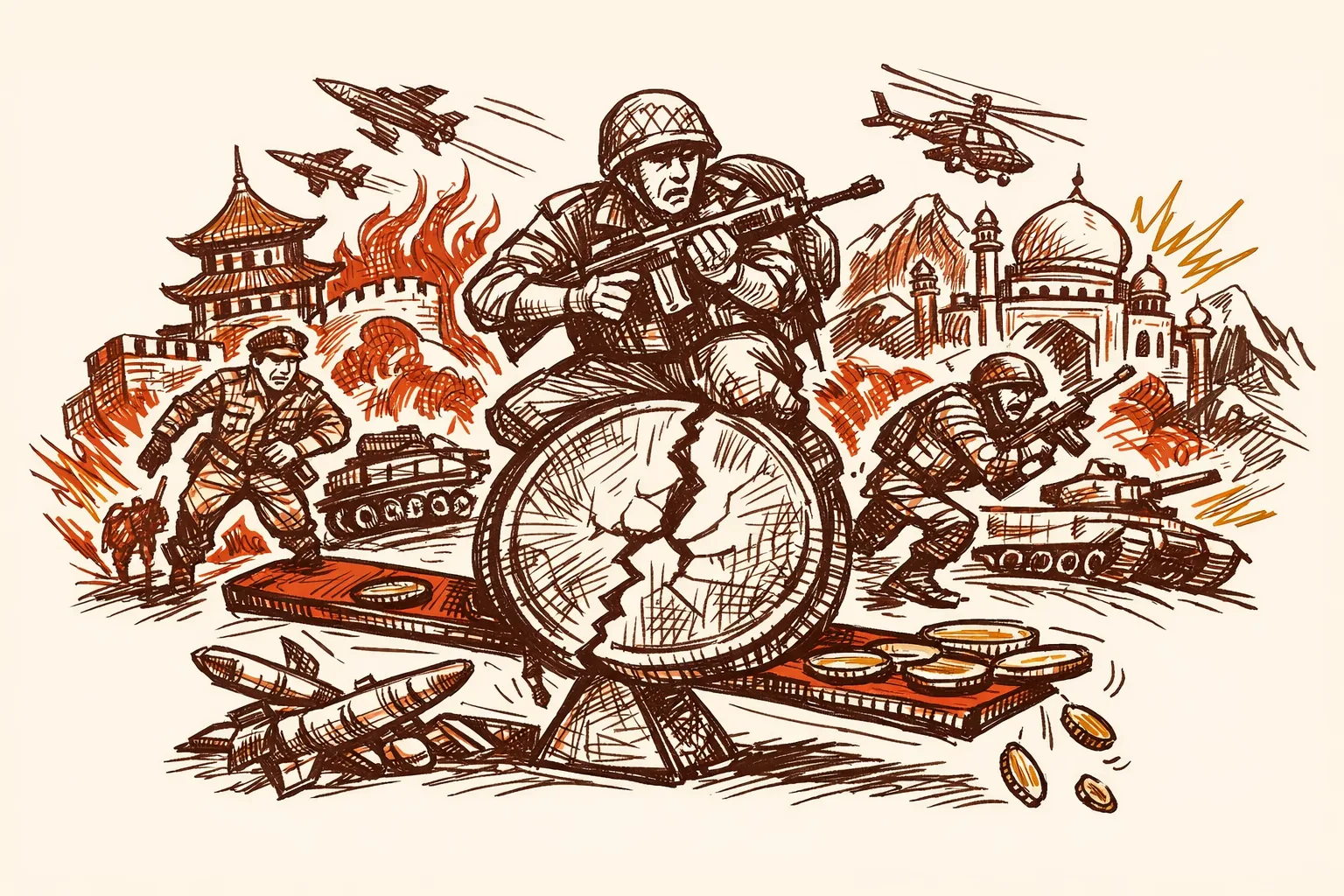
Stand at Leh's airport in Ladakh - where civilian flights share a runway with military cargo planes, and soldiers move supplies by hand to posts that sit above 15,000 feet - and the scale of India's defense challenge becomes very real. A two-front war fought simultaneously against China and Pakistan is what you see from that runway.
India faces a coordinated threat from two directions at once. China sits on the northern border with the world's second-largest defense budget. Pakistan sits to the west, armed with Chinese drones and Chinese jets. Both have shown they will act together. The Pahalgam terror attack and Operation Sindoor made that clear.
India's military is ready to fight. The question is whether the defense budget is ready to fund a long one.
The Scale of the Problem
India's defense budget has fallen steadily from 4 percent of its GDP in the late 1980s to under 2 percent today, according to analysis published by The Diplomat. The current allocation at roughly 1.9 percent of GDP is the lowest since 1960 as a share of national output, according to The Print, citing retired Lieutenant General H.S. Panag.
The numbers in absolute terms: India's defense budget for the current financial year is approximately Rs 7.85 lakh crore - about USD 86 to 94 billion. Then compare it to China. China's official defense budget is USD 277 billion. The Stockholm International Peace Research Institute estimates China's actual defense spending at about USD 318 billion, according to CSIS.
India's budget is roughly one-third of China's declared figure. Against a coordinated China-Pakistan threat, that ratio matters.
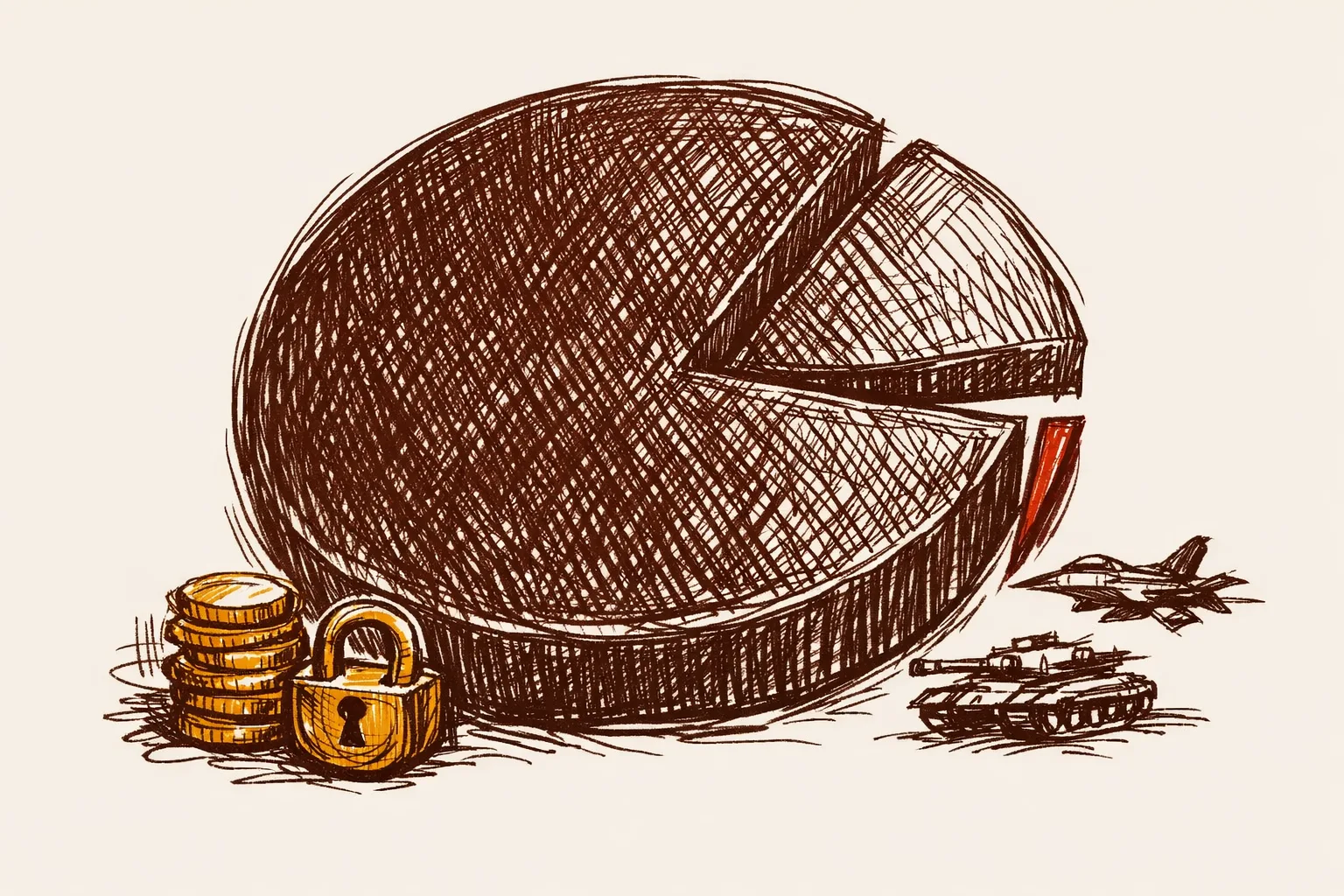
The structure of India's spending makes this worse. About 46 percent of the defense budget goes to salaries and operations. Another 24 percent covers pensions. That leaves only 26 percent for buying new equipment.
The Indian Air Force operates just 30 fighter squadrons, well below its sanctioned strength of 42.5. Delays in the domestic Tejas fighter jet program have widened this gap. The Indian Army's artillery and rocket systems remain inadequate. The Navy faces gaps in mine detection and mine-clearing capability.
The gap between what the armed forces request and what they actually receive has been 17 to 23 percent annually, according to The Print.
What Operation Sindoor Proved - and What It Exposed
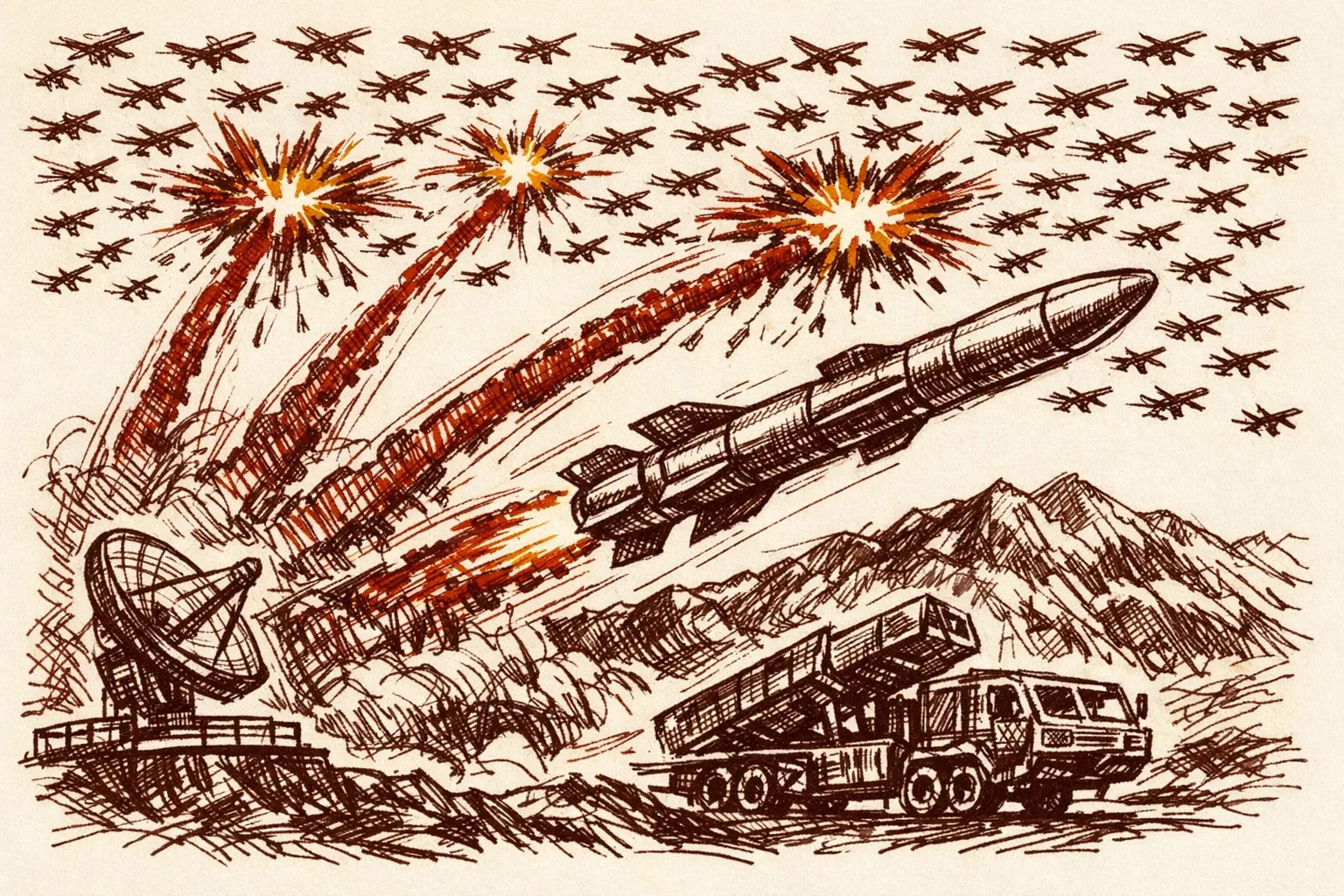
In May, after the Pahalgam terrorist attack that killed 26 civilians, India launched Operation Sindoor. According to the government's Press Information Bureau, the Indian Air Force bypassed and jammed Pakistan's Chinese-supplied air defense systems, completing the mission in 23 minutes. India's indigenous systems - BrahMos cruise missiles, the Akash air defense network, and loitering munitions from domestic manufacturers - performed well.
The Carnegie Endowment for International Peace documented that India's layered air defense network proved resilient when Indian Army and Air Force networks worked together to intercept a volley of over 600 drones fired across India's western front.
But War on the Rocks documented serious gaps as well: weaknesses in counter-drone systems, intelligence and surveillance coverage, communications in a contested electronic environment, speed of sensor-to-shooter targeting, and long-range strike capacity. Pakistan's drone volleys challenged India's ability to efficiently task air defense assets, and many of India's own drone systems were operating on vulnerable, open radio frequencies.
The post-Sindoor response has been fast. India's defense expenditure reached its highest level in six years. Out of a total capital outlay of Rs 1,80,000 crore, the Defense Ministry disbursed Rs 1,11,374.67 crore in the first eight months alone. Emergency procurement contracts covered remotely piloted aircraft, loitering munitions, counter-drone technology, and very short range air defense systems.
Emergency procurement is always more expensive than planned procurement. India needs a defense budget large enough to buy this equipment before the crisis, not during it.
Why the Budget Has Stayed This Low
The core structural problem is pension spending. The defense pension bill consumes approximately 24 percent of the total defense allocation, according to the Delhi Policy Group. This leaves the capital budget squeezed.
The Kargil Review Committee, writing in 1999, recommended reducing pension expenditure as a share of defense spending. That recommendation has not been implemented.
Procurement delays compound the problem. The submarine procurement program known as Project 75(I) - conceived in the early 2000s - took nearly six years after the Defense Acquisition Procedure of 2020 to reach contract signing. A procurement cycle that spans 20 years from concept to contract is not suited to a world of drone swarms and artificial intelligence warfare.
Research and development spending is also thin. The Defense Research and Development Organisation received only 3.94 percent of the total defense budget, according to the Delhi Policy Group. That is not enough to build the technology edge India needs against China's advances in hypersonic weapons, space warfare, and cyber capabilities.
There is no legal commitment to a minimum defense budget. The Ministry of Finance told a parliamentary committee that defense expenditure cannot be fixed as a percentage of GDP because resources are allocated on a need basis.
What Has Already Been Tried
India has attempted defense reform many times. The record is mixed.
Kargil Review Committee (1999) - Partially Implemented. After Pakistan's intrusion in Kargil, Prime Minister Vajpayee set up a committee led by K. Subrahmanyam. It found that India's national security system had seen very little change since 1947. Real action followed: a new Defense Intelligence Agency, the National Technical Research Organisation, improved surveillance satellites, and the Integrated Defense Staff were all created. But the central recommendation - a Chief of Defense Staff - sat unimplemented for two full decades.
Shekatkar Committee (2016) - Adopted in Principle, Slow in Practice. The Shekatkar Committee recommended reducing India's 17 single-service commands to 3 integrated theater commands. The proposal was accepted in principle. Implementation has moved slowly, held up by inter-service disagreements over command hierarchy and career structures.
Chief of Defense Staff Created (2019) - A Real Step Forward. Prime Minister Modi announced the Chief of Defense Staff position in 2019 - the largest structural change in India's higher defense management since independence. General Bipin Rawat was the first to hold the post. A new Department of Military Affairs was created alongside it to handle joint procurement, training, and restructuring.
Inter-Services Organisation Act (2023) - Enacted. Parliament passed the Inter-Services Organisation Act in 2023, giving commanders of joint organizations authority to issue orders and exercise discipline over personnel from all three services. This was a necessary legal foundation for theater commands.
Theater Commands - Moving Now. India is on the verge of operationalizing three integrated theater commands before the current Chief of Defense Staff General Anil Chauhan completes his term. The first theater command is expected to be operational by May, General Chauhan confirmed. The Defense Ministry has declared the current year the Year of Reforms, with theater commands as the primary target.
How Other Countries Fixed This
The United States - Goldwater-Nichols Act (1986)
Before 1986, the US military had the same problem India has today. Each service operated in its own lane. The 1983 invasion of Grenada exposed this: different services could not communicate, could not coordinate, and nearly bungled an operation against a tiny island nation.
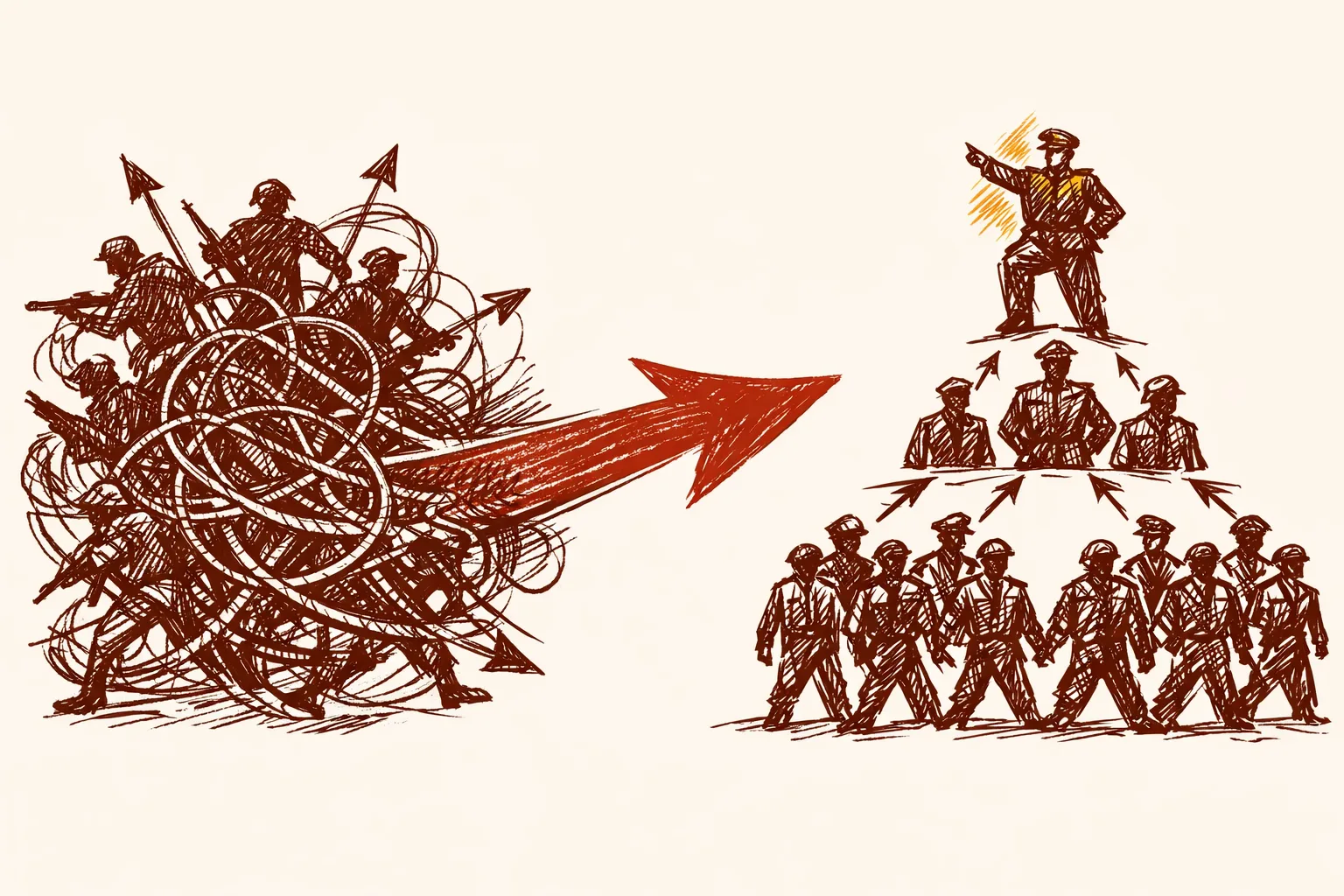
The Goldwater-Nichols Act of 1986 fixed this in one legislative action. The law streamlined the military chain of command to run directly from the President through the Defense Secretary to combatant commanders - bypassing individual service chiefs in operational matters. Service chiefs were given a new role: recruit, train, and equip forces. Regional commanders ran actual operations.
The result: when the US fought the Gulf War in 1991, joint command worked. One commander, clear authority, all services coordinated.
India's theater command reform is following the same logic. The US did it by law in one year. India has been discussing it for 25 years.
China - PLA Reorganization (2016)
In 2015, President Xi Jinping reorganized China's military into five integrated theater commands - each with authority over all services within its geographic area - and reduced ground forces by 300,000 troops to free up money for technology. China is already fielding J-35A stealth jets and has supplied them to Pakistan.
Note China's own weaknesses: Xi Jinping's anti-corruption purges have removed two members of China's Central Military Commission since 2023. A military built on falsified readiness reports and procurement corruption has its own fragility. India's advantage is the integrity of its civil-military institutions.
Japan - Rapid Budget Expansion
Japan's military spending remained fixed at roughly 1 percent of GDP for decades. Then Japan committed to raising defense spending to 2 percent of GDP, with spending already reaching 1.4 percent on that path. The trigger was a realistic assessment of China's military expansion and North Korea's missile program. Japan proved that a country can change its defense spending trajectory quickly when political will exists.
Who Is Accountable
The Ministry of Defense controls the defense budget. The Ministry of Finance sets the overall envelope within which defense must compete. The Department of Military Affairs, headed by the Chief of Defense Staff, is responsible for theater command implementation and joint procurement reform. The Defense Research and Development Organisation is accountable for indigenous weapons development - and currently receives only 3.94 percent of the total defense allocation. The Border Roads Organisation received Rs 7,146.50 crore in the current budget, a 9.74 percent increase, for border infrastructure - that allocation is working.
What Would It Cost
According to Lieutenant General Panag, an allocation of 2.5 to 3 percent of GDP is essential to transform the armed forces for a two-front threat. At 2.5 percent of GDP, the defense budget would be approximately USD 100 billion - roughly Rs 1 lakh crore more than the current allocation.
An increase of just 0.5 percent of GDP would double the capital defense budget - the portion used to actually buy weapons.
The post-Sindoor defense budget is set at Rs 7.85 lakh crore, a 15.19 percent increase and the largest allocation ever. The question is whether it is sustained and whether the procurement process can actually spend the money on time.
What Needs to Happen
First, commit to a floor. India needs a political commitment that defense will not fall below 2.5 percent of GDP. Every government from independence through 2010 delivered this. The floor creates predictability that arms manufacturers and planners need to build long-term capacity.
Second, complete theater commands this year. The proposal is mature. General Chauhan has confirmed the first command is ready to activate. The US took one year to restructure its military by law. India has spent 25 years in discussion.
Third, cut procurement timelines in half. A 20-year cycle from need to contract is not a procurement system. Emergency procurement under Operation Sindoor showed India can move fast when required. That speed should become the standard. The Ministry of Defense's post-Sindoor performance clauses in emergency contracts - which allow cancellation if delivery targets are missed - are the right model.
Fourth, double the defense research and development budget. At 3.94 percent of the defense allocation, the Defense Research and Development Organisation cannot build the next generation of weapons India needs. Private sector defense firms need faster access to funding and faster trial clearances.
Fifth, fix the pension drag. The Kargil Review Committee identified this problem in 1999. Moving to a contributory pension scheme for new recruits - as was done for civil servants - would free significant capital budget over time without reducing benefits for serving veterans.
Operation Sindoor validated indigenous technology. Defense exports crossed Rs 24,000 crore in the last financial year, with a target to reach Rs 50,000 crore. A defense industry that exports stays funded, stays competitive, and stays ready.
The civilization that built the BrahMos missile domestically for Rs 80 crore when Russia quoted Rs 1,300 crore for the same job does not have an innovation problem. It has a budget commitment problem. Fix the budget floor, complete the commands, and let India's engineers and soldiers do the rest.