The Problem You Feel Every Festival Season
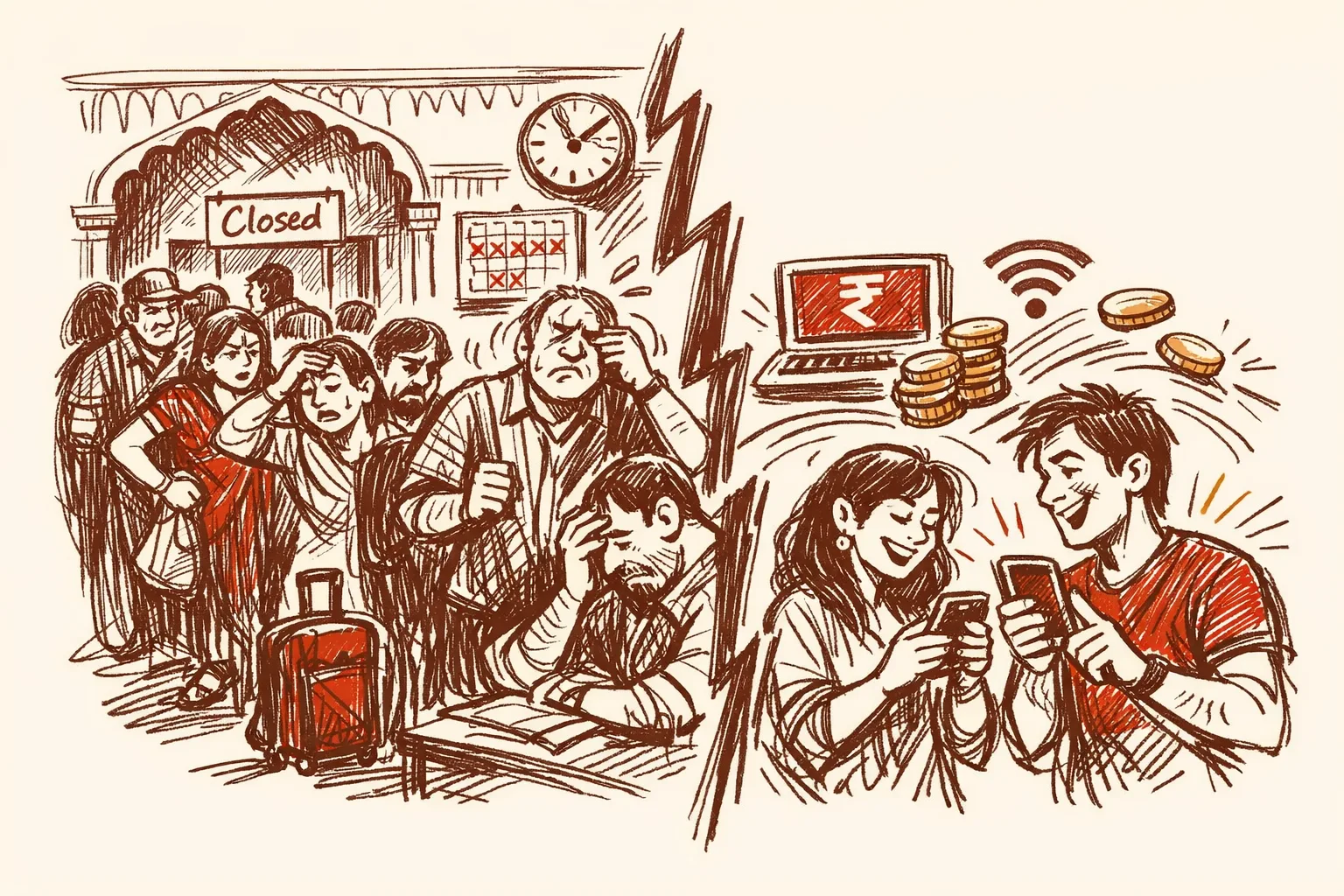
It is the week before Diwali. A small business owner in Kanpur needs to transfer funds to pay her supplier. The branch is closed for a state holiday. The cheque she deposited on Wednesday will not clear until Monday. That is five days of her working capital sitting frozen.
But there is a second problem that happens even when there is no holiday at all. You walk into a bank branch at 1:30 in the afternoon. Every counter is empty. Staff are at lunch. Nobody tells you how long to wait. You just stand there.
India has one of the highest volumes of bank holidays among major economies. The Reserve Bank of India (RBI) publishes a city-wise holiday matrix every year. Banks close on all Sundays, the second and fourth Saturdays of every month, national holidays, and a long list of state and regional festival holidays. In a single month, a bank branch in some states can be closed for 14 or more days.
For a salaried worker, that used to mean waiting for your pay. For a business owner, it meant frozen cash. A farmer with a loan EMI due on a bank holiday faced anxiety about penalties and nowhere to turn. India had a real bank holiday disruption problem. It is now being fixed. The lunch-hour problem is trickier. The rule is already clear. The enforcement is not.
The Lunch-Hour Problem Nobody Talks About
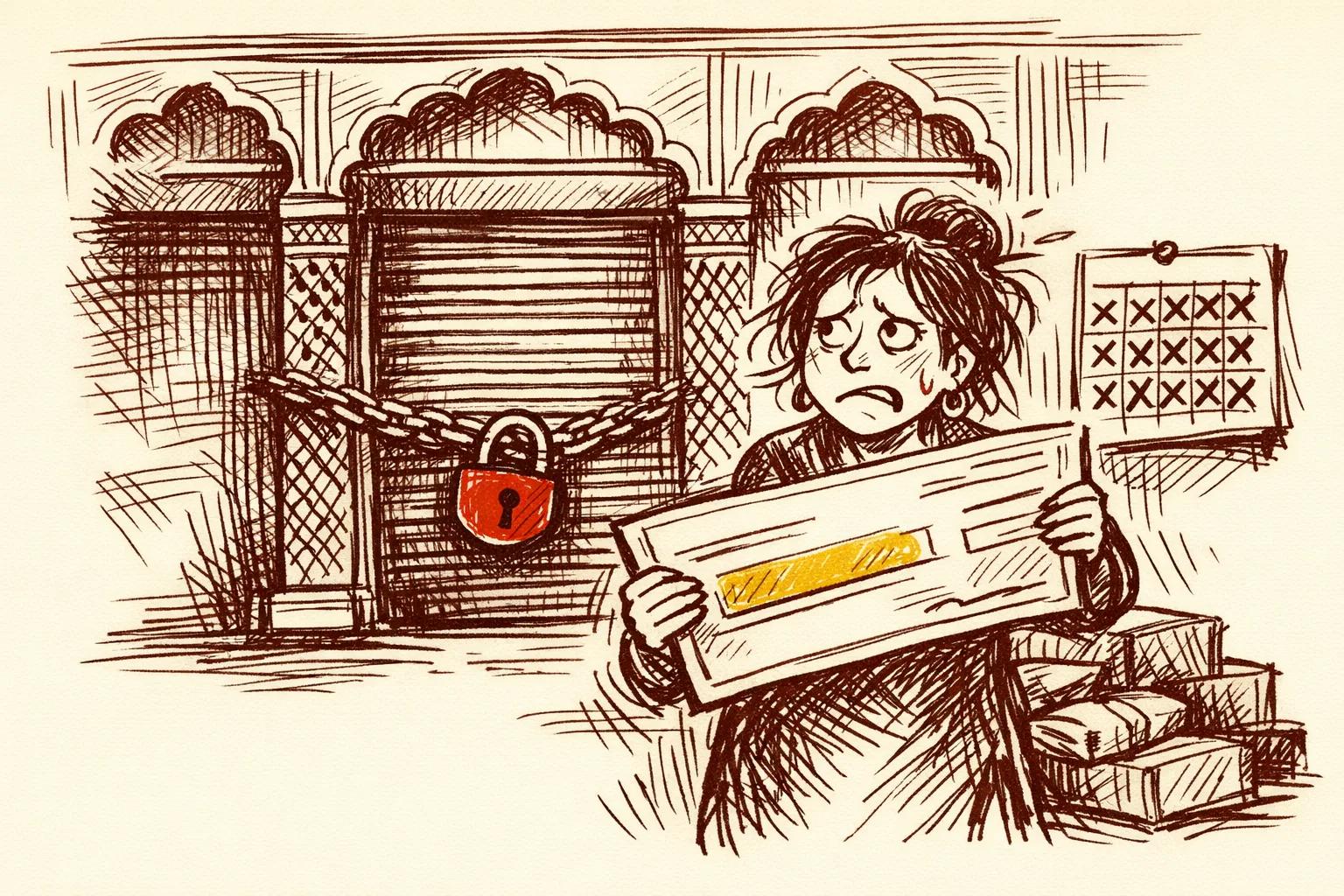
Walk into a bank in Chamba or Chandigarh at 1:30 in the afternoon. There is a good chance you will find counters empty and staff nowhere to be seen. No holiday. No system outage. Just everyone on lunch at the same time.
The RBI rule on this is not ambiguous. According to The Legal Shots, the RBI requires that service be available throughout banking hours and that no part of a bank should be completely closed during working hours. Punjab National Bank stated publicly on their official account that "as per RBI guidelines, there are no official lunch hours for bank branches" and that staff must take breaks in a staggered manner so operations continue without interruption.
According to Paisabazaar's banking guide, banks do not close during lunch hours and employees take their lunch breaks in batches so work is not affected. According to Moneygyaan's banking timings guide, the staggered break period typically runs between 1:00 PM and 3:00 PM - but the branch itself should never go fully dark.
So the rule exists. The problem is that in many branches across India, the rule is ignored. A customer who arrives at 1:30 PM and finds every counter empty has no easy way to report it in the moment. By the time they file a complaint, the delay already cost them time they cannot get back. A daily-wage worker who took half a day off to visit the branch is the one who pays for that failure.
According to The Legal Shots, customers who face a service interruption during banking hours can remind staff of the RBI guidelines, and if the problem continues, can file a complaint with the branch manager or through the bank's official grievance redressal channels. The RBI Ombudsman is also available if a complaint is not resolved by the bank within 30 days, as noted by the India.gov.in National Government Services Portal.
The fix here requires no new law and no new technology. It requires branch managers to enforce a rotation that is already mandated. And it requires banks to treat a mid-day counter shutdown as a disciplinary matter, not a routine inconvenience.
What Still Gets Disrupted
Digital payments in India run 24x7, every day of the year. UPI - India's Unified Payments Interface, built by the National Payments Corporation of India - has no holiday restrictions at all. According to ICICI Bank's official guidance, UPI services are available 24 hours a day, all seven days, throughout the year. That means person-to-person transfers, merchant payments, and bill payments all work on Diwali, on Republic Day, on any Saturday.
IMPS (Immediate Payment Service) also runs around the clock. So does RTGS (Real Time Gross Settlement) for large transfers.
But some things still stop on bank holidays. Cheque clearances halt completely. Account opening verification pauses. Certain loan documentation processes freeze. Cash deposits over the counter are not possible. And for small businesses that still operate partly on cheques - particularly in wholesale trade and real estate - a cluster of holidays means real disruption.
According to Paytm's banking guide, cheques deposited just before a bank holiday only begin processing on the next working day, which can delay funds by several days. In a real-world example: a tenant in Bengaluru deposits a rent cheque on the 13th. The 14th and 15th are state holidays in Karnataka. The cheque does not move until the 16th. The landlord calls. The tenant panics. This still happens.
For businesses, the Ministry of MSME's Annual Report found that over half of MSMEs reported cash flow issues - many tied to payment timing mismatches. When a bank holiday falls between a payment due date and a cheque clearance window, thin-margin businesses feel it immediately.
The Scale of the Holiday Calendar
According to IndiaBonds, there is no single pan-India figure - every city and state has its own holiday calendar on top of the national baseline. National holidays like Republic Day, Independence Day, and Gandhi Jayanti apply everywhere. State-specific holidays like Karnataka Rajyotsava (November 1) apply only locally.
Banks also close on the second and fourth Saturdays of every month - 24 Saturdays per year before counting a single festival. In some states, the total non-working days for a bank branch can approach 90 or more per year - roughly one in four calendar days.

What Has Already Been Tried - and What Worked
December 2019 - NEFT goes 24x7. The RBI announced that NEFT (National Electronic Funds Transfer) would operate around the clock on all days, including weekends and holidays, from December 16, 2019. This ended the old batch-settlement model that forced transactions to queue until the next working day.
August 2021 - NACH goes 24x7. The RBI extended 24x7 operations to NACH - the National Automated Clearing House, which handles salary credits, EMI debits, pension transfers, and government benefit payments. Before this change, if your salary credit was scheduled for a Sunday or a bank holiday, it would arrive only on the next working day. According to The Quint, the official RBI notice read: Effective 1 August 2021 all the sessions that are currently available on normal working days will be operational on all days including week end and other holidays. Overnight, millions of salary workers, pensioners, and loan borrowers stopped worrying about holiday-day timing.
UPI - continuous from launch. UPI was built holiday-blind from day one. Since its pilot launch in April 2016 by the NPCI, UPI has never had a holiday schedule. Today, according to Wikipedia citing NPCI data, UPI processes over 640 million transactions per day - more than Visa's 639 million. It accounts for 84% of all digital payments in India. The world's largest real-time payment system never closes.
The remaining friction - cheque clearing, in-branch services, complex loan documentation - is the residual of a paper-era system that UPI was designed to replace.
How Other Countries Fixed This
Hong Kong - Keeping Settlement Running on Holidays
Hong Kong's Real Time Gross Settlement system, known as HKD CHATS, has operated on all Hong Kong general holidays except January 1 since the system went live. According to the Hong Kong Monetary Authority's published report, CHATS has been operating on all Hong Kong general holidays, allowing international banks to process regional payments without interruption even when local offices are closed. The lesson - separate the settlement engine from the branch calendar - is one India has adopted.
The United Kingdom - Faster Payments with No Holiday Gap
The UK's Faster Payments Service processes retail payments in seconds, 24x7, including bank holidays. Transfers between accounts complete in under two minutes on Christmas Day the same as on a Tuesday in March. India's UPI mirrors this design exactly - and at a far larger scale. Where the UK processes tens of millions of Faster Payments transactions daily, India's UPI processes over 640 million. India did not just copy the model. India built the biggest version of it.
Australia - The New Payments Platform
Australia launched its New Payments Platform in 2018, enabling real-time, 24x7 account-to-account transfers on all public holidays and weekends. Australia's model is notable because it also solved the cheque problem through a PayID system that replaced cheque-based identity matching. India has an equivalent through Aadhaar-linked payments and UPI IDs. The gap is the completion of migrating the remaining cheque-dependent workflows to digital rails.
Who Is Accountable
The RBI's Department of Payment and Settlement Systems is the single agency responsible for India's payment infrastructure. The Board for Regulation and Supervision of Payment and Settlement Systems sets all policy. The NPCI executes. For the remaining disruptions - cheque clearance windows, in-branch documentation delays, ATM cash shortages during extended holidays - accountability sits jointly with the RBI (system design), the Indian Banks' Association (operational standards), and individual bank CEOs (branch-level execution).
For the lunch-hour problem, accountability sits with branch managers directly. The RBI rule already requires staggered breaks. When a counter goes empty at 1:30 PM and stays empty for 90 minutes, that is a branch manager failing to enforce a rule that already exists. Nobody gets flagged for it. That is the real gap.
If ATM cash runs dry during a Diwali holiday cluster, that is a bank operations failure, not a systemic policy failure. The policy framework is sound. Branch-level execution is where gaps remain, and nobody gets fired for it.

What Would It Cost
India has already spent the bulk of what was needed. The UPI infrastructure is self-sustaining through NPCI, funded by member banks. The NACH 24x7 upgrade required no public budget allocation - it was a process change, not a capital investment.
Australia's New Payments Platform cost roughly AUD 1 billion to build from scratch. India built UPI for a fraction of that cost, achieved ten times the scale, and integrated 675 banks on one platform. According to the Press Information Bureau, UPI now serves 491 million individuals and 65 million merchants. The investment has already been made. What remains is adoption completion and operational discipline - not new spending.
The one real cost is ATM cash availability during holiday clusters. Banks need to pre-position cash before long weekends. This is a logistics and planning issue with a known solution that requires no new law.
The lunch-break enforcement problem costs nothing to fix. The rule is written. The staggered-break system is already the mandated approach. The only cost is a branch manager willing to enforce it - and a bank willing to hold that manager responsible when they do not.
What Needs to Happen
First, complete the shift from cheques to digital for business workflows. The NPCI should set a deadline for all commercial transactions above a threshold to move to UPI or RTGS. The government can lead by example - central and state governments should eliminate cheque issuance entirely for vendor payments.
Second, mandate pre-holiday ATM cash loading. The RBI should add a specific requirement: ATMs must be fully loaded at least 48 hours before any bank holiday lasting two or more days.
Third, standardize in-branch holiday coverage for urgent services. The RBI should require every district to have at least one bank branch open for a half-day on major state holidays - not all branches, just enough to ensure no district is completely without access during a five-day holiday cluster.
Fourth, enforce the lunch-break rule that already exists. The RBI and the Indian Banks' Association should require banks to log mid-day counter availability as a branch compliance metric. A branch where all counters go empty for more than 30 minutes during banking hours should be treated as a service failure. Customers who face this should be able to file a complaint on the spot - through the bank's app or the RBI's Integrated Ombudsman portal - without waiting until they get home. The rule is there. The enforcement mechanism needs teeth.