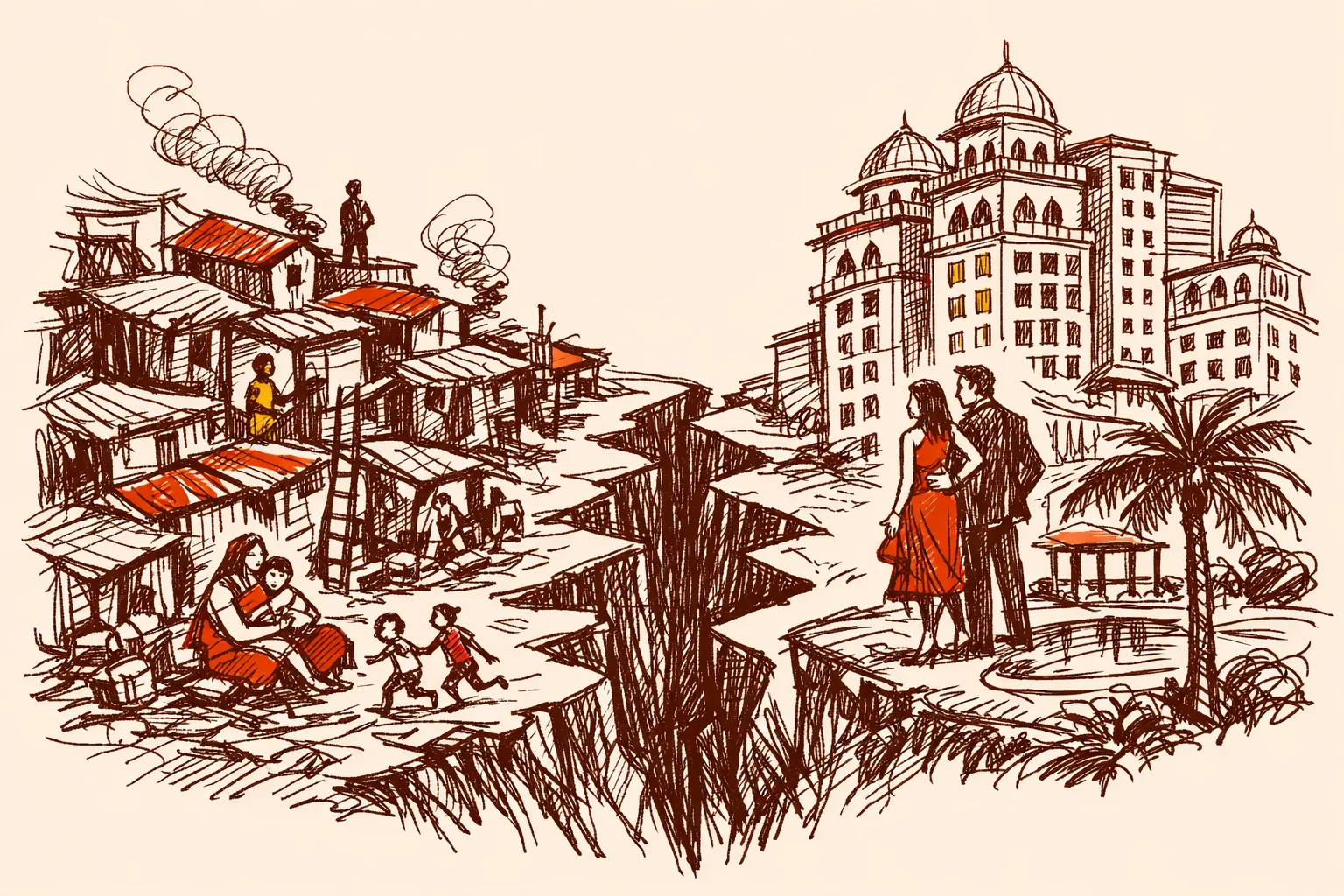
What You See Flying Into Mumbai
Fly into Mumbai and the first thing you notice, stretching below the flight path, is a dense patchwork of tin rooftops and grey brick. That is Dharavi - nearly a square mile of informal housing sitting between two of the city's main railway lines, home to close to one million people. It is one of the most densely packed places on Earth.
Dharavi is a symbol of a problem running through every major Indian city.
I grew up in Chamba, Himachal Pradesh - a small hill town far from any megacity. But I saw what happened when people migrated to urban areas chasing work. They did not find housing. They found whatever space was available. That is still true today.
The Scale of the Problem
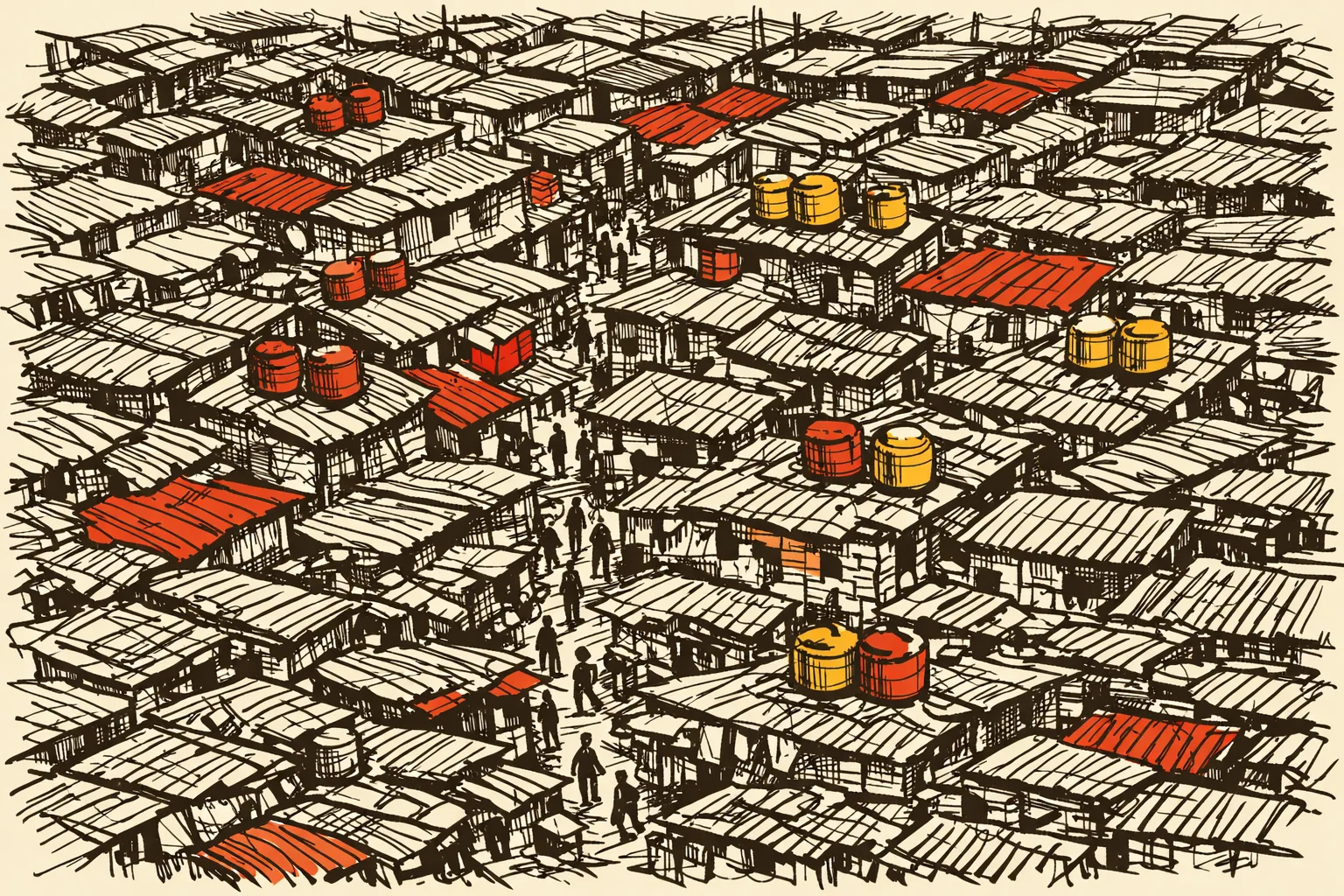
According to the last full slum census, conducted by the Registrar General of India in 2011, 65 million people lived in slums across urban areas. The government's own housing ministry data estimates approximately 14.2 million slum households exist across the country today, sheltering around 65 million individuals - about 17.4 percent of India's urban population.
The numbers are almost certainly undercounted. There are four different official definitions of slums in India alone, meaning the perceived size of the problem varies wildly depending on which definition you use. The last comprehensive slum census was in 2011. Policymakers are still working from that data.
According to the Observer Research Foundation, the urban housing shortage was 18.78 million houses for the period 2012-2017, and 95 percent of the gap was for low-income households. In Mumbai alone, the city constructs merely 20,000 apartments annually, while the requirement stands at 1 lakh.
According to India's National TB Elimination Programme data, TB disproportionately affects people living in urban slums where overcrowding and poor ventilation accelerate disease transmission. TB costs India an estimated $24 billion annually in lost productivity and healthcare expenses.
Why India Has Slums
Cities grow faster than their housing supply, and that is why slums exist.
The UN estimates India's urban population will nearly double from 461 million in 2018 to 877 million by 2050. Every year, millions of rural workers move to cities for work. They come to places like Dharavi, Govindpuri in Delhi, and similar settlements in Hyderabad and Chennai because those are the only places they can afford.
Households earning less than Rs 10,000 per month suffered 95 percent of the housing shortage. The formal market builds for buyers who exist. Workers earning Rs 10,000 a month are not those buyers. So they build their own.
According to the housing ministry, only 30 percent of urban land in India is appropriately planned. Zoning rules make dense, affordable housing near jobs nearly impossible to approve. Workers end up living in informal settlements close to work because the formal market has nothing for them.
The result: more than half of Mumbai's residents live in slums - in one of Asia's richest cities.
What Has Already Been Tried
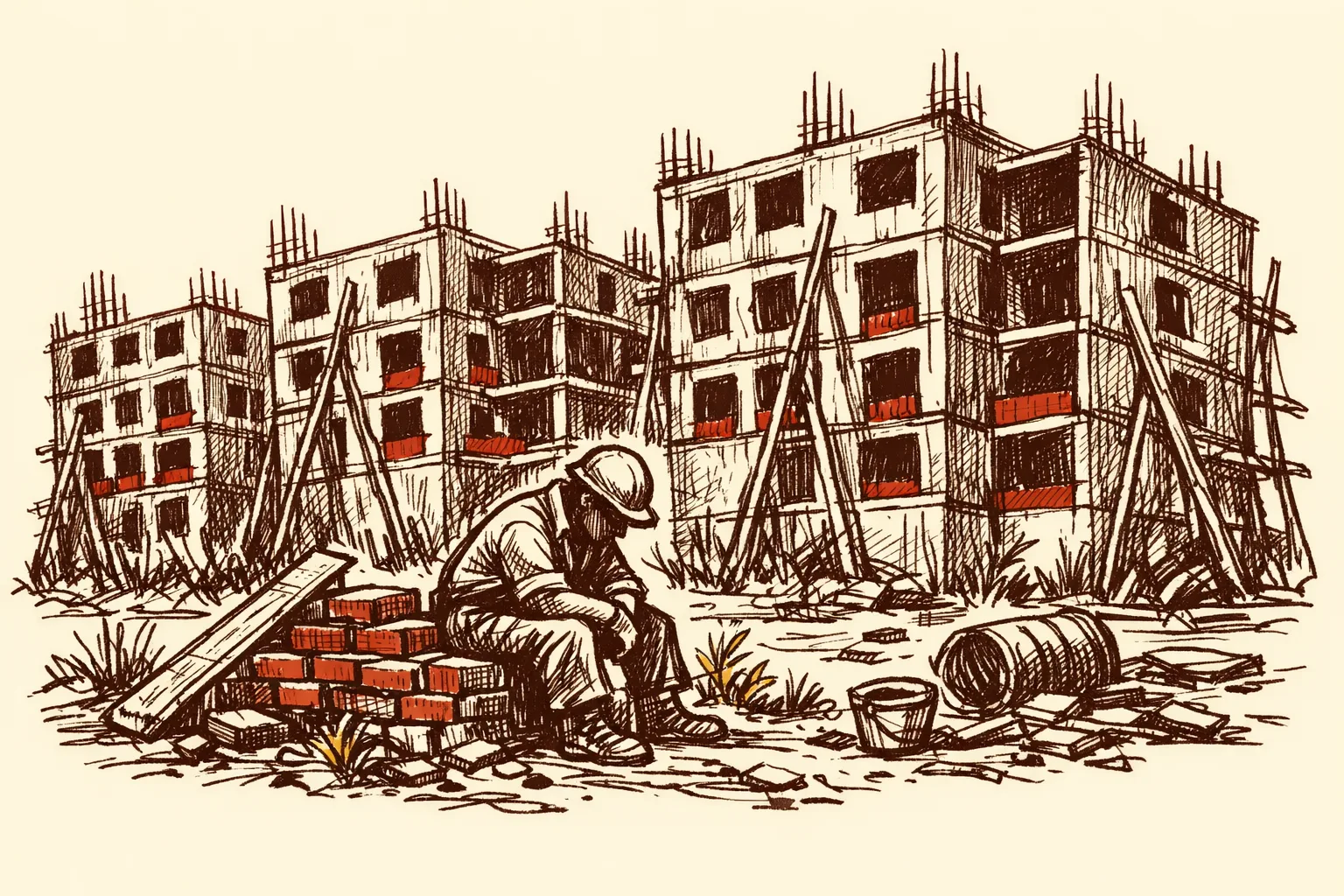
India has been trying to fix this for decades. The record is mixed - not because the ambition was wrong, but because execution repeatedly fell short.
JNNURM - the Jawaharlal Nehru National Urban Renewal Mission was launched by Prime Minister Manmohan Singh in 2005. It envisaged over $20 billion in urban investment over seven years. The Comptroller and Auditor General reviewed the results. Of 1,517 housing projects sanctioned, only 22 were completed. Of 1,298 urban infrastructure projects sanctioned, only 231 were completed. Urban local bodies had never developed the basic financial management systems the programme required. Funds were released. Houses did not come up.
Rajiv Awas Yojana explicitly aimed at a slum-free India by 2022. It was wound down without meeting its targets.
PMAY-Urban - Pradhan Mantri Awas Yojana is the Modi government's Housing for All mission, launched in 2015. The scheme has digital tracking, geo-tagging of every construction stage, and Direct Benefit Transfer so funds go directly to beneficiaries. According to the Parliamentary Standing Committee on Housing, of 123 lakh homes sanctioned, 107 lakh have been grounded for construction and 61 lakh have been delivered.
But the committee also found gaps. As of December 2022, 5.6 lakh completed homes had not been handed over because basic services like water and electricity were missing. Some states - including Rajasthan, Nagaland, Manipur, and Meghalaya - had not been releasing their matching share of funds, pushing the cost burden onto the poorest beneficiaries. And 60 percent of all sanctioned homes were under the beneficiary-led construction pathway, which only helps people who already own land. Slum dwellers who hold no title to the ground beneath their homes cannot use it.
The Dharavi Test Case
Dharavi is a 590-acre settlement in the heart of Mumbai, home to nearly one million people. Thousands of micro-enterprises - leather workshops, recycling units, garment factories, pottery kilns - generate an estimated $1 billion annually. Proposals to redevelop Dharavi date back to the 1950s. Every previous attempt collapsed due to lack of funding, lack of political will, or both.
The current project, awarded to the Adani Group through an open international bidding process in 2022, covers 646 acres. Residents who lived in Dharavi before 2000 will receive 350-square-foot homes free of cost. Those who arrived between 2000 and 2011 will get homes at a discounted price under PMAY. Businesses will receive free commercial spaces and a five-year GST rebate. The rehabilitation cost is estimated at Rs 23,000 crore, with revenue potential from the commercial component of Rs 20,000 crore.
Whether this project delivers on time will be one of the most important tests of India's urban governance capacity in this generation.
How Other Countries Fixed This
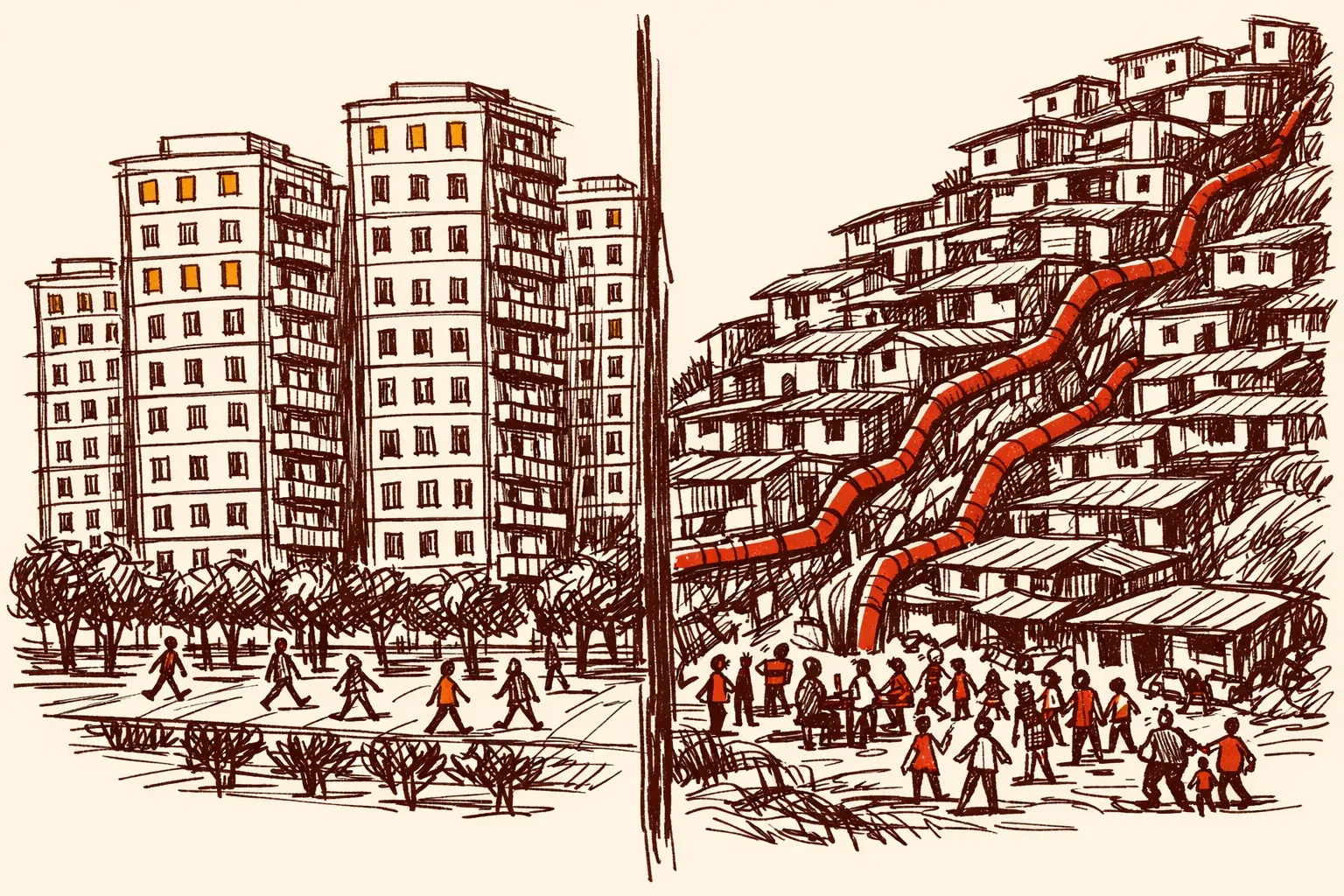
Singapore - One Agency, Total Authority, Twenty-Five Years
Singapore in the 1960s had the same problem. Hundreds of thousands of people lived in makeshift squatter settlements with no water, no sanitation, and no land title.
The government created a single agency - the Housing and Development Board - with full authority to plan, acquire land, build, and manage housing. A Land Acquisition Act passed in 1966 empowered the state to acquire private land at controlled prices. The HDB built at high density and moved communities together so people kept their social networks. By 1980 close to 70 percent of Singapore's population lived in public housing. Squatter settlements were cleared entirely by 1985. Today the HDB has built over one million apartments, housing about 80 percent of Singapore's population, with around 90 percent owning their flats.
One takeaway: a single agency with land acquisition power and a long-term mandate can solve the problem within a generation.
Brazil - Upgrade in Place, Then Maintain
Rio de Janeiro's Favela-Bairro programme, launched in 1995, brought services to the favela instead of demolishing and relocating. Roads, drains, water lines, and community spaces went into existing settlements. Across 130 favelas, the programme improved official water service access by 21.6 percent and sewerage service by 21 percent. The World Bank called it a global leader in slum upgrading.
Then came the lesson. An Inter-American Development Bank assessment ten years later found that infrastructure had degraded to near-baseline conditions in most upgraded favelas. No maintenance budget was locked in, and as political administrations changed, funding dried up. The IDB concluded that continuity over time - not a one-time intervention - determines success.
India's JNNURM failed for the same reason. Every future Indian slum programme needs a dedicated operations budget built in from day one.
Who Is Accountable
India's housing ministry controls PMAY-Urban and slum redevelopment policy. The Parliamentary Standing Committee on Housing and Urban Affairs reviews implementation annually. State governments are legally responsible for actual construction. Urban local bodies handle last-mile delivery.
The accountability gap is at the state level. States that do not release their matching share - named in Parliamentary Committee reports - face no consequence under current rules. That must change.
What Would It Cost
According to NITI Aayog, India needs 4.2 crore housing units in total. Under PMAY-Urban, the central government committed Rs 2 lakh crore for 2 crore urban homes. The Dharavi project alone has a rehabilitation cost of Rs 23,000 crore, partially offset by Rs 20,000 crore in commercial real estate revenue.
The real cost of not acting is higher. TB - heavily concentrated in slum populations - costs India an estimated $24 billion annually. Every year of delay compounds that bill.
What Needs to Happen
Give land titles first. People without secure tenure do not invest in their homes. Odisha has already begun granting land rights to slum dwellers. Every state must do this. Land titling costs almost nothing. It unlocks billions in private investment.
Fix the state share problem. If states do not release their matching funds, homes do not get built. States that fail to release funds on time should face automatic reductions in future housing allocations.
Build to maintain. Brazil's experience shows that infrastructure without a maintenance budget degrades to baseline within a decade. Every PMAY project must include a ring-fenced operations and maintenance fund released annually.
Scale the in-situ redevelopment vertical. The PMAY component that rebuilds slums on the same land without displacing residents is underused. It should be the primary model in dense urban areas. States should get higher central assistance for every in-situ project completed.
Protect the informal economy through transition. Dharavi earns $1 billion a year from its informal industries. The redevelopment plan's provision of free commercial space and a GST rebate is the right approach. Every major slum redevelopment must treat the resident economy as an asset to preserve.
India is already building airports, metros, and expressways at a pace that was unthinkable two decades ago. The tools are there. What comes next is execution at scale.