India's Financial Capital Goes Underwater Every Year
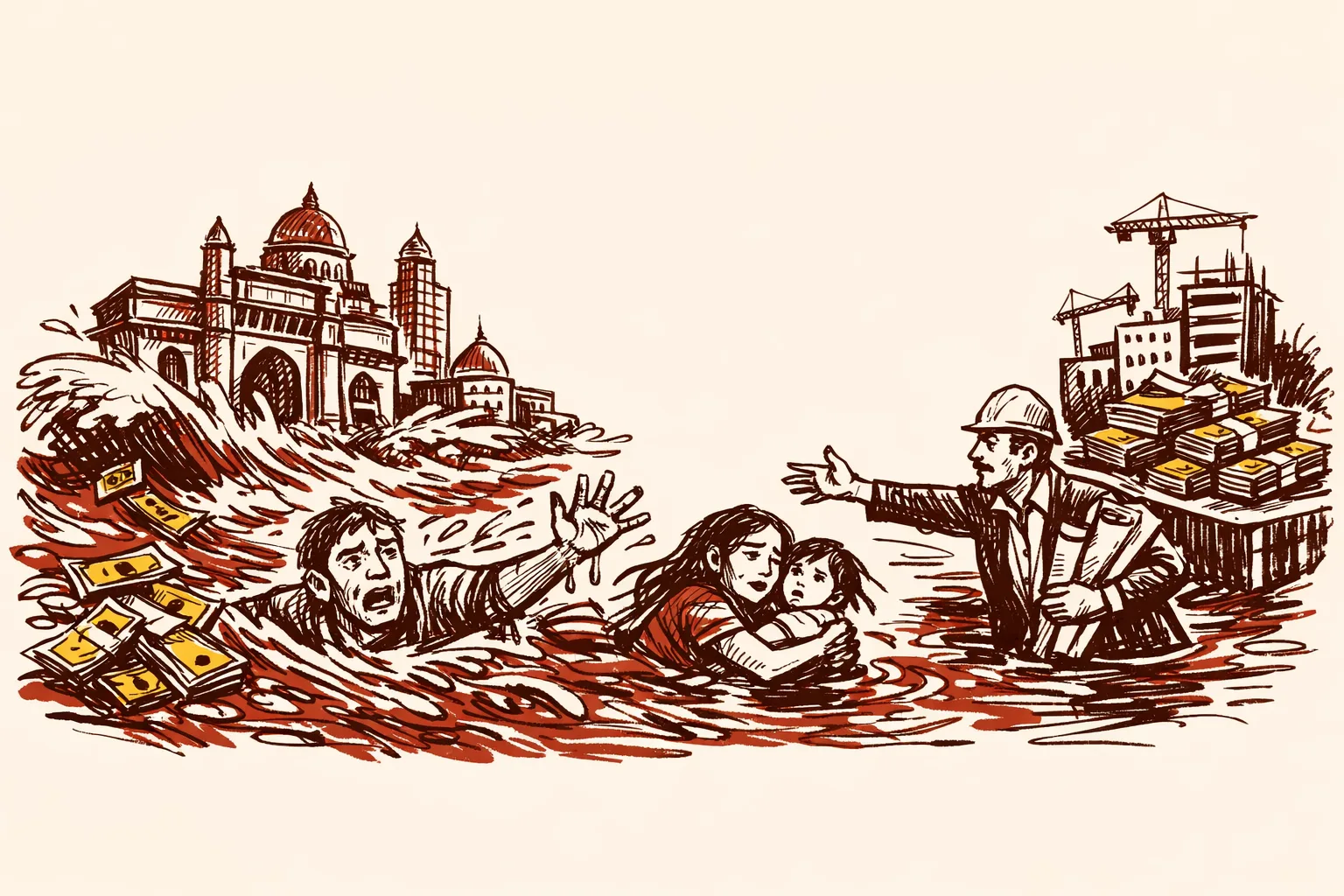
Every July, something embarrassing happens in Mumbai. Trains stop. Offices close. Streets that hold some of the most valuable real estate in Asia disappear under brown water - taking luxury cars with them. And then, a few days later, the city dries out - and nothing changes.
Tokyo gets typhoons. Kuala Lumpur sits on a flood plain. Both have figured it out. Mumbai has not - and the cost of that failure is being paid by every Indian.
Mumbai is India's commercial capital. It generates roughly 6 percent of India's GDP, according to the Reserve Bank of India. When it floods, the entire country loses. Stock markets slow. Logistics halt. Factories across the supply chain go dark. Foreign investors notice.
The Scale of the Problem
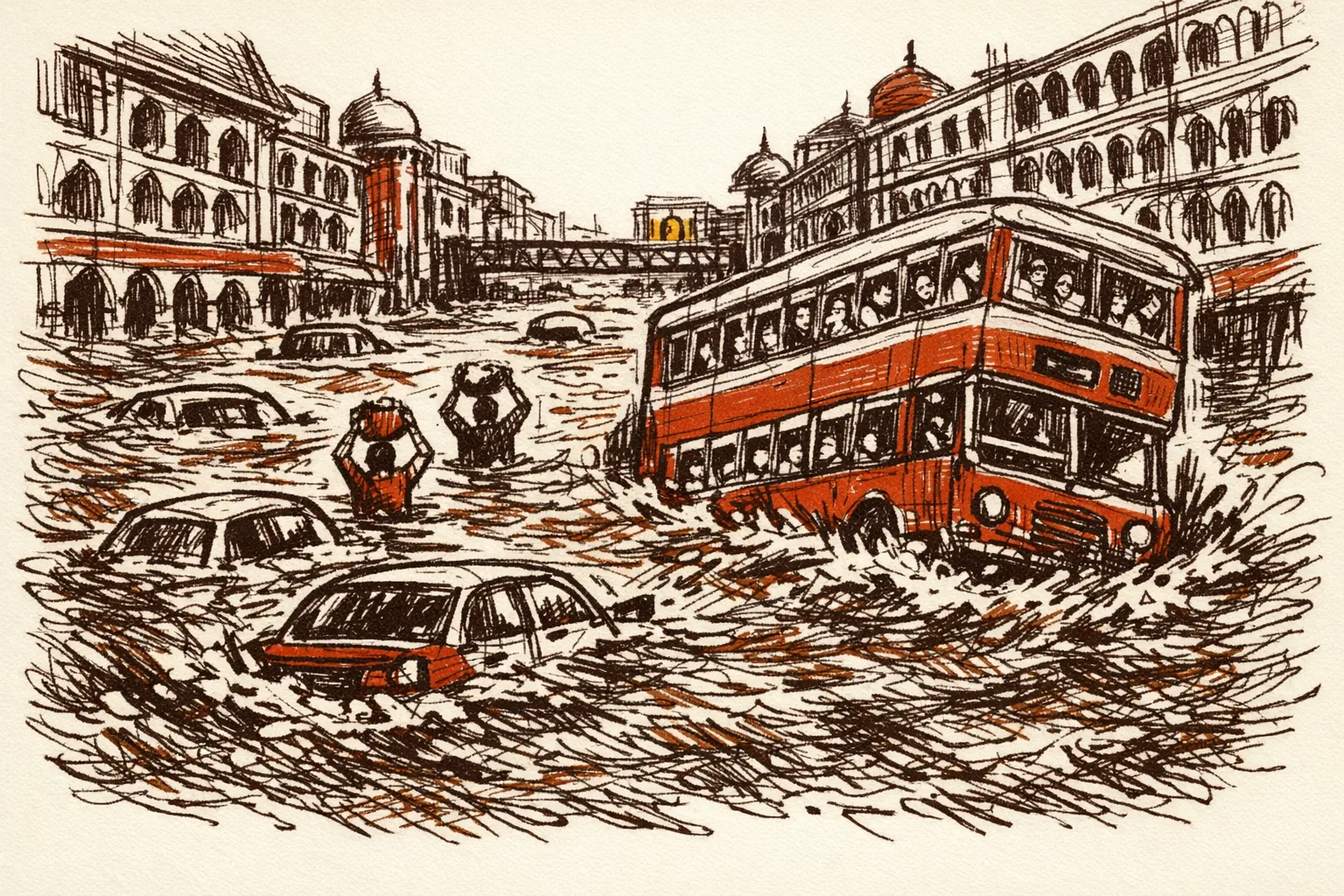
According to the World Bank, India's annual flood losses already stand at USD 4 billion and are projected to reach USD 30 billion by mid-century if nothing changes.
For Mumbai specifically, Swiss Re calculated that a repeat of the catastrophic flood of July 26, 2005 - when 944 millimetres of rain fell in a single day - could now cost Rs 20,000 crore. That is roughly USD 2.3 billion from one storm event alone.
That 2005 flood killed over 1,000 people and submerged more than 30 percent of the city. Economic and insured losses that year reached Rs 13,500 crore. The stock exchange functioned only partially. Banks across India lost connectivity. The airport shut for over 30 hours. Over 700 flights were cancelled.
The World Bank ranks Mumbai fifth globally for average annual flood losses. The Mumbai Climate Action Plan found that 35 percent of Mumbai's population lives in flood-prone areas.
Why Mumbai Floods - The Real Causes
Three causes drive the problem. They are not separate. They feed each other.
First: the drainage system is 160 years old. Mumbai's storm water drainage network was designed in 1860 to handle 25 millimetres of rain per hour. Mumbai now regularly receives more than that in a single heavy shower. The network consists of 2,000 kilometres of open drains and 440 kilometres of closed drains - most built for a city that no longer exists. Of 186 outfalls that release water to the sea, only three have floodgates. The other 183 let seawater back into the city during high tide. When it rains heavily and the tide is high at the same time, water has nowhere to go. It comes from above and it comes from below.
Second: the Mithi River has been strangled. The Mithi River - a 17.84-kilometre waterway that once drained Mumbai's entire eastern suburbs into the Arabian Sea - has been reduced to an open sewer. Slums, scrap yards, and industrial units have encroached on the Mithi's catchment area for decades. Over 620 acres of the Mithi's floodplain have been filled in and built over - including by the Bandra Kurla Complex, India's most expensive commercial district.
Third: the mangroves are gone. Mumbai lost 40 percent of its mangrove cover between the early 1990s and 2005. A research paper in Environmental Journals found that mangroves at the Mithi River reduce flood inundation area by 21 percent. Losing them made every flood worse.
What Has Already Been Tried
India has not ignored this problem. The attempts have been real. The results have been disappointing - from poor execution and split accountability, not from lack of policy.
The BRIMSTOWAD Project (1993 onwards): After severe floods in 1985, the Municipal Corporation of Greater Mumbai commissioned British engineering firm Watson Hawksley to redesign the city's entire storm water system. The report was submitted in 1993. It proposed replacing old drains, building pumping stations, and doubling the system's capacity from 25 mm per hour to 50 mm per hour.
Only about 15 percent of the recommendations were carried out before the 2005 floods. The BMC committee had earlier rejected the project as too costly. The 2005 flood killed over 1,000 people and cost several times the project's budget.
After 2005, the Maharashtra government revived BRIMSTOWAD. The initial budget was Rs 1,200 crore. By 2017, costs had risen to Rs 4,500 crore. Of 58 planned drainage improvement works, only 28 were completed as of 2019. State Minister Ashish Shelar later demanded a white paper accounting for Rs 1 lakh crore spent on flood-related civic projects over 20 years, alleging corruption in the Mithi River project.
The Chitale Committee (2006): After the 2005 disaster, the Maharashtra government formed a fact-finding committee under Madhav Chitale. It recommended widening and deepening the Mithi, creating a 50-metre buffer zone on both banks, relocating encroachments, and restoring floodplains. The BMC widened parts of the Mithi - but failed to create the buffer zone. Encroachments continued. High concrete walls were built along the river's edges, severing the ecological relationship of the river with surrounding ecosystems.
The Mithi River Development Authority (2005): Set up immediately after the 2005 flood to oversee the river's rehabilitation. Initial completion was promised by 2010. The work is still ongoing. Twenty years after the flood, the Mithi is still choked, silted and disconnected from the city despite thousands of crores spent.
Three separate reform attempts. Three partial or failed outcomes. Plans announced, budgets allocated, accountability split across agencies, results not delivered, city floods again.
How Other Countries Fixed This
Tokyo Built the World's Largest Underground Flood Channel
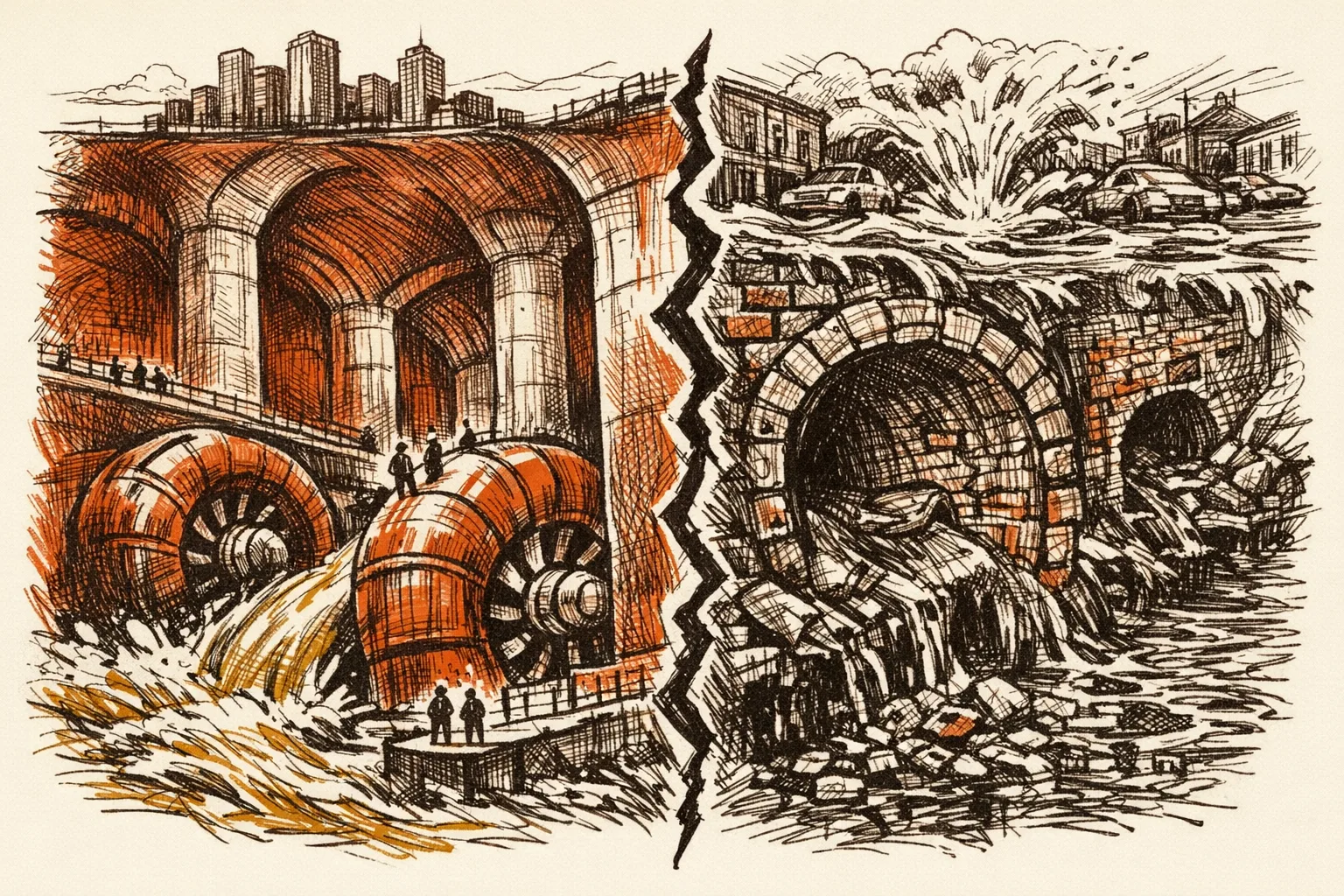
Tokyo faces the same problem as Mumbai: massive rainfall, a dense city, rivers that overflow. The Metropolitan Area Outer Underground Discharge Channel - known as G-Cans - was completed in 2006 after 13 years of construction. It cost USD 2.6 billion. The system consists of five concrete silos connected by 6.4 kilometres of tunnels running 50 metres underground. During heavy rain, overflow from five rivers pours into these shafts, travels through the tunnels, and fills a massive underground chamber. Four turbines then pump 200 cubic metres of water per second into the Edo River.
Japan's Ministry of Land, Infrastructure, Transport and Tourism estimated the channel reduced flood damage by approximately 148.4 billion yen in its first 18 years. It has reduced the number of flooded homes in the area by two-thirds.
One ministry. One mandate. One tunnel. Done in 13 years.
Kuala Lumpur Built a Tunnel That Doubles as a Road
In 2001, the Malaysian government commissioned the Stormwater Management and Road Tunnel, known as SMART - 9.7 kilometres long, the longest stormwater tunnel in Southeast Asia. During normal weather, it functions as a motorway. During heavy storms, traffic is cleared and the full tunnel fills with floodwater.
Construction cost USD 515 million. The projected benefits over 30 years include USD 1.58 billion in flood damage prevented. Since opening, the SMART tunnel has diverted floodwaters on over 40 occasions and averted an estimated RM 1.4 billion in public damage. It can address 45 percent of Klang Valley's major floods on its own.
Because the tunnel needed to sit under government land, planners made it a road. Toll revenue helped fund it. That one design insight turned an infrastructure cost into an infrastructure asset.
Who Is Accountable
The Brihanmumbai Municipal Corporation - India's wealthiest civic body with a budget of Rs 74,366 crore - is the primary agency responsible for storm water drainage in Mumbai. Less than 18 percent of the BMC's budget has been allocated to civic infrastructure including drainage. The Storm Water Drain Department received Rs 912.10 crore as capital expenditure in one recent budget, representing 6 percent of total allocations.
Multiple agencies share jurisdiction over Mumbai's rivers and drainage. The BMC controls 11.8 kilometres of the Mithi. The Mumbai Metropolitan Region Development Authority controls the remaining 6 kilometres. The Mithi River Development and Protection Authority was set up specifically to coordinate - and has largely failed to do so. When three agencies own one river, nobody is responsible for outcomes.
The Maharashtra state government sets land-use rules. Encroachment on floodplains and river buffers was ignored or actively permitted. Builders filled wetlands. Slums spread onto riverbanks. The Bandra Kurla Complex was built directly on 620 acres of the Mithi's floodplain. The Supreme Court-monitored committee noted this in its own report.
What Would It Cost
Improving Mumbai's drainage system alone could reduce flood losses by as much as 70 percent, according to PreventionWeb. Against annual flood damage that can reach billions of dollars, that is an extraordinary return.
The revised BRIMSTOWAD project has a current cost estimate of Rs 4,500 crore. Tokyo's far larger underground channel cost USD 2.6 billion. Kuala Lumpur's SMART tunnel cost USD 515 million. Against the World Bank's projection of USD 30 billion in annual flood losses across India by mid-century, they are inexpensive.
India's flood insurance coverage stands at just 8 to 11 percent of losses. Most damage is uninsured and falls on individuals, small businesses, and the government directly. Extending flood insurance coverage could cut indirect flood losses in Mumbai by 50 percent.
The BMC already has the budget. The money is not the barrier. Execution and accountability are.

What Needs to Happen
Four specific things must happen.
One: complete BRIMSTOWAD under a fixed deadline with personal accountability. The project was proposed in 1993. It must be assigned a single commissioner with a fixed completion date. If the deadline is missed, the commissioner is replaced.
Two: restore the Mithi River's floodplain. The Supreme Court-monitored expert committee recommended a 50-metre no-development buffer on both banks of the Mithi. That recommendation has been ignored for almost two decades. Encroachments must be cleared. The retaining walls that cut the river off from its own ecosystem must be reassessed.
Three: unify command over Mumbai's drainage. One agency must own the entire drainage system - drains, rivers, outfalls, and pumping stations. One agency, one budget line, one point of accountability. Every monsoon failure must have a name attached to it.
Four: protect and restore mangroves as flood infrastructure. Mumbai's mangrove cover has been recovering in recent years. That recovery must be protected by law. Mangroves are not just ecology - they are flood barriers. Destroying them to build real estate is a subsidy from every flood victim to every developer.