A Road Is Not Just a Road
Drive through the Thar Desert in western Rajasthan. The land is flat and brutal - sand, scrub, silence. The international border with Pakistan is sometimes less than 10 kilometres away. Ask a villager how long it takes to reach a town, a hospital, a market. Then ask an Army officer how long it takes to move troops and equipment to a forward position.
Both questions have the same answer. And both depend on the same thing - roads.
This is the world that Project Chetak operates in. Asphalt on sand, bunkers along a waterway, and supply lines to soldiers posted at the edge of India define it.
On April 4, the Border Roads Organisation (BRO) - India's military-run infrastructure agency, formed in 1960 under the Ministry of Defence - celebrated Project Chetak's 47th Raising Day at Bikaner, Rajasthan. Forty-seven years of building and maintaining roads along one of the world's most sensitive frontiers.
What Project Chetak Actually Does
Project Chetak was raised in 1980. It covers Rajasthan, Punjab, and northern Gujarat - the entire land frontier with Pakistan in the western sector. According to the Ministry of Defence, it is one of the largest BRO projects by geographical coverage.
Project Chetak maintains more than 4,000 kilometres of road network. It also maintains 214 kilometres of Ditch Cum Bund - a shallow canal with a raised earthen embankment embedded with bunkers - along India's western border.
The Ditch Cum Bund is dual-purpose. During a conflict it slows enemy vehicles and troops. It also controls flooding during monsoon.
Its motto is Chetak ka Prayas, Desh ka Vikas - Chetak's Effort, Nation's Progress. The name comes from the legendary warhorse of Maharana Pratap, who fought the Battle of Haldighani in 1576. Chetak carried his injured master to safety and then collapsed.
Project Chetak supports three Indian Army commands - Western Command, South Western Command, and Southern Command. Feeder roads toward the international border are currently being upgraded from narrow tracks to National Highway double-lane specifications, according to the Ministry of Defence.
The Mindset That Held India Back
For decades after India's defeat in the 1962 war with China, Indian strategic thinking held that building roads near borders was dangerous. The fear was that new roads would help an invading force advance faster.
As a result, according to a Jamestown Foundation analysis, up to the mid-2000s India consciously let existing roads near its border with China fall into disuse and refrained from constructing new ones. The same defensive hesitation shaped planning on the western front.
When the BRO's own officials appeared before Parliament's Standing Committee on Defence, they said it plainly: "It would not be incorrect to say that few years back the philosophy of our nation was that we should not make roads as near to the border as possible. That philosophy is telling today very clearly as to why we do not have roads."
This was not a fringe view. It was official Indian doctrine for decades. The Cabinet Committee on Security approved 73 strategic roads along the China border in 1999 with a target completion date of 2006. By 2017 only 30 of those 73 roads had been completed - more than a decade late.
Galwan ended that debate. In June 2020, Indian and Chinese soldiers fought hand-to-hand in Ladakh's Galwan Valley. Twenty Indian soldiers died. China had spent two decades building roads, railways, and tunnels across Tibet. India had not matched it.
The Raksha Anirveda defence journal put it clearly: infrastructure development is a strategic stabiliser, not a provocation. The DS-DBO road in Ladakh had reduced India's logistical vulnerability and allowed sustained presence in the contested sector. China's aggression was triggered by exactly that denial.
Roads are deterrence.
What Has Already Been Done
Project Chetak has operated continuously since 1980. But the pace of investment has accelerated dramatically under the current government.
In the financial year -25, the BRO recorded its highest-ever annual expenditure of Rs 16,690 crore, according to the Ministry of Defence. The target for the following year has been set at Rs 17,900 crore. Budget allocation from Parliament has risen from Rs 6,500 crore to Rs 7,146 crore - but the organisation is spending far beyond that allocation by drawing on defence capital funds.
In December, Defence Minister Rajnath Singh dedicated 125 BRO infrastructure projects to the nation in a single day - the largest single-day inauguration in BRO history. The 125 projects included 28 roads and 93 bridges across nine states and union territories, at a combined cost of approximately Rs 5,000 crore. Rajasthan was among the states covered.
Since its formation in 1960, the BRO has built over 64,100 kilometres of roads, 1,179 bridges, 7 tunnels, and 22 airfields. BRO has also been entirely placed under the Ministry of Defence since 2015, ending a previous arrangement where it reported partly to the Ministry of Road Transport.
India's Central Public Works Department also began construction of a 1,450-kilometre border road along the Pakistan frontier across Punjab and Rajasthan, complementing Project Chetak's existing network and strengthening anti-tunnel and anti-infiltration capacity.
How Other Countries Have Done This
Finland - Infrastructure as the First Line of Defence
Finland shares a 1,340-kilometre border with Russia. After Russia's full-scale invasion of Ukraine, Finland joined NATO and immediately began treating border infrastructure as a defence priority.
The Norwegian, Swedish, and Finnish transport ministers issued a joint statement calling for a shared Nordic infrastructure strategy to support military mobility across borders. Every major road upgrade near the Russian border is assessed for military mobility requirements before construction begins. India has moved toward this model - BRO's placement entirely under the Ministry of Defence since 2015 was a step in that direction.
China - The Lesson India Learned the Hard Way
China's approach to border roads is not a model to copy. It is a warning about what happens when one side invests and the other does not.
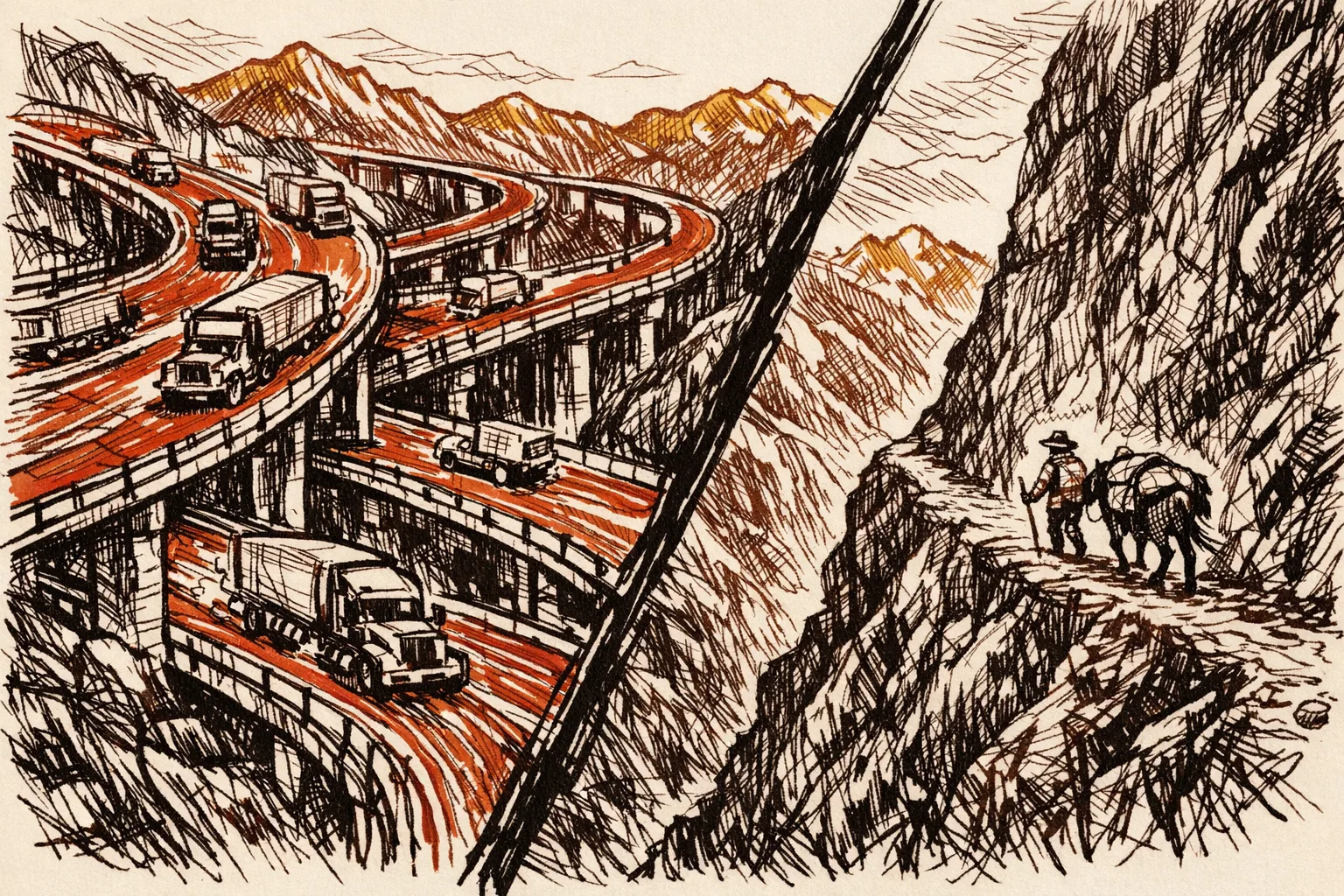
China doubled its road network in Tibet to nearly 40,000 kilometres. That infrastructure allowed China to project force rapidly to any point on the Sino-Indian border. India's delayed border road programme left its troops dependent on narrow tracks, air supply, and pack animals for final-mile logistics at high altitude. The Galwan clash exposed the cost of that gap.
On the western front, Project Chetak means India does not face that gap with Pakistan. It must not be allowed to develop one.
Who Is Accountable
Project Chetak reports to the Director General Border Roads, currently Lt. Gen. Raghu Srinivasan. The Director General reports to Raksha Mantri Rajnath Singh through the Ministry of Defence.
The Border Roads Development Board - chaired by the Minister of State for Defence, with the Army Chief, Air Chief, and Engineer-in-Chief as members - exercises financial oversight. BRO has held ISO 9001 quality certification since 1999.
The gap between allocation (Rs 7,146 crore) and actual spending (Rs 16,690 crore) is bridged through additional defence capital approvals - a sign that demand for border infrastructure exceeds the standard budget line, and that the current government has been willing to fund the gap.
What It Would Cost to Accelerate
The Ministry of Defence has a total operational road requirement of 852 roads covering 30,118 kilometres, according to the Vivekananda International Foundation. Of those, 530 roads spanning 22,803 kilometres are classified under the long-term works plan. Project Chetak's 4,000-kilometre network is a large part of the western sector's portion of that plan.
Upgrading feeder roads near the international border to National Highway double-lane standards is not cheap. But the cost of not having those roads is higher. In a conflict scenario, every hour of delayed troop movement is a tactical disadvantage. Better roads also mean better market access for border villages - which reduces out-migration, keeps communities rooted near the frontier, and maintains the human presence that is itself a form of territorial assertion.
BRO is currently building approximately 35 kilometres of roads per day nationwide.
What Needs to Happen Next
Three things matter most.
First, feeder road upgrades must be completed on deadline. The roads being upgraded in Jaisalmer and nearby districts must not slip. Parliamentary oversight of BRO project timelines should be routine, not reactive.
Second, BRO's digital tools must be expanded. The organisation has already adopted drone-based mapping and GIS survey software. That capability must be extended to real-time maintenance monitoring - so that a road washed out by monsoon floods triggers a repair order within hours, not weeks.
Third, India must resist any future argument that border road construction is provocative. Galwan settled that argument. Infrastructure does not cause aggression - it reveals it, and then denies the adversary easy gains. That principle applies to the Pakistan border as much as to the China border. Project Chetak is deterrence infrastructure and should be funded accordingly.